
Nutrition
High Fiber Foods: A USDA Chart of 35 Foods, and How Much Fiber You Need
The top high fiber foods are beans, lentils and split peas, with about 11 to 19 grams per cooked cup, followed by chia seeds, avocado, acorn squash, bulgur and raspberries. Most adults need 21 to 38 grams of fiber a day, yet the average American gets about 16.
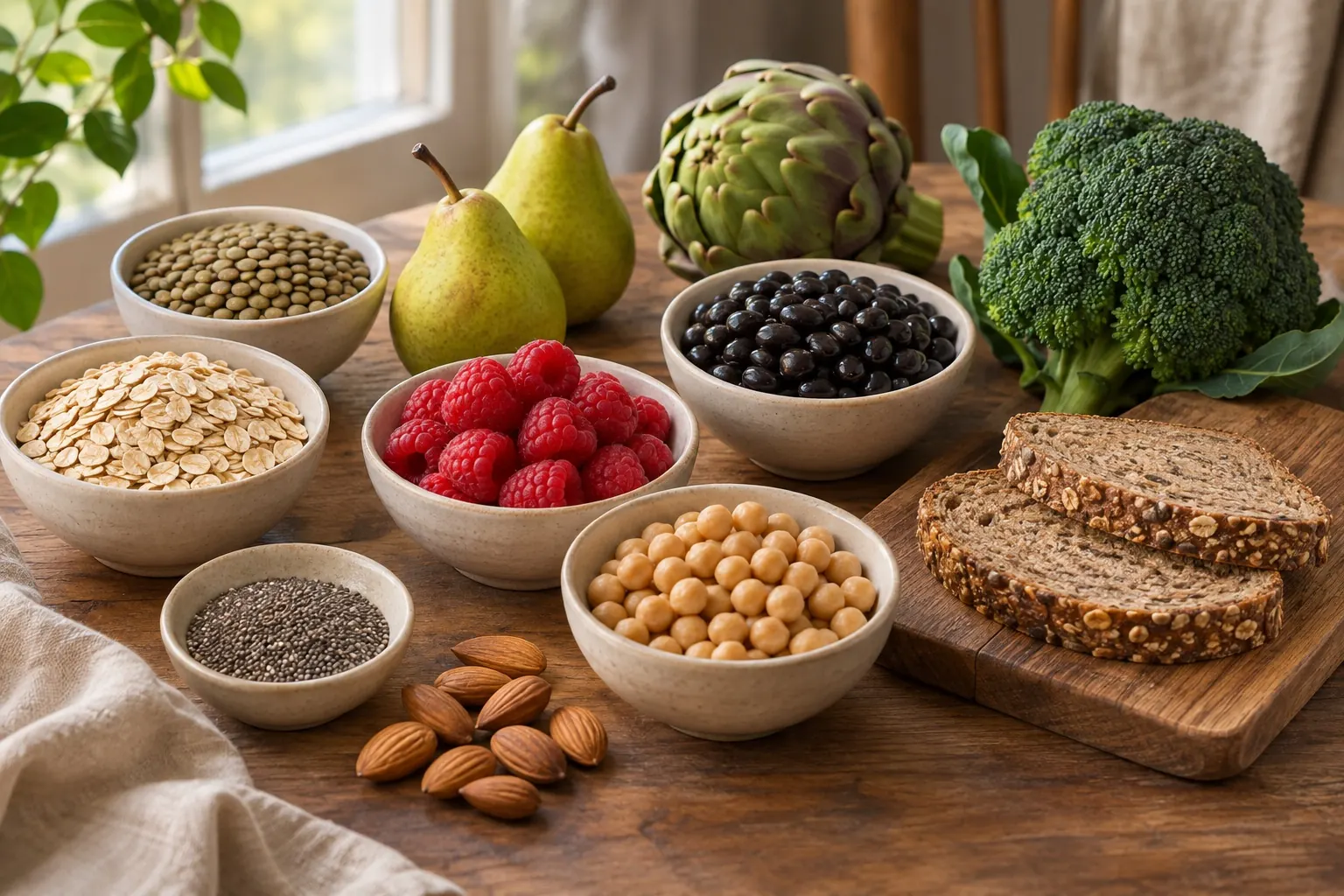
High fiber foods list: USDA chart
We pulled these numbers from USDA FoodData Central, the federal nutrient database, using common serving sizes, and sorted the foods from most to least fiber per serving. Calories are there too, because they matter if you're choosing between two foods with similar fiber.
| Food | Serving | Fiber (g) | Calories |
|---|---|---|---|
| Navy beans, cooked | 1 cup | 19.1 | 255 |
| Split peas, cooked | 1 cup | 16.3 | 231 |
| Lentils, cooked | 1 cup | 15.6 | 230 |
| Pinto beans, cooked | 1 cup | 15.4 | 245 |
| Black beans, cooked | 1 cup | 15.0 | 227 |
| Chickpeas, cooked | 1 cup | 12.5 | 269 |
| Kidney beans, cooked | 1 cup | 11.3 | 225 |
| Chia seeds, dried | 1 oz | 9.8 | 138 |
| Avocado (California) | 1 whole, peeled and pitted | 9.2 | 227 |
| Acorn squash, baked | 1 cup cubes | 9.0 | 115 |
| Bulgur, cooked | 1 cup | 8.2 | 151 |
| Edamame, cooked from frozen | 1 cup | 8.1 | 188 |
| Raspberries, raw | 1 cup | 8.0 | 64 |
| Blackberries, raw | 1 cup | 7.6 | 62 |
| Collard greens, cooked | 1 cup chopped | 7.6 | 63 |
| Canned pumpkin | 1 cup | 7.1 | 83 |
| Artichoke, cooked | 1 medium | 6.8 | 64 |
| Barley, pearled, cooked | 1 cup | 6.0 | 193 |
| Pear, raw | 1 medium | 5.5 | 101 |
| Quinoa, cooked | 1 cup | 5.2 | 222 |
| Whole-wheat spaghetti, cooked | 1 cup | 4.6 | 174 |
| Apple with skin, raw | 1 medium | 4.4 | 95 |
| Oatmeal, cooked with water | 1 cup | 4.0 | 166 |
| Sweet potato, baked in skin | 1 medium | 3.8 | 103 |
| Potato, baked, flesh and skin | 1 medium | 3.8 | 161 |
| Green peas, cooked from frozen | 1/2 cup | 3.6 | 62 |
| Popcorn, air-popped | 3 cups | 3.5 | 93 |
| Almonds | 1 oz (about 23 almonds) | 3.5 | 164 |
| Prunes (dried plums) | 5 prunes | 3.4 | 114 |
| Brown rice, cooked | 1 cup | 3.2 | 248 |
| Banana, raw | 1 medium | 3.1 | 105 |
| Orange, raw | 1 medium | 3.1 | 62 |
| Broccoli, cooked | 1/2 cup chopped | 2.6 | 27 |
| Whole-wheat bread | 1 slice | 1.9 | 81 |
| Ground flaxseed | 1 tbsp | 1.9 | 37 |
Source: USDA FoodData Central, SR Legacy data. Legumes, grains and vegetables are cooked without salt, except the oatmeal entry, which is cooked with salt (salt doesn't change fiber). The Daily Value for fiber on food labels is 28 grams.
A quick way to read it: the FDA counts 20% of the Daily Value or more per serving as high, and for fiber that's 5.6 grams or more. Everything from navy beans down to barley clears that bar in a single serving, and the pear comes within a tenth of a gram.
How much fiber per day do you need?
The National Academy of Medicine sets these daily amounts for adults, as listed by Mayo Clinic:
- Women 50 or younger: 25 grams
- Women older than 50: 21 grams
- Men 50 or younger: 38 grams
- Men older than 50: 30 grams
NIDDK puts the adult range at 22 to 34 grams depending on age and sex, and the Daily Value on food labels is 28 grams. Most of us fall well short: MedlinePlus says the average American eats only about 16 grams a day.
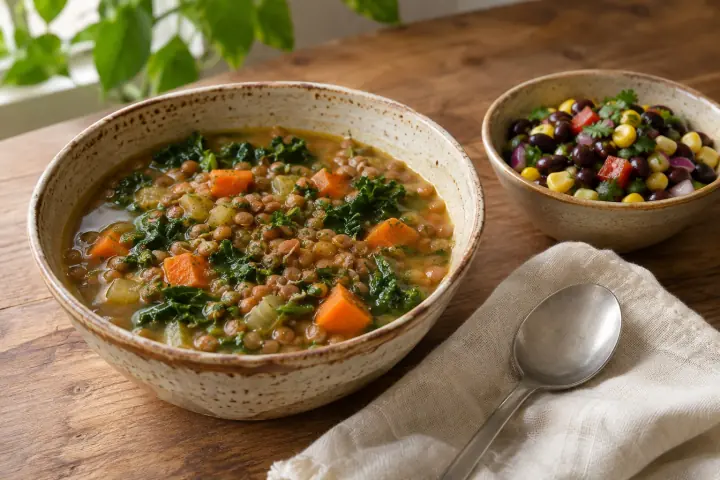
Closing that gap takes less than it sounds. Using the chart, a day with 1 cup of oatmeal topped with 1 cup of raspberries (12 grams), half a cup of lentils in a soup at lunch (about 8 grams), an apple (4.4 grams), and a baked sweet potato with half a cup of broccoli at dinner (6.4 grams) adds up to about 31 grams.
High fiber foods for constipation
Fiber adds weight and bulk to stool and softens it, which makes it easier to pass, as Mayo Clinic explains. NIDDK's list of foods to lean on when you're constipated:
- Whole grains: whole wheat bread and pasta, oatmeal and bran flake cereals
- Legumes: lentils, black beans, kidney beans, soybeans and chickpeas
- Fruits: berries, apples with the skin on, oranges and pears
- Vegetables: carrots, broccoli, green peas and collard greens
- Nuts: almonds, peanuts and pecans
Two rules make them work. Add fiber a little at a time so your body gets used to it, and drink water and other fluids, which NIDDK says help fiber work better. NIDDK also suggests cutting back on foods with little or no fiber, such as chips, fast food, meat and many processed and prepared foods.
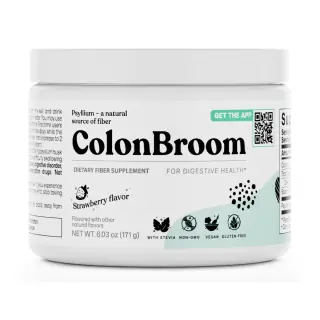
If food alone isn't enough, a supplement can help. A 2022 meta-analysis of 16 trials found fiber supplements improved chronic constipation, with psyllium and pectin showing clear effects, best above 10 grams a day for at least four weeks. Our psyllium husk guide explains how to take it safely, and if you'd rather drink your fiber, we reviewed ColonBroom, a strawberry psyllium drink with 3.6 grams of psyllium per scoop.
Soluble fiber foods
Soluble fiber dissolves in water and turns into a gel during digestion, which slows digestion. It's the type that can help lower cholesterol and blood sugar. Mayo Clinic and MedlinePlus list these as good sources:
- Oats and oat bran
- Barley
- Beans, lentils and peas
- Apples, bananas, citrus fruits and avocados
- Carrots
- Nuts and seeds
- Psyllium
Two of these have FDA-authorized heart-health claims. Foods can say that 3 grams or more a day of beta-glucan soluble fiber from whole oats or barley, or 7 grams or more a day of soluble fiber from psyllium husk, as part of a diet low in saturated fat and cholesterol, is linked to a lower risk of heart disease. Okra's slippery gel is another viscous fiber; our okra water guide covers what it can and can't do.
Insoluble fiber foods
Insoluble fiber doesn't dissolve in water. It adds bulk to stool and helps material move through the digestive system, which is why it helps with constipation. Mayo Clinic's examples include whole-wheat flour, wheat bran, nuts, beans, and vegetables such as cauliflower, green beans and potatoes.
You don't need to sort your plate by type. Most high-fiber plant foods contain both, so eating a variety of vegetables, fruits, whole grains, beans and nuts covers you.
High fiber foods for weight loss
Fiber won't melt weight off, but it helps in steady, modest ways. Mayo Clinic notes that high-fiber foods tend to be more filling and less energy dense, meaning fewer calories for the same amount of food. A large series of reviews in The Lancet found that, in clinical trials, people eating more fiber had lower body weight, blood pressure and cholesterol than those eating less.
The trial results are real but small. A meta-analysis of 62 trials found that viscous (gel-forming) fiber lowered body weight by about a third of a kilogram, even without a calorie-restricted diet. Another, of 21 trials, found that eating about one serving of beans, lentils, chickpeas or peas a day led to a similar small weight loss over about six weeks. Psyllium supplements on their own did not change weight in a review of 22 trials.
The practical move is to fill your plate with foods that bring a lot of fiber for few calories. From the chart: raspberries (8 grams for 64 calories), blackberries, collard greens, a cooked artichoke, acorn squash, canned pumpkin and 3 cups of air-popped popcorn (3.5 grams for 93 calories). For lunches built around beans and lentils, see our high-protein lunch ideas.
High fiber fruits and vegetables
From the USDA chart, the fruits and vegetables with the most fiber per serving:
- Avocado: 9.2 grams in a whole California avocado
- Acorn squash: 9.0 grams per cup, baked
- Raspberries: 8.0 grams per cup
- Blackberries: 7.6 grams per cup
- Collard greens: 7.6 grams per cup, cooked
- Canned pumpkin: 7.1 grams per cup
- Artichoke: 6.8 grams in a medium one, cooked
- Pear: 5.5 grams in a medium one
- Apple with the skin: 4.4 grams in a medium one
Keep the skin on when you can. Mayo Clinic notes that removing the skin from fruit, or the pulp from juice, lowers the fiber.
High fiber breakfast and snack ideas
Mayo Clinic's easiest wins: choose a breakfast cereal with 5 grams of fiber or more per serving, pick breads with at least 2 grams per serving and a whole grain listed first, top cereal with fruit, and snack on whole fruit, raw vegetables, air-popped popcorn or a handful of nuts. Some combinations, using the USDA numbers:
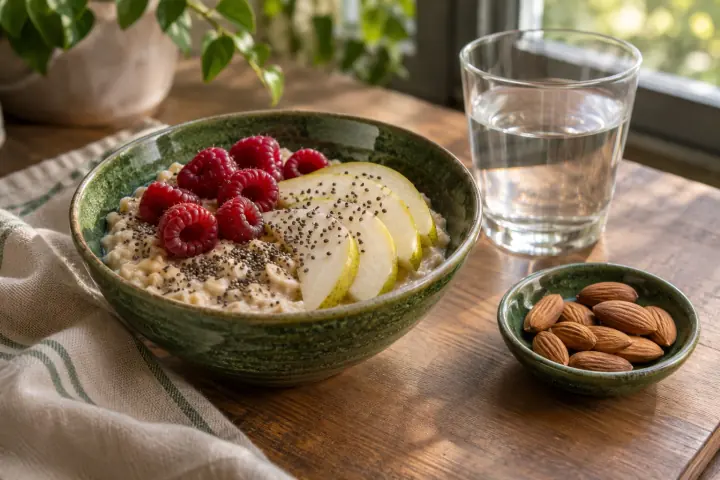
- Oatmeal with raspberries and ground flaxseed: 1 cup cooked oatmeal, 1 cup raspberries and 1 tablespoon ground flaxseed, about 14 grams
- Chia pudding: 1 ounce of chia seeds, about 9.8 grams before any fruit
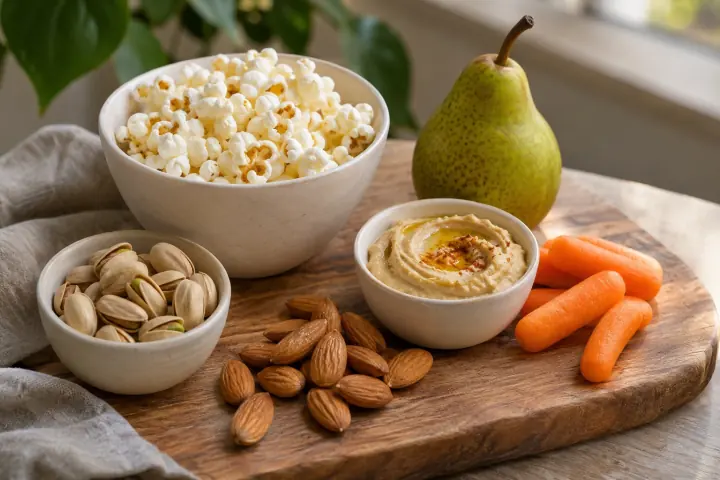
- A pear and an ounce of almonds: about 9 grams
- Three cups of air-popped popcorn: 3.5 grams for 93 calories
- Whole-wheat toast with avocado: 2 slices of whole-wheat bread and half an avocado, about 8 grams
Nuts, seeds and dried fruit are calorie-dense, as Mayo Clinic points out, so a handful goes a long way.
How to add fiber without the bloating
Adding a lot of fiber at once can cause gas, bloating and cramping. Mayo Clinic and MedlinePlus both advise increasing it over a few weeks so the natural bacteria in your gut can adjust, and drinking plenty of water, because fiber works best when it absorbs water. MedlinePlus notes that the gas often fades as your gut adapts. Our guide on how to get rid of bloating has more on the foods most likely to cause gas.
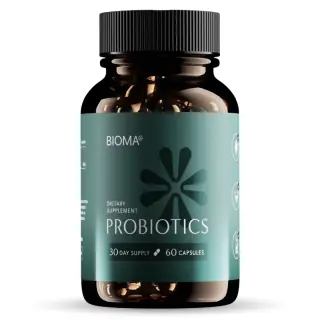
Some of the fiber you eat also feeds the "good" bacteria in your gut, as Mayo Clinic explains. Our guide to probiotic foods covers the fermented foods and prebiotic foods that support them, and if you're weighing a probiotic supplement as well, we reviewed Bioma, a two-capsule probiotic that adds a small dose of prebiotic fiber.
When to talk to a doctor first
A high-fiber diet suits most people, but Mayo Clinic lists situations where your doctor may ask you to eat less fiber for a while:
- After surgery on the stomach or intestines
- During a flare of Crohn's disease or ulcerative colitis, or a bout of diverticulitis
- If you have narrowed areas (strictures) in the intestines
- During radiation therapy aimed at the belly or pelvis
- With gastroparesis, where the stomach empties slowly
- Before a colonoscopy
See a doctor if constipation doesn't improve with diet changes, and right away if it comes with rectal bleeding, blood in your stool, constant belly pain, vomiting, fever or weight loss you can't explain, as NIDDK advises. For children, MedlinePlus notes that younger kids may not eat enough calories to reach adult fiber amounts, so ask their pediatrician what's right.
Fiber and gut health products we've reviewed
FAQ
What foods are highest in fiber?
Legumes lead the USDA chart: a cooked cup of navy beans has about 19 grams, split peas 16.3 and lentils 15.6. Among smaller servings, an ounce of chia seeds has 9.8 grams.
Which fruit has the most fiber?
Of the common fruits in our chart, a whole California avocado has 9.2 grams, a cup of raspberries 8.0, a cup of blackberries 7.6, a medium pear 5.5 and a medium apple with the skin 4.4.
Can you eat too much fiber?
Adding too much too fast can cause gas, bloating and cramps, so increase it over a few weeks and drink plenty of water. Some conditions, such as a Crohn's flare or gastroparesis, call for less fiber, so follow your doctor's advice if you have one.
Is oatmeal high in fiber?
A cup of cooked oatmeal has about 4 grams. Oats are rich in beta-glucan, a soluble fiber: the FDA allows a heart-health claim for 3 grams or more of beta-glucan a day from whole oats or barley.
Do bananas have a lot of fiber?
A medium banana has about 3.1 grams, roughly 11% of the 28-gram Daily Value. A pear (5.5 grams) or a cup of raspberries (8 grams) gives more.
Are fiber supplements as good as high fiber foods?
Mayo Clinic says whole foods are generally better because they bring a mix of fibers, vitamins and minerals. A supplement such as psyllium can help when food isn't enough, especially for constipation.
Sources
- FoodData Central, SR Legacy data set, USDA Agricultural Research Service
- FoodData Central home, USDA
- Daily Value on the Nutrition and Supplement Facts Labels, FDA
- Dietary fiber: Essential for a healthy diet, Mayo Clinic
- Dietary fiber, MedlinePlus
- Eating, Diet and Nutrition for Constipation, NIDDK
- Symptoms and Causes of Constipation, NIDDK
- 21 CFR 101.81, Health claims: soluble fiber from certain foods and risk of coronary heart disease, eCFR
- Carbohydrate quality and human health: a series of systematic reviews and meta-analyses, Lancet (2019), PubMed
- Can dietary viscous fiber affect body weight independently of an energy-restrictive diet? A systematic review and meta-analysis, Am J Clin Nutr (2020), PubMed
- Effects of dietary pulse consumption on body weight: a systematic review and meta-analysis, Am J Clin Nutr (2016), PubMed
- The effects of psyllium supplementation on body weight, BMI and waist circumference in adults: a systematic review and meta-analysis, Crit Rev Food Sci Nutr (2020), PubMed
- The Effect of Fiber Supplementation on Chronic Constipation in Adults: an updated systematic review and meta-analysis, Am J Clin Nutr (2022), PubMed
This guide is general information, not medical advice. Talk to your doctor before making changes to your diet, sleep or exercise routine.