
Stress relief
Vagus Nerve Exercises: Simple Ways to Calm Your Body, and What the Evidence Shows
Vagus nerve exercises are simple habits, mostly slow breathing and cold water on the face, that nudge your body toward its calm, rest-and-digest mode. Slow breathing has by far the most research behind it. Humming, gargling, quick "resets" and wearable stimulators have much less, so here is what to try first and what to keep in perspective.
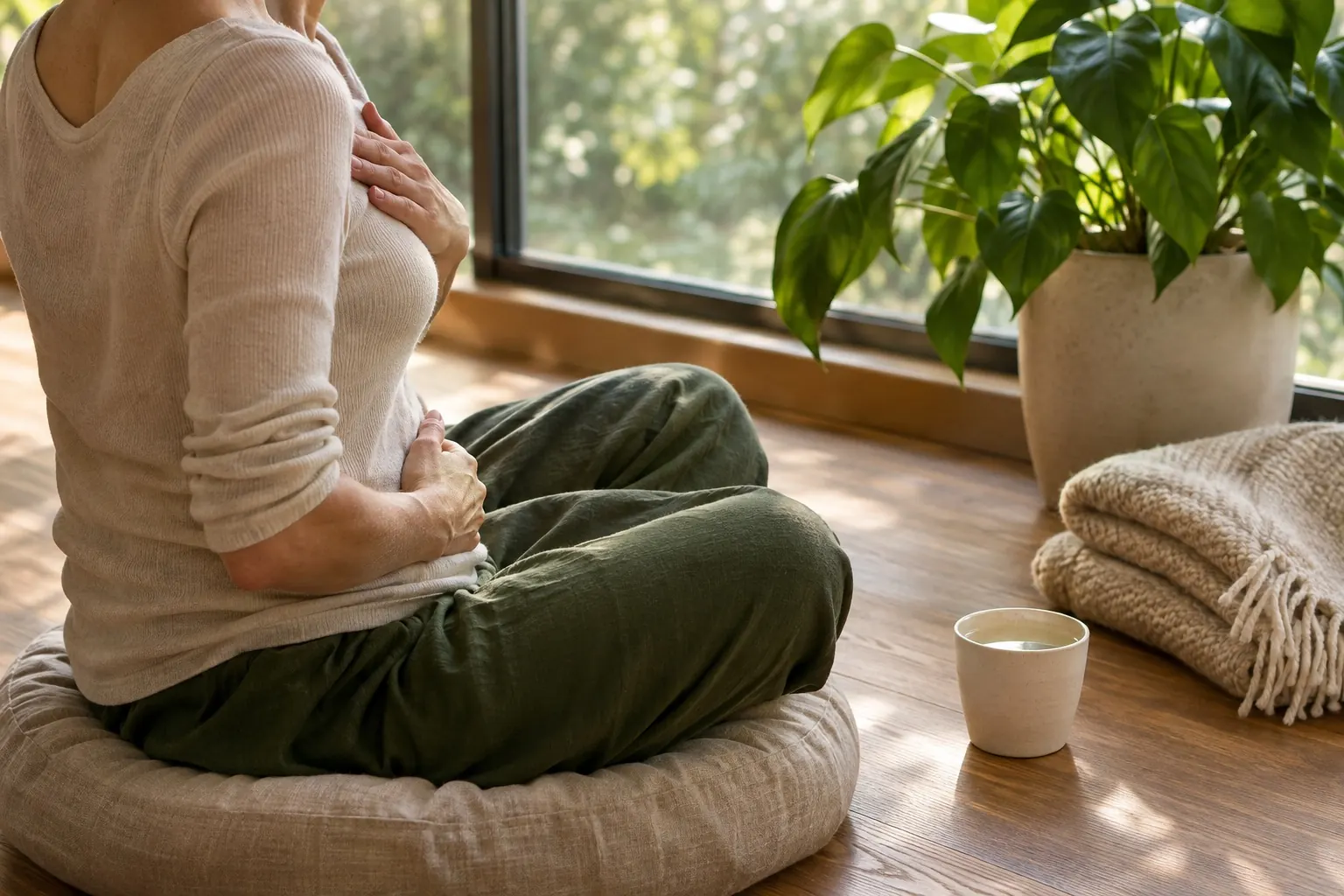
What is the vagus nerve?
You have two vagus nerves, a left and a right, and together they're the main nerves of the parasympathetic nervous system, the part that runs your body's quieter, automatic work. Cleveland Clinic notes that they carry 75% of that system's nerve fibers and are the longest cranial nerves, running from the brainstem through the neck and chest down to the large intestine.
Along the way they help control digestion, heart rate, blood pressure and breathing, along with mood, immune responses, speech, taste, and mucus and saliva production. That reach is why the vagus nerve gets so much attention: if one nerve touches so many systems, calming it sounds like a shortcut to calming everything.
There's no way to measure the vagus nerve directly at home. Researchers use heart rate variability (HRV) instead, the tiny beat-to-beat changes in your heart rate. One part of HRV reflects how strongly the vagus nerve is slowing the heart, and most of the studies below use it as their yardstick.
Do vagus nerve exercises work? What the research shows
Some do, in a modest way, and the evidence is uneven. Here is how the most common methods compare when you look at systematic reviews rather than social media clips.
| Method | What the research found | How strong the evidence is |
|---|---|---|
| Slow breathing | A 2022 review of 223 studies found vagus-linked HRV rose during slow breathing, right after one session, and after programs of several sessions. | The largest body of evidence on this list |
| Breathwork for stress | A 2023 meta-analysis of 12 randomized trials (785 adults) found a small-to-medium drop in self-reported stress compared with no breathwork, with similar effects on anxiety and low mood. | Moderate risk of bias in most trials; the authors urge caution |
| Cold water on the face | A 2023 review of 17 studies (311 people) found vagus-linked HRV rose during face immersion, cooling, diving or cold-water immersion, but not afterward. | Few, small studies of low quality |
| Whole-body cold plunges | Reviews of 11 and 13 studies found mixed effects on stress and mood, and the 2026 review concluded the evidence doesn't establish a benefit. | Limited and at high risk of bias |
| Humming, singing, gargling | We found no systematic review that tested them. | No good evidence either way |
| Ear or neck electrical stimulation | Reviews of 13 and 14 trials linked it to better sleep and lower anxiety scores, mostly with ear devices, but a 2026 review found no clear effect on HRV. | Early and inconsistent |
Sources: the systematic reviews and meta-analyses listed at the end of this guide.
The honest summary: slow, controlled breathing is the vagus nerve exercise with real support, it's free, and it takes a few minutes. Everything else is either weaker, shorter-lived or still being studied.
How to stimulate your vagus nerve with belly breathing
Belly breathing, also called diaphragmatic breathing, is the foundation for every other breathing exercise here. You breathe low into your belly instead of high into your chest, and you let the breath out slowly.
The National Center for Complementary and Integrative Health (NCCIH) points to a 2019 review of 3 studies with 880 participants that found preliminary evidence diaphragmatic breathing may help reduce stress. These are Cleveland Clinic's steps:
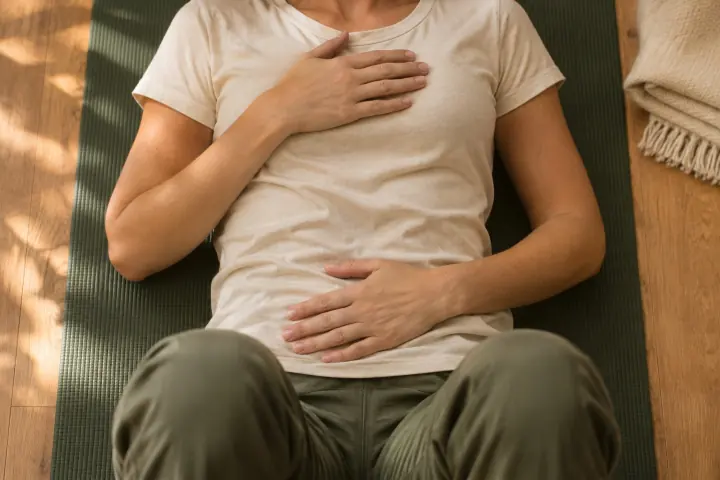
- Lie on your back with your knees bent and your head supported, or sit comfortably with your shoulders, head and neck relaxed.
- Place one hand on your upper chest and the other just below your rib cage.
- Breathe in slowly through your nose so your stomach pushes your lower hand out. Try to keep the hand on your chest still.
- Tighten your stomach muscles as you breathe out through pursed lips, letting your lower hand sink back in.
- Start with 5 to 10 minutes, about three or four times a day, and lengthen the sessions as it gets easier.
It can feel tiring at first. Cleveland Clinic says that with practice the pattern starts to come automatically.
Box breathing: how to do it
Box breathing gives each part of the breath the same count, like the four sides of a square. The even rhythm and the counting give a busy mind something to hold on to, which is why it's popular before a presentation, a hard conversation or a flight. Cleveland Clinic's version:
- Breathe out slowly until your lungs feel empty.
- Breathe in through your nose for a count of four.
- Hold your breath for a count of four.
- Breathe out for a count of four.
- Hold again for a count of four, then repeat for three to four rounds.
Practice once or twice a day, even on calm days, so it feels familiar when you need it. Stay at your comfort level and breathe gently. If the holds make you feel strained, shorten them.
4-7-8 breathing: how to do it
4-7-8 breathing stretches the out-breath to twice the length of the in-breath, which makes it a favorite at bedtime. Cleveland Clinic describes it this way:
- Rest the tip of your tongue against the ridge behind your upper front teeth.
- Breathe out completely through your mouth with a whooshing sound.
- Close your mouth and breathe in quietly through your nose for a count of four.
- Hold your breath for a count of seven, without straining.
- Breathe out through slightly pursed lips for a count of eight, with the same whoosh.
- Repeat for a total of four rounds.
Count at whatever pace feels comfortable and keep the 4-7-8 ratio. Feeling a little lightheaded at first is common and tends to pass with practice; if it happens, stop and breathe normally. For more ways to wind down at night, see our guide on how to fall asleep faster.
Cold water on your face
Cold water on the face sets off part of the diving response, a reflex that slows the heart. In the 2023 review of 17 studies, vagus-linked HRV rose clearly while people were exposed to the cold, but the change didn't last once it ended. Whole-body immersion had a bigger effect than cooling the forehead alone.
To try it, fill a basin or bowl with cold water, hold your breath for a few seconds and dip your face, or press a cold, wet washcloth over your forehead and eyes while you breathe slowly. Think of it as a quick circuit breaker for a moment of panic or anger, not a lasting change.

Cold plunges and ice baths are a bigger step. A 2025 review of 11 studies (3,177 participants) found lower stress 12 hours after cold immersion but no change at the other times measured, plus a short-term rise in inflammation. A 2026 review of 13 studies concluded the evidence does not establish that cold water improves mood or stress. If you have a heart condition, ask your doctor before trying cold immersion.
Humming, singing and gargling
These come up in almost every list of vagus nerve exercises, because the vagus nerve supplies muscles of the throat and voice box. We found no systematic review showing that humming, singing or gargling changes vagal activity or stress.
They're harmless, though, and humming or singing naturally stretches out your breath out. If you enjoy them, treat them as a pleasant add-on to slow breathing rather than a treatment on their own.
What is a vagus nerve reset?
"Vagus nerve reset" isn't a medical term. Online it usually means a short routine that strings together slow breathing, a splash of cold water, humming or a gentle neck stretch. Nothing actually resets a nerve.
The parts with evidence behind them work in the moment: slow breathing raises vagus-linked HRV during and right after a session, and cold water does so while it lasts. The slow-breathing review also found higher HRV after programs of several sessions. In other words, a reset is a useful pause, and the habit is what builds up.
Vagus nerve stimulation devices: what to know
Vagus nerve stimulation started as a surgical treatment. Cleveland Clinic explains that a device implanted in the chest sends mild electrical signals through a wire wrapped around the left vagus nerve, and the FDA has approved it for epilepsy and for depression that doesn't respond to standard treatments. In 2017 the FDA also authorized a new category of non-invasive vagus nerve stimulators for headache.
Wellness devices worn on the ear or neck are newer. A 2026 meta-analysis of 13 randomized trials linked them to better sleep quality and lower insomnia scores, with the clearest results from devices on the inner ear. Another 2026 review of 14 trials in people with sleep problems found better sleep and lower anxiety and depression scores, with only mild side effects, and called the findings preliminary. On the other side, a 2026 review found no significant effect on HRV, and a 2020 critical review found no firm evidence yet on the best spot or settings to stimulate.
If you're thinking about a device, ask your doctor first. Don't use a vagus nerve stimulator with a pacemaker, a hearing implant or any other active implant unless your doctor agrees, and keep in mind that most of the research above used devices worn on the ear.
A 5-minute calm-down routine
If you want one routine to start with, this one uses only the parts with the most support:
- Sit or lie down and place one hand on your chest and one on your belly.
- Do one minute of slow belly breathing, letting each breath out run a little longer than the breath in.
- Do three to four rounds of box breathing, or four rounds of 4-7-8 breathing at night.
- If you're very wound up, finish with a cold, wet washcloth on your face for a few breaths.
- Repeat daily for a few weeks. The changes researchers measured built up with regular practice.
Stress that keeps you awake or keeps returning deserves more than breathing alone. Our guide on calming your mind day to day covers other everyday steps.
Who should be careful
- NCCIH says relaxation techniques are generally considered safe for healthy people, but some people report more anxiety, intrusive thoughts or a fear of losing control. If that happens, stop and try a different technique.
- There are rare reports that relaxation techniques may worsen symptoms in people with epilepsy or certain psychiatric conditions, or with a history of abuse or trauma. Talk to your doctor or therapist first.
- Long breath holds can leave you lightheaded. Shorten the counts, and don't practice breath holds while driving.
- Skip cold immersion if you have heart disease unless your doctor agrees.
- If you're pregnant, have a heart condition or have an implanted device, check with your doctor before using any electrical stimulator.
When to see a doctor
Breathing exercises are for everyday stress. They don't replace care for an anxiety disorder, depression or a problem with the vagus nerve itself. Cleveland Clinic lists these possible signs of vagus nerve trouble, all worth a doctor's visit:
- Dizziness or fainting, especially fainting set off by extreme heat, anxiety, hunger, pain or stress
- Changes in heart rate, blood pressure or blood sugar
- Difficulty swallowing or losing your gag reflex
- Hoarseness, wheezing or losing your voice
- Loss of appetite or unexplained weight loss
- Nausea or vomiting, acid reflux, belly pain or bloating
See a health care provider too if stress, anxiety or sleeplessness is severe or lasts for weeks. Call 911 for chest pain, trouble breathing or fainting with an injury.
FAQ
What is the fastest way to stimulate the vagus nerve?
Slow breathing with a long, gentle breath out, or cold water on your face. In studies, both raised vagus-linked heart rate variability while people were doing them. The effect of cold water faded once the cold ended.
How long do vagus nerve exercises take to work?
You may feel calmer within a few minutes. In a 2022 review of 223 studies, vagus-linked heart rate variability rose during slow breathing, right after one session and after programs of several sessions, so regular practice is what builds the effect.
Is box breathing or 4-7-8 breathing better?
Neither has been shown to be better. Both are forms of slow, controlled breathing. Box breathing's even counts suit the daytime, and 4-7-8's longer breath out makes it a favorite at bedtime. Pick the one you'll actually practice.
Does humming stimulate the vagus nerve?
It's plausible but unproven. We found no systematic review testing humming, singing or gargling. Humming does slow your breath out, so it can be a pleasant add-on to slow breathing.
What are the symptoms of vagus nerve problems?
Cleveland Clinic lists dizziness or fainting, changes in heart rate or blood pressure, trouble swallowing, hoarseness or voice loss, nausea, belly pain or bloating, and loss of appetite or unexplained weight loss. See a doctor if you notice any of them.
Do vagus nerve stimulation devices work?
The research is early. Reviews of ear and neck devices found better sleep and lower anxiety scores in some trials, mostly with ear devices, but no clear effect on heart rate variability. Implanted stimulators are FDA-approved for epilepsy and hard-to-treat depression.
Sources
- Vagus Nerve: What It Is, Function, Location and Conditions, Cleveland Clinic
- Relaxation Techniques: What You Need To Know, National Center for Complementary and Integrative Health (NIH)
- Diaphragmatic Breathing, Cleveland Clinic
- Box Breathing Benefits and Techniques, Cleveland Clinic
- How To Do the 4-7-8 Breathing Exercise, Cleveland Clinic
- Effects of voluntary slow breathing on heart rate and heart rate variability: A systematic review and a meta-analysis, Neurosci Biobehav Rev (2022), PubMed
- Effect of breathwork on stress and mental health: A meta-analysis of randomised-controlled trials, Sci Rep (2023), PubMed
- The diving response and cardiac vagal activity: A systematic review and meta-analysis, Psychophysiology (2023), PubMed
- Effects of cold-water immersion on health and wellbeing: A systematic review and meta-analysis, PLoS One (2025), PubMed
- Cold-water exposure and psychological outcomes in adults: a systematic review and meta-analysis, Front Physiol (2026), PubMed
- Transcutaneous vagus nerve stimulation influences sleep quality and insomnia: A systematic review and meta-analysis, Sleep Med Rev (2026), PubMed
- Transcutaneous auricular vagus nerve stimulation for sleep disorders: a systematic review and meta-analysis, Psychol Health Med (2026), PubMed
- Neuromodulation of heart rate variability: A systematic review, Auton Neurosci (2026), PubMed
- Critical Review of Transcutaneous Vagus Nerve Stimulation: Challenges for Translation to Clinical Practice, Front Neurosci (2020), PubMed
- De Novo DEN150048: non-invasive vagus nerve stimulator for headache (granted April 14, 2017), U.S. Food and Drug Administration
This guide is general information, not medical advice. Talk to your doctor before making changes to your diet, sleep or exercise routine.