
Pest control
How to Get Rid of Mice in Your House and Keep Them Out
To get rid of mice, seal every opening wider than 1/4 inch, store food and garbage in sealed containers, and set snap traps along the walls where you find droppings. Clean up the mess wet, never with a broom or vacuum, and keep trapping until a full week passes with no new signs.
Signs of mice in the house, and what mouse droppings look like
Mice are mostly active at night, so you usually find the evidence before the animal. UC IPM, the University of California's pest program, lists droppings, fresh gnaw marks, tracks and nests of shredded paper or fabric behind boxes, in drawers or in the garage. A musky smell usually means a bigger, older problem.
Mouse droppings are dark, pointed and about the size of a grain of rice, according to Penn State Extension. University of Arkansas Extension puts them at about 1/4 inch, smooth, with tapered or rounded ends, which helps you tell them from the two look-alikes:
| Droppings from | Size | What they look like |
|---|---|---|
| House mouse | About 1/4 inch, like a grain of rice | Dark, smooth, with pointed or rounded ends |
| Rat | Up to 3/4 inch, like a small raisin | Dark and blunt |
| Cockroach | 1/8 to 1/4 inch | Ridges along the length and squared-off ends under a magnifying glass |
Based on University of Arkansas and Penn State Extension.
Arkansas Extension adds other clues: gnawing with fresh shavings or chewed insulation, scratching in the walls or ceiling at night, greasy rub marks along the bottom of walls, and a loose ball of shredded material 4 to 6 inches across. Whatever you find, don't sweep or vacuum the droppings; the cleanup section explains why.
How to get rid of mice in the house, step by step
Arkansas Extension describes rodent control as three steps that work together: sanitation, rodent-proofing and reducing the population. Trapping alone never ends if new mice can still walk in, and sealing alone shuts the current ones inside with you, so start all three in the same week.
- Map the activity: every spot with droppings, gnaw marks or nesting material. Traps go there, and gaps are usually nearby.
- Take away the food. Move dry goods, pet food and birdseed into hard containers with tight lids, and keep garbage in a lidded can.
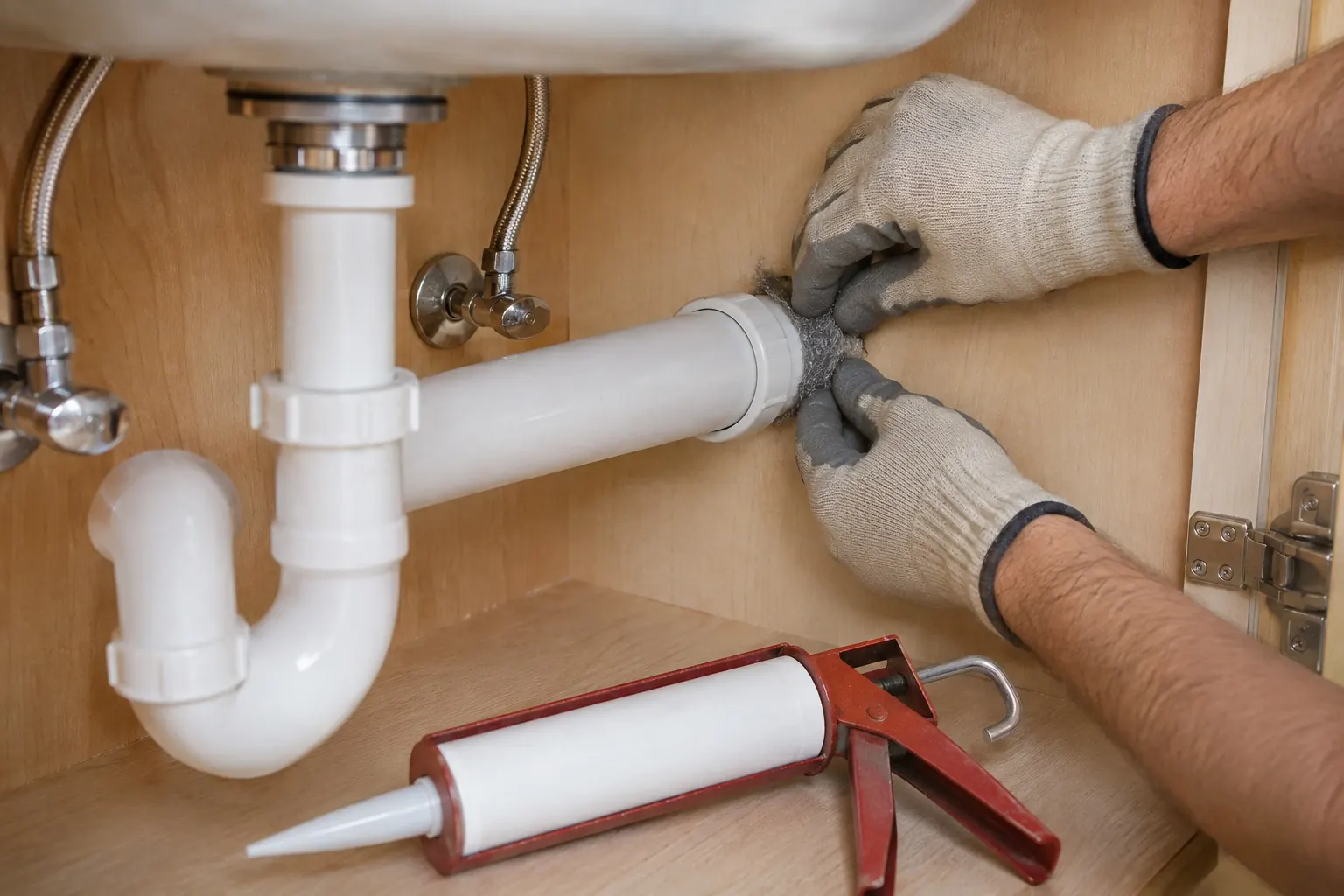
- Seal the gaps with steel wool and caulk for small holes, and hardware cloth or sheet metal for big ones.
- Set snap traps along the walls where you saw signs, baited end touching the wall.
- Check the traps every day, wearing gloves.
- Clean droppings, urine and nests with the wet method, never with a broom or vacuum.
- Keep trapping until a full week passes with no catches and no new signs. CDC says that's when an infestation is likely over.
Speed matters: a female house mouse may have 5 to 10 litters a year with about 5 or 6 pups in each, according to UC IPM, and mice breed year-round when food and shelter are steady.
Steel wool for mice: how to seal the gaps they use
A mouse can squeeze through a hole the width of a pencil, about 1/4 inch, according to CDC. That's why sealing beats any spray or gadget. CDC suggests checking these spots first:
- Under and behind kitchen cabinets, and around the pipes under sinks and the washing machine
- Closet corners, around the fireplace, and the basement or crawl space
- Around windows and doors, and where the foundation meets the ground
- Attic and crawl space vents, and the roof line: eaves, gables and soffits
- The garage. Arkansas Extension notes that mice slip under poorly fitting garage doors, then follow pipes and wires into the house.
For small holes, CDC suggests stuffing in steel wool held in place with caulk, or using spray foam. Larger holes need hardware cloth, lath screen, sheet metal or cement cut to fit around pipes.
Two cautions. Steel wool rusts over time, so UC IPM and Arkansas Extension treat it as a temporary plug; for a permanent repair, Arkansas Extension suggests patching plaster or mortar smoothed flat so there's no edge to gnaw. And UC IPM rates plastic screening, rubber, vinyl, expanding foam and wood as poor plugs on their own, because mice chew through them.
Finish with the doors: Arkansas Extension says the gap at an exterior door's threshold shouldn't exceed 1/4 inch, and Penn State recommends door sweeps.
How to keep mice away: take away food, water and shelter
Mice don't need much. Arkansas Extension says one mouse eats only about a tenth of an ounce of food a day, stays within an area 10 to 30 feet across and gets most of its water from food. Cleaning alone won't end an infestation, it notes, but a messy kitchen lets one grow and makes traps less tempting.

- Store cereal, grains, nuts, pet food and birdseed in glass, metal or hard plastic containers with tight lids, up off the floor, as Penn State suggests.
- Feed pets only what they finish in one sitting (UC IPM), and put the bowl away at night.
- Wipe up crumbs the same day, keep trash in a lidded can and fix leaks. EPA's basic advice for any pest is to remove its food, water and shelter.
- Cut clutter: paper, cardboard and fabric piles are ready-made nesting material.
- Outside, CDC suggests keeping woodpiles and compost at least 100 feet from the house, with firewood raised about a foot off the ground.
Mouse traps: the best kind and where to put them
CDC recommends traditional snap traps for homes. Set properly, a wooden snap trap is 75% to 88% effective, according to Arkansas Extension, and UC IPM notes that a wide trigger plate catches more mice. Penn State calls snap traps the safest traps for catching mice in the home, kept out of children's reach.
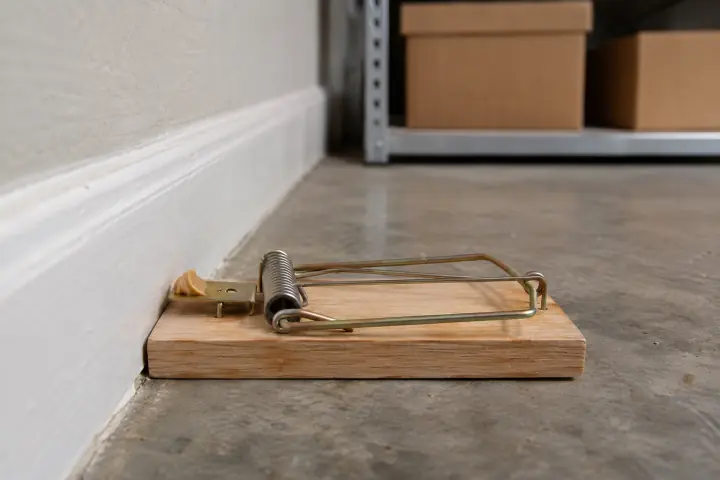
- Put each trap on the floor with the baited end touching the wall, so it makes a T. Mice run along walls and cross the trigger (CDC).
- Set traps where you found droppings, behind appliances, inside cabinets and near entry points (CDC).
- Use plenty. Arkansas Extension suggests two traps side by side, with sets no more than 6 feet apart where mice are active.
- Bait lightly: a small dab of peanut butter is the classic. CDC also lists mutton fat, and Arkansas Extension suggests nutmeats, chocolate or bacon.
- Check traps daily (CDC) and wear gloves to empty them.
What about glue boards and humane mouse traps? CDC advises against glue and live traps because they scare mice into urinating, which raises your chance of getting sick. Arkansas Extension adds that glue boards can injure or starve the mouse and shouldn't go where children, pets or wildlife can touch them. And UC IPM, a California program, says relocating mice is illegal without a permit and doesn't work.
Mouse poison and rodent bait stations: use them carefully, if at all
Rodent baits work, but they carry risks that traps don't. EPA rules limit rodenticides sold to homeowners to ready-to-use bait stations, and loose pellets are no longer allowed in those products. Penn State Extension goes further: it advises against rodenticides inside homes and warns that mouse poison pellets or chunks are dangerous for children and pets. If you do use bait:
- Read the label before you buy and before each use, and check that the product is labeled for that spot, indoors or outdoors (EPA).
- Keep bait sealed in its station, placed only where children and pets can't reach it (EPA). Arkansas Extension notes that some stations resist children but not dogs.
- Expect a wait and maybe a smell. UC IPM says baits take several days, and since mice stay within about 30 feet of their nest, a poisoned mouse may die inside a wall.
- Remove dead rodents promptly so pets and wildlife don't eat them, and store baits away from food, ideally locked up (EPA).
Skip foggers and insect sprays: Penn State notes they're made for insects and don't affect rodents. If a child may have eaten bait, call Poison Control at 1-800-222-1222 right away; for a pet, call your veterinarian.
How to clean mouse droppings safely
Rodent urine and droppings can carry germs, and stirring them into the air is the thing to avoid. CDC's rule is simple: don't sweep or vacuum droppings, because that can release virus-containing droplets into the air. Use the wet method instead.
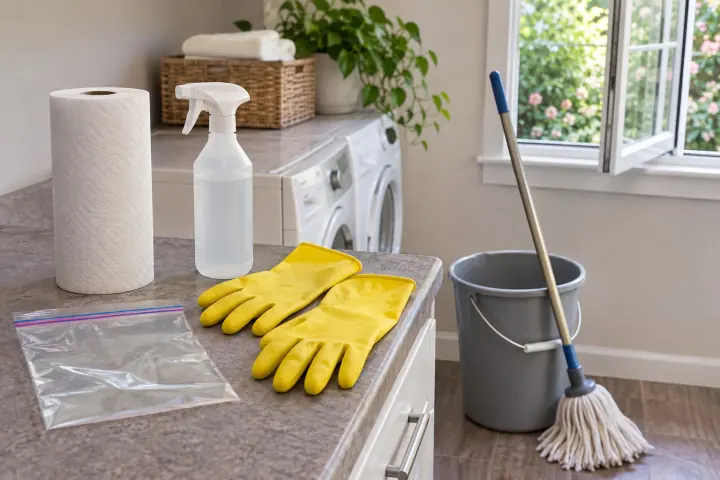
- Air it out. For a shed, cabin, garage or other closed-up space, CDC says to open the doors and windows and leave for 30 minutes before you start.
- Put on rubber or plastic gloves.
- Mix a fresh bleach solution, 1.5 cups of household bleach in 1 gallon of water (1 part bleach to 9 parts water), or use a product whose label says disinfectant. Use bleach on its own: CDC says never to mix it with ammonia or any other cleaner.
- Spray the droppings, urine and any nest until they're very wet, and let them soak for 5 minutes or as long as the label says.
- Wipe it all up with paper towels and put them in a covered garbage can. For a dead mouse or a nest, put it in a plastic bag with any used trap, knot the bag, place it in a second bag and knot that one too.
- Mop or sponge the floors, counters, cabinets and drawers with disinfectant.
- Wash your gloves with soap and water or disinfectant before taking them off, then wash your hands with soap and warm water.
- Wash soiled bedding, clothes and stuffed toys in hot water with detergent, and shampoo or steam-clean carpets and upholstered furniture.
Do mice carry diseases? Hantavirus and other risks
In the US, the most common hantavirus that causes hantavirus pulmonary syndrome is spread by the deer mouse, according to CDC. People catch it through contact with rodents' urine, droppings and saliva; bites are a rare route. Deer mice have a white belly and a well-furred tail (UC IPM), but the same careful cleanup applies to any rodent mess.
CDC says symptoms usually start 1 to 8 weeks after contact: fatigue, fever and muscle aches in the large muscle groups, and in about half of patients headaches, dizziness, chills or stomach trouble. Four to 10 days later, coughing and shortness of breath can follow as the lungs fill with fluid, and 38% of people who develop those breathing symptoms may die.
House mice bring other problems. UC IPM lists leptospirosis, salmonella and lymphocytic choriomeningitis, notes that mouse urine is a major allergen linked to asthma in sensitive children, and warns that chewed wiring is believed to cause some unexplained fires.
Do ultrasonic pest repellers work against mice?
Plug-in repellers are popular because there's nothing to bait or empty, but the independent evidence is mixed at best. UC IPM says ultrasound doesn't reach behind objects, mice get used to repeated sounds, and there's little evidence such devices drive out established mice. A University of Arizona Cooperative Extension review concluded that commercial devices haven't been shown to work in homes; in the rodent study it describes, rats and mice showed a mild dislike that faded, though those researchers suggested well-placed devices may help. EPA treats repellers as devices, so makers don't submit efficacy data before selling them.
If you want one as an extra layer, we've reviewed two. PestPulse is a plug-in unit that, according to the brand, combines ultrasonic, electromagnetic and predator-like pulses, shifts its pattern so pests don't get used to it, and covers up to 900 sq ft. The Repellio Ultrasonic Pest Repeller is rated by its brand for up to 120 sq ft, about one room, and the brand's chart describes 3 to 4 weeks for full results. Neither brand publishes independent tests.
To give either its best chance, use one unit per problem room, plugged in low near where mice travel with nothing blocking it, and keep sealing, cleaning and trapping. Keep them away from pet hamsters, gerbils or guinea pigs. A repeller is an add-on, never a substitute for closed gaps and sealed food.
Peppermint oil, dryer sheets and other home remedies
Peppermint oil is the most searched home remedy for mice, but none of the university and government guides we checked recommends it, and we found no test showing that it, or dryer sheets, keeps mice out. Arkansas Extension says repellents such as mothballs or ammonia may move rodents around for a while but do nothing to remove them, and that some people are allergic to naphthalene, the active ingredient in mothballs.
A cat isn't a plan either: UC IPM says cats and dogs catch some mice but rarely control a population. No scent or pet closes a 1/4-inch gap.
When to call a professional
A few mice can usually be handled with traps and a weekend of sealing. Call a licensed pest control company when:
- You keep catching mice week after week, or fresh droppings keep showing up.
- You can't reach the entry points, such as the roof line, soffits or crawl space.
- Mice are inside walls or the ceiling, or you smell a dead mouse you can't find.
- You find gnawed wiring. Call an electrician too.
- An attic, shed or cabin needs a big cleanup, or someone at home has asthma or a weakened immune system.
EPA suggests hiring a company with a certified, licensed applicator (your state department of agriculture can confirm it), asking for references and the labels of any pesticides they'll use, and getting several estimates.
A health note: if you develop fever, fatigue and muscle aches in the weeks after cleaning up after rodents, see a doctor right away and mention the exposure, as CDC advises. Call 911 for trouble breathing. If anyone swallows rodent bait, call Poison Control at 1-800-222-1222; the call is free and confidential.
Plug-in pest repellers we've reviewed
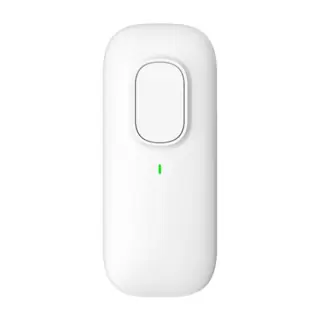
PestPulse review
Renters and families who want a no-chemical, plug-and-forget extra layer against insects and mice in kitchens, garages and basements. From $19.50.
Read the review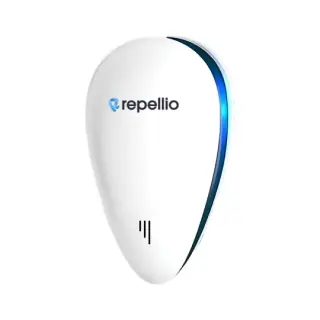
Repellio Ultrasonic Pest Repeller review
Small spaces and single problem rooms, like a dorm, an apartment kitchen or a garage, where you want a chemical-free unit you can plug in and move around. From $20.00.
Read the review
FAQ
How long do mice live?
Usually 9 to 12 months, according to UC IPM, though some have lived up to 3 years. A female can have 5 to 10 litters a year, so a few mice become many within months.
How small of a hole can a mouse fit through?
About 1/4 inch, the width of a pencil, according to CDC. Seal anything that size or bigger, especially around pipes, vents and doors.
What is the best bait for mouse traps?
A small dab of peanut butter is the classic. CDC also lists mutton fat, and Arkansas Extension suggests nutmeats, chocolate, bacon or a marshmallow tied to the trigger.
Does peppermint oil keep mice away?
There's no good evidence it does. The extension guides we checked don't recommend scent repellents, and Arkansas Extension says repellents like mothballs or ammonia only move rodents around for a while.
How do I get rid of mice in the walls?
Set snap traps along the floor near the activity and seal the gaps around pipes and outside. Avoid poison, which can leave a mouse to die inside the wall (UC IPM). If the noises continue, call a pro.
Can I vacuum mouse droppings?
No. CDC says sweeping or vacuuming can release virus-containing droplets into the air. Soak the droppings with a bleach solution or disinfectant, wait 5 minutes and wipe them up with paper towels.
Sources
- Seal Up to Prevent Rodent Infestations, Centers for Disease Control and Prevention
- Trap Up to Reduce Rodent Populations, Centers for Disease Control and Prevention
- How to Clean Up After Rodents, Centers for Disease Control and Prevention
- About Hantavirus, Centers for Disease Control and Prevention
- How to Safely Clean and Sanitize with Bleach, Centers for Disease Control and Prevention
- Pest Notes: House Mouse, UC IPM, University of California Agriculture and Natural Resources (2025)
- Controlling Mice and Rats, MP546, University of Arkansas Cooperative Extension Service
- Is There a Mouse in the House? Eliminate Mice with IPM, Penn State Extension
- Common Urban Pests: Identification, Prevention, and Control, Penn State Extension
- Restrictions on Rodenticide Products, U.S. Environmental Protection Agency
- Safely Use Rodent Bait Products, U.S. Environmental Protection Agency
- Do's and Don'ts of Pest Control, U.S. Environmental Protection Agency
- Pesticide Devices: A Guide for Consumers, U.S. Environmental Protection Agency
- Sonic Pest Repellents, AZ1639, University of Arizona Cooperative Extension
- Tips for Selecting a Pest Control Service, U.S. Environmental Protection Agency
- Poison Control (National Capital Poison Center)
This guide is general information. Read and follow the label of any pesticide, rodent bait or trap, keep baits, traps and cleaning products out of reach of children and pets, and call a licensed pest professional for a large or lasting infestation. If anyone swallows rodent bait, call Poison Control at 1-800-222-1222.