
Sleep
How to Sleep With Neck Pain: The Best Positions, the Right Pillow and Quick Relief
How to sleep with neck pain, in short: lie on your back or your side, with a pillow that keeps your neck level with the mattress, and stay off your stomach. Below are the setups for each position, what to look for in a pillow, and how to ease a stiff neck the morning after. If it hasn't improved after a week of home care, or comes with the warning signs listed at the end, see a doctor.

Why you wake up with a stiff neck
Most neck pain comes from strained or tense muscles, and MedlinePlus, the National Library of Medicine's health site, says everyday activities are usually to blame. Sleeping in an uncomfortable position is on its list, alongside hunching over a desk, a screen set too high or too low, and jerky twists during exercise.
Night after night, position matters because you hold it for hours. Cleveland Clinic's chiropractors point to stomach sleeping as a frequent culprit, because your head stays turned to one side for hours at a time. A pillow that's too high, too low or too soft does the same thing more quietly: it bends your neck forward or sideways for hours.
The best sleeping position for neck pain
Sleep on your back or on your side. Cleveland Clinic calls back sleeping often the most comfortable position for people with neck and back pain, and its chiropractors advise against stomach sleeping. Whatever your position, the goal is the same: a neck that stays parallel to the mattress instead of bending up, down or sideways.


| Position | How to set it up | Pillow |
|---|---|---|
| On your back | Arms in the same position on both sides; a pillow under your knees if your lower back aches too. | Medium height. Too low tips your jaw toward the ceiling, too high pushes it toward your chest. |
| On your side | Face forward without tucking your chin, a pillow between your knees, and switch sides from night to night. | Thick and firm enough to fill the space between your ear and shoulder so your head doesn't droop. |
| On your stomach | Best avoided with neck pain, since your head stays twisted to one side. | A body or side pillow can help you shift onto your side while still feeling some pressure on your front. |
Based on Cleveland Clinic's sleeping-position and pillow advice.
Changing a lifelong position takes a few nights. Bolster yourself with extra pillows while you get used to it. Side sleeping is also the first thing doctors suggest for snoring, so if that's a problem in your house too, see our guide on how to stop snoring.
What to look for in the best pillow for neck pain
There's no single best pillow for neck pain, and the research says so. A 2021 meta-analysis of pillow trials found that supportive pillows reduced neck pain, pain on waking and neck disability in people with chronic neck pain, with the clearest results for rubber (latex) and spring pillows, while pillow design made no difference to sleep quality. The authors concluded that a pillow's shape and height probably matter most for keeping the neck aligned. A 2025 review of 5 newer studies with 239 participants found only limited evidence and no clear winner among latex, foam and standard pillows.
So choose by fit, not by label. Cleveland Clinic's rule of thumb is a pillow that keeps your neck parallel to the mattress, and its chiropractors add these pointers:
- Match the height to your position: high enough on your side that your head doesn't droop, and on your back just high enough to keep your jaw level.
- Match it to your mattress. On a firm mattress your shoulder sinks in less, so you need a thicker pillow; on a soft or pillow-top mattress, a thinner one.
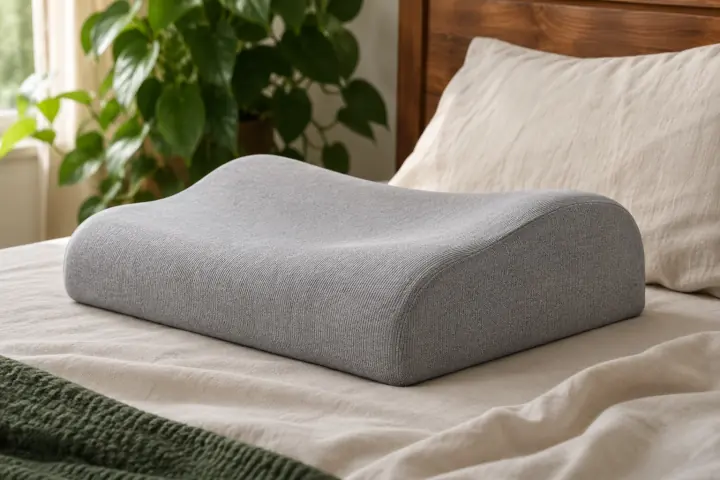
- Consider a contoured shape. Cleveland Clinic says cervical contour pillows, with a dip for the head and a raised edge under the neck, work best for most people, with foam contour pillows next.
- Pick a material that holds its shape. Natural latex supports without trapping as much heat; memory foam is the choice if you're allergic to latex. Feather pillows shift during the night and give little neck support.
- Buy with a return window, since you only know after a few nights whether a new shape suits your neck.
Your mattress counts too. MedlinePlus suggests a firm mattress and a pillow that supports your neck, and two systematic reviews of mattress trials favored medium-firm mattresses for comfort, sleep quality and spinal alignment.
If you'd like to try a contoured memory foam pillow, we reviewed Derila Ergo. It has what the brand calls a butterfly design, with support wings and a cut-out for the shoulder, and the brand says it works for side, back and stomach sleepers. We found no independent trial of Derila Ergo itself, the pillow can take a few nights to get used to, and it comes with a 60-day return policy if it doesn't suit you.
How to fix neck pain from sleeping
For a stiff neck from sleeping in a bad position, these home-care steps come from MedlinePlus and Cleveland Clinic:
- Take an over-the-counter pain reliever such as ibuprofen or acetaminophen, exactly as the label directs. Ask a pharmacist first if you have a health condition or take other medicines.
- Use ice for the first 48 to 72 hours, then switch to heat: a warm shower, a warm compress or a heating pad. Don't fall asleep with a heating pad or ice bag in place.
- Ease off your usual physical activity for the first few days, but keep the neck moving gently.
- Do slow range-of-motion movements: chin up and down, look side to side, then tip each ear toward its shoulder.
- At your desk or in the car, Cleveland Clinic suggests rolling your shoulders back and down 10 times, squeezing your shoulder blades together 10 times, gently pressing your head back into the headrest for 30 seconds, and bringing each ear toward its shoulder 10 times.
- Ask someone to massage the sore area gently.
- That night, use the position and pillow setup above.
How long does a stiff neck last?
There's no fixed timeline, but most stiff necks from sleeping are minor muscle strains that respond to the steps above. MedlinePlus advises contacting your provider if the pain hasn't gone away after a week of self-care, if over-the-counter pain relievers taken regularly don't help, or if the pain gets worse when you lie down or wakes you at night.
If neck pain keeps you awake on top of everything else, our guide on falling asleep faster has techniques you can use in bed.
When to see a doctor about neck pain
Call 911 or go to the emergency room if you have:
- A fever and headache with a neck so stiff you can't touch your chin to your chest, which can be a sign of meningitis
- Neck pain with shortness of breath, sweating, nausea, vomiting, or arm or jaw pain, which can be a heart attack
- Neck pain after a fall, blow or injury, and you can't move your arm or hand
MedlinePlus also advises contacting your provider if you have numbness, tingling or weakness in an arm or hand; swollen glands or a lump in the neck; trouble swallowing or breathing along with the pain; pain so severe you can't get comfortable; loss of bladder or bowel control; or trouble walking and keeping your balance.
See your doctor before trying new routines if you have arthritis, osteoporosis or a past neck injury or surgery.
A contoured pillow we reviewed

FAQ
What is the best sleeping position for neck pain?
On your back or on your side, with a pillow that keeps your neck level with the mattress. Cleveland Clinic calls back sleeping often the most comfortable position for neck and back pain, and advises against sleeping on your stomach.
What kind of pillow is best for neck pain?
One that keeps your neck parallel to the mattress in your usual position. Reviews of pillow trials found the clearest benefits for latex and spring pillows but no clear winner overall, and Cleveland Clinic says cervical contour pillows work best for most people.
How do I get rid of a stiff neck from sleeping wrong?
Use ice for the first 48 to 72 hours and then heat, take an over-the-counter pain reliever as the label directs, keep the neck moving gently, and fix your pillow and position. See a provider if it hasn't improved after a week.
How long does a stiff neck last?
There's no fixed timeline, and most stiff necks from sleeping are minor muscle strains. MedlinePlus advises contacting your provider if it hasn't gone away after a week of self-care, or sooner if it's severe, wakes you at night or comes with arm numbness or weakness.
How should I sleep with a pinched nerve in my neck?
Use the same neutral back or side positions, but see a doctor first: numbness, tingling or weakness in an arm or hand is one of the signs MedlinePlus says needs a provider's attention.
Sources
- Neck pain, MedlinePlus Medical Encyclopedia (National Library of Medicine)
- Best Sleeping Positions for Pain, Cleveland Clinic
- The Best Sleeping Positions for a Restful Night, Cleveland Clinic
- Is Your Pillow Giving You a Stiff Neck While You Sleep?, Cleveland Clinic
- Stiff Neck? Remedies to Find Neck Pain Relief, Cleveland Clinic
- The effects of pillow designs on neck pain, waking symptoms, neck disability, sleep quality and spinal alignment in adults: A systematic review and meta-analysis, Clin Biomech (2021), PubMed
- Effect of pillow on pain, disability and sleep quality in patients with chronic neck pain: A systematic review, Rehabilitacion (2025), PubMed
- Effect of different mattress designs on promoting sleep quality, pain reduction, and spinal alignment: systematic review of controlled trials, Sleep Health (2015), PubMed
- What type of mattress should be chosen to avoid back pain and improve sleep quality? Review of the literature, J Orthop Traumatol (2021), PubMed
This guide is general information, not medical advice. Talk to your doctor before making changes to your diet, sleep or exercise routine.