
Recipe
Overnight Oats Recipe: An Easy Chia Seed Base and 6 Variations
This overnight oats recipe takes 5 minutes: stir 1/2 cup rolled oats with 1/2 cup milk, 1/4 cup Greek yogurt and 1 tablespoon of chia seeds in a jar, then refrigerate overnight, or at least 4 hours. Below you'll find the ratio, six variations from high-protein to mocha, and the nutrition of each jar worked out from USDA data.
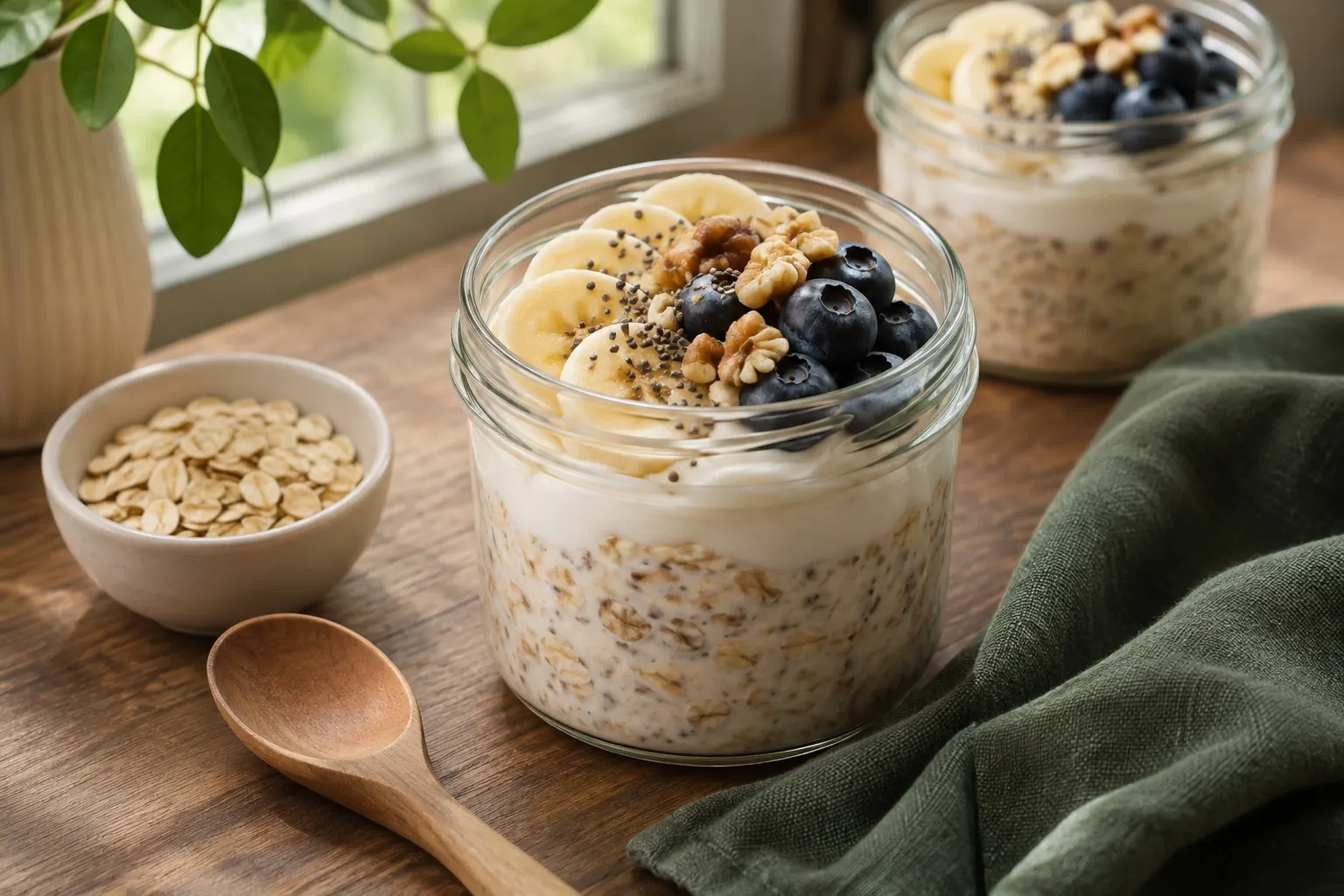
Overnight Oats with Chia Seeds and Greek Yogurt
Ingredients
- 1/2 cup old-fashioned rolled oats
- 1/2 cup 2% milk (or any milk)
- 1/4 cup plain nonfat Greek yogurt
- 1 tbsp chia seeds
- 2 tsp maple syrup
- 1/4 tsp vanilla extract
- 1 pinch each of salt and ground cinnamon
- 1/2 cup fresh or frozen blueberries, for topping
Steps
- Add the oats, chia seeds, salt and cinnamon to a jar or container with a lid (a 16-oz jar fits one serving).
- Pour in the milk, yogurt, maple syrup and vanilla, and stir until no dry oats remain. Scrape the bottom of the jar.
- Close the lid and refrigerate overnight, or for at least 4 hours.
- In the morning, stir, add a splash of milk if it's thicker than you like, and top with the blueberries. Eat cold, or warm it up (see below).
Per serving, estimated from USDA FoodData Central: 380 calories, 18 g protein, 9 g fiber, 24 g sugar. Includes the blueberries. About 8 g of the sugar is added sugar from the maple syrup; the rest comes from the milk, yogurt and fruit.
The overnight oats ratio
Start with equal parts rolled oats and liquid: 1/2 cup oats to 1/2 cup milk. The yogurt and chia seeds in this recipe each soak up some of that liquid and thicken the jar, so the 1/4 cup of yogurt counts as part of the liquid.
From there, adjust to taste:
- Thicker, almost scoopable oats: keep the recipe as written, or add another 1/2 tablespoon of chia.
- Looser, porridge-like oats: add 2 to 4 tablespoons more milk, either the night before or in the morning.
- No chia: use 1/2 cup oats to 1/2 cup milk plus the yogurt, and expect a softer set.
- Quick oats: use the same amounts, but they soften more and can turn mushy. Old-fashioned rolled oats keep some chew.
- Steel-cut oats: they stay quite chewy after one night. Add 2 extra tablespoons of milk and give them a full night in the fridge.
How to make overnight oats, step by step
There's no cooking, but the order you add things helps.
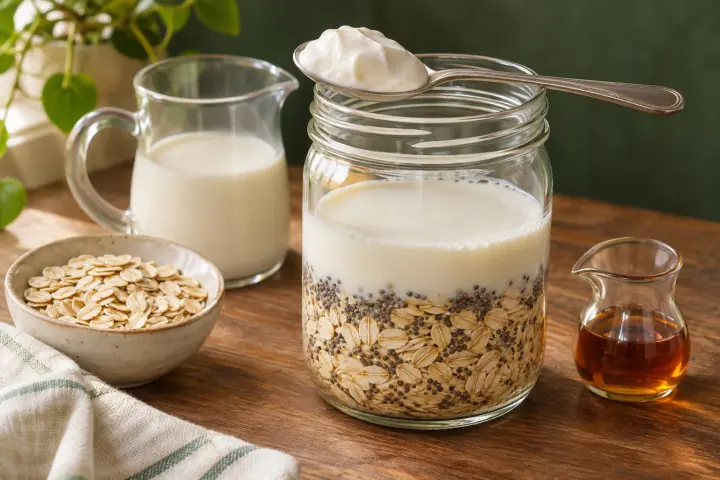
- Put the dry ingredients in the jar first: oats, chia, salt and cinnamon.
- Add the milk, yogurt, maple syrup and vanilla on top.
- Stir thoroughly, all the way to the bottom. Chia seeds clump if they sit in one spot, so a jar with a lid that you can shake is handy.
- Refrigerate overnight. The oats soften and the chia gels while you sleep.
- Add fruit, nuts or nut butter in the morning so they stay fresh and crunchy.
Overnight oats with chia seeds
Chia is what makes this version thick and creamy. The seeds contain soluble fiber, the kind that attracts water and turns to gel, according to MedlinePlus. One tablespoon of chia seeds adds about 51 calories, 2 grams of protein and nearly 4 grams of fiber, based on USDA data.
Together, the 1/2 cup of oats and 1 tablespoon of chia give the base jar about 8 grams of fiber before you add any fruit. With the blueberries, it's about 9 grams, roughly a third of the 28-gram Daily Value the FDA uses on food labels.
If you're new to eating this much fiber, MedlinePlus suggests adding fiber gradually over a few weeks and drinking plenty of fluids, to avoid gas and cramps. You could start with half a tablespoon of chia.
Overnight oats with yogurt, or without
Greek yogurt makes the oats tangy and creamy and adds protein. A quarter cup of plain nonfat Greek yogurt brings about 6 grams of protein, and half a cup about 13, according to USDA FoodData Central.
Plain yogurt is the better pick. The Dietary Guidelines for Americans, 2025–2030, recommend dairy with no added sugars, and they say full-fat dairy is fine, so plain whole-milk Greek yogurt works too. Flavored yogurts can add more sugar than the maple syrup does.
Making overnight oats without yogurt is easy: replace the 1/4 cup yogurt with another 1/4 cup of milk. The texture is a little thinner and the protein drops by about 6 grams.
Protein overnight oats
The base jar already has about 18 grams of protein. For a breakfast that keeps you going longer, here are two ways to push it higher, with the protein per jar from USDA data:
- More yogurt: use 1/2 cup Greek yogurt instead of 1/4 cup. About 24 grams of protein and 415 calories per jar with the blueberries.
- Protein powder: stir 1/2 scoop (about 2 1/2 tablespoons) of vanilla or unflavored whey protein powder into the milk and add an extra 1/4 cup of milk, since the powder absorbs liquid. About 33 grams of protein and 465 calories per jar with the blueberries.
- A full scoop of powder pushes it to about 45 grams, but it also gets chalky. Most people prefer half a scoop plus the yogurt.
How much protein do you need? The 2025–2030 Dietary Guidelines set a goal of 1.2 to 1.6 grams of protein per kilogram of body weight a day, adjusted to your calorie needs, and suggest prioritizing protein foods at every meal. For a 150-pound adult (68 kg), that's about 82 to 109 grams a day, so a 25- to 30-gram breakfast covers a good share. For more ideas, see our high-protein lunch ideas.
6 overnight oats variations
Each one starts from the base jar (1/2 cup oats, 1/2 cup milk, 1/4 cup Greek yogurt, 1 tablespoon chia, 2 teaspoons maple syrup, vanilla, salt and cinnamon). Only the changes are listed.
- Blueberry (the base): top with 1/2 cup blueberries. Frozen berries work and thaw by morning if you add them the night before.
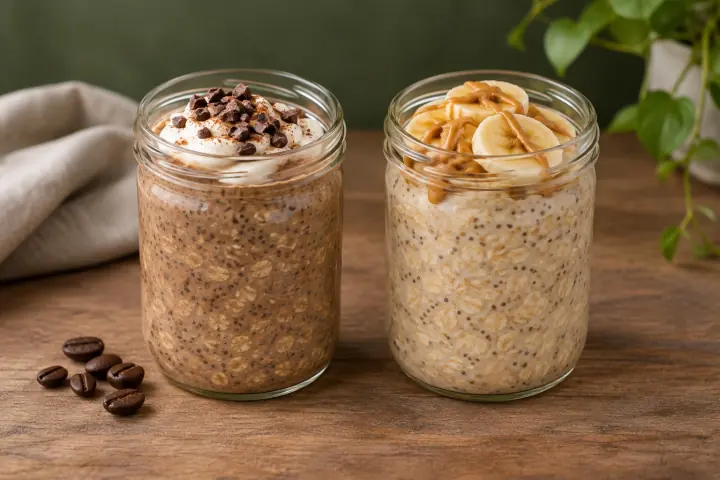
- Peanut butter banana: stir 1 tbsp peanut butter into the milk, cut the maple syrup to 1 tsp, and top with half a sliced medium banana instead of the berries.
- Mocha overnight oats: replace 1/4 cup of the milk with 1/4 cup cold brewed coffee and stir in 1 tbsp unsweetened cocoa powder. No berries. This jar has roughly 36 mg of caffeine, a fraction of a cup of coffee. If your morning coffee is an instant blend such as Bryo, a scoop dissolved in 2 tablespoons of hot water can stand in for the brewed coffee; it's sweetened with stevia, so taste before adding maple syrup.
- Apple pie: swap the berries for 1/2 cup diced apple and raise the cinnamon to 1/2 tsp. Add the apple in the morning so it stays crisp.
- High-protein: use 1/2 cup Greek yogurt, or the half-scoop protein powder version above.
- Overnight oats with water, dairy-free: replace the milk and yogurt with 3/4 cup water or unsweetened almond milk. Lighter, but much lower in protein.
Overnight oats calories, jar by jar
We calculated each variation from USDA FoodData Central values for the exact amounts above. Numbers are per jar and include the toppings listed.
| Variation | Calories | Protein | Fiber | Sugar |
|---|---|---|---|---|
| Blueberry base | 380 | 18 g | 9 g | 24 g |
| Base without fruit | 340 | 17 g | 8 g | 17 g |
| Peanut butter banana | 470 | 22 g | 10 g | 22 g |
| Mocha (no fruit) | 320 | 17 g | 10 g | 14 g |
| Apple pie | 370 | 18 g | 10 g | 22 g |
| High-protein, 1/2 cup yogurt | 415 | 24 g | 9 g | 26 g |
| High-protein, 1/2 scoop powder | 465 | 33 g | 10 g | 27 g |
| With water, no dairy | 285 | 8 g | 9 g | 16 g |
Calculated from USDA FoodData Central and rounded; see Sources. Each jar has about 8 g of added sugar from maple syrup (4 g in the peanut butter version). Protein powders vary by brand, so check your label.
The 2025–2030 Dietary Guidelines say one meal should contain no more than 10 grams of added sugars. Every jar here fits. Flavored yogurt, sweetened milk and extra syrup are what push overnight oats past that line.
Overnight oats meal prep
Overnight oats are made for batch prep. Line up four jars on Sunday night and breakfast is done through Wednesday.
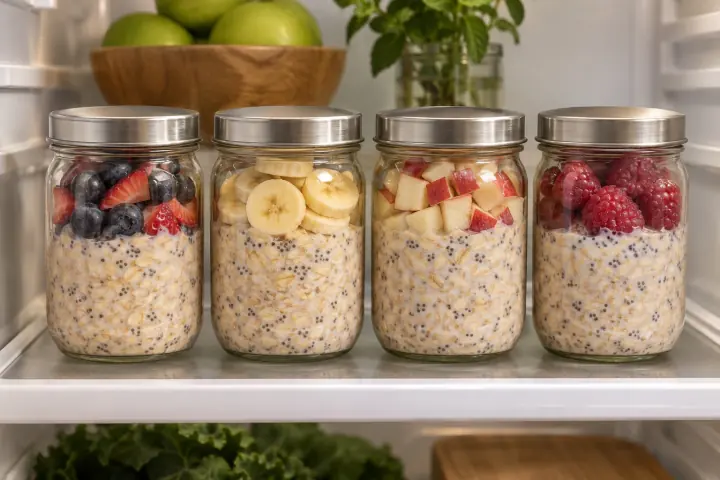
- Make up to four days ahead. There's no official storage time for overnight oats, so we follow the FDA's refrigerator chart for leftovers and mixed dishes, which gives 3 to 4 days.
- Keep the fridge at 40°F or below, as the FDA recommends.
- Don't leave a jar out of the fridge for more than 2 hours, or 1 hour above 90°F. Use an ice pack if you eat it at work.
- Add bananas, apples and nuts the morning you eat them. Berries hold up for a day or two.
- Scale the recipe by four: 2 cups oats, 2 cups milk, 1 cup Greek yogurt, 1/4 cup chia seeds, 2 tbsp plus 2 tsp maple syrup and 1 tsp vanilla. Mix in a large bowl, then divide between the jars.
Are overnight oats healthy?
They can be one of the easiest healthy breakfasts there is. Oats are a whole grain, and the 2025–2030 Dietary Guidelines advise prioritizing fiber-rich whole grains, with 2 to 4 servings a day depending on your calorie needs.
Oats are also rich in beta-glucan, a soluble fiber. A 2016 meta-analysis of 58 randomized trials found that a median of 3.5 grams of oat beta-glucan a day lowered LDL ("bad") cholesterol by about 0.19 mmol/L, roughly 7 mg/dL, compared with control diets. That's a modest drop, and the trials varied a lot.
The healthy part depends on what goes in the jar. Plain yogurt, measured nut butter and whole fruit keep it a balanced meal. Sweetened yogurt, chocolate spreads and a heavy pour of syrup turn it into dessert.
Overnight oats for weight loss
No breakfast burns fat by itself, but overnight oats have two things going for them if you're trying to eat less without feeling hungry: protein and fiber.
On protein, a 2016 meta-analysis found that higher-protein preloads increased feelings of fullness more than lower-protein ones, though the authors warned that the conditions were tightly defined and the results shouldn't be stretched too far. On fiber, the evidence is more mixed: a 2013 systematic review found that most fibers tested didn't reduce appetite in short studies, but oat beta-glucan was one of the few with support from more than one study.
In practice, the protein versions are the most filling, and the toppings decide the calories. The jars above range from about 285 to 470 calories, a 185-calorie spread that comes almost entirely from the yogurt, powder and peanut butter. If weight loss is your goal, measure the nut butter and pick plain yogurt. Our guide to natural appetite suppressants covers what else helps with hunger.
Still falling short on fiber even with oats and chia? If a drink is easier for you, we reviewed ColonBroom, a flavored psyllium fiber powder with 3.6 g of psyllium per scoop. It's an add-on for regularity, not a weight-loss product: a review of 22 trials found psyllium alone didn't change body weight.
Can you heat up overnight oats?
Yes. Overnight oats are usually eaten cold, but you can warm them. Move them to a microwave-safe bowl (or take the metal lid off a glass jar), add a splash of milk, and microwave for 1 to 2 minutes, stirring halfway. Add fresh fruit after heating.
When to see a doctor
Overnight oats are an everyday food, but check with a professional in these situations:
- Celiac disease. NIDDK says most people with celiac disease can safely eat moderate amounts of oats, but cross-contact with gluten grains is common, so choose oats labeled gluten-free and ask your doctor or dietitian whether oats belong in your diet.
- Diabetes. A jar of overnight oats carries a meaningful amount of carbohydrate, so ask your doctor or dietitian how it fits your meal plan.
- Chronic kidney disease. NIDDK notes that some people with CKD need moderate amounts of protein, so talk to your care team before adding protein powder.
- New digestive symptoms after adding fiber, such as constipation with blood in the stool, constant belly pain, vomiting, fever or weight loss without trying. NIDDK says to see a doctor right away.
- Pregnancy, children's diets, or any medication you take with food: ask your doctor first.
Reviewed products that fit an overnight oats routine
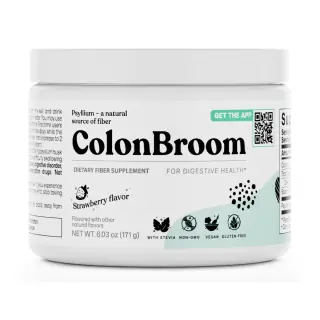
ColonBroom review
Adults who want an easy, tasty way to add psyllium fiber for regularity and fewer bloated days. From $0.93 a day.
Read the review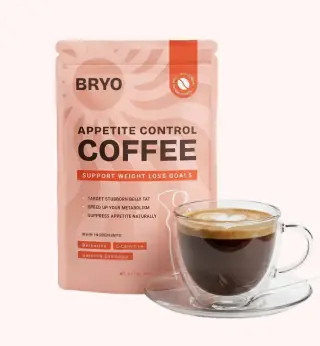
Bryo review
Daily coffee drinkers who want a flavored instant coffee with appetite-focused ingredients, alongside sensible eating. From $0.60 a day.
Read the review
FAQ
How long do overnight oats last in the fridge?
Plan on 3 to 4 days, the FDA refrigerator chart's window for leftovers and mixed dishes, in a fridge at 40°F or below. Add fresh fruit on the day you eat them.
Can you heat up overnight oats?
Yes. Transfer them to a microwave-safe bowl, add a splash of milk and microwave for 1 to 2 minutes, stirring halfway.
What is the ratio for overnight oats?
Start with equal parts rolled oats and liquid, such as 1/2 cup oats to 1/2 cup milk. Yogurt and chia thicken it, so add a few tablespoons more milk if you like it looser.
Can I make overnight oats with water?
Yes. Replace the milk and yogurt with 3/4 cup water. It works, but it tastes less creamy and has far less protein, about 8 grams per jar instead of 18.
Can I use steel-cut or quick oats?
Quick oats work but turn softer, almost mushy. Steel-cut oats stay chewy, so give them a full night and 2 extra tablespoons of liquid. Old-fashioned rolled oats are the easiest middle ground.
Are overnight oats good for weight loss?
They can help as a filling, fiber-rich breakfast, especially the higher-protein versions. Calories range from about 285 to 470 per jar depending on toppings, so measure nut butter and choose plain yogurt.
Sources
- Oats, raw (FDC ID 2708489), USDA FoodData Central
- Milk, reduced fat (2%) (FDC ID 2705386), USDA FoodData Central
- Yogurt, Greek, nonfat milk, plain (FDC ID 2705424), USDA FoodData Central
- Chia seeds (FDC ID 2707590), USDA FoodData Central
- Syrups, maple (FDC ID 169661), USDA FoodData Central
- Vanilla extract (FDC ID 173471), USDA FoodData Central
- Blueberries, raw (FDC ID 171711), USDA FoodData Central
- Peanut butter (FDC ID 2707537), USDA FoodData Central
- Bananas, raw (FDC ID 173944), USDA FoodData Central
- Coffee, brewed (FDC ID 2710375), USDA FoodData Central
- Cocoa, dry powder, unsweetened (FDC ID 169593), USDA FoodData Central
- Apples, raw, with skin (FDC ID 171688), USDA FoodData Central
- Spices, cinnamon, ground (FDC ID 171320), USDA FoodData Central
- Beverages, Protein powder whey based (FDC ID 173180), USDA FoodData Central
- Soluble vs. insoluble fiber, MedlinePlus (National Library of Medicine)
- Fiber, MedlinePlus Medical Encyclopedia (National Library of Medicine)
- Daily Value on the Nutrition and Supplement Facts Labels, FDA
- Dietary Guidelines for Americans, 2025–2030, USDA and HHS
- The effect of oat β-glucan on LDL-cholesterol, non-HDL-cholesterol and apoB for CVD risk reduction: a systematic review and meta-analysis of randomised-controlled trials, Br J Nutr (2016), PubMed
- The Effects of Increased Protein Intake on Fullness: A Meta-Analysis and Its Limitations, J Acad Nutr Diet (2016), PubMed
- The effect of fiber on satiety and food intake: a systematic review, J Am Coll Nutr (2013), PubMed
- The effects of psyllium supplementation on body weight, body mass index and waist circumference in adults: a systematic review and dose-response meta-analysis of randomized controlled trials, Crit Rev Food Sci Nutr (2020), PubMed
- Are You Storing Food Safely?, FDA
- Refrigerator & Freezer Storage Chart, FDA
- Eating, Diet, & Nutrition for Celiac Disease, NIDDK
- Healthy Eating for Adults with Chronic Kidney Disease, NIDDK
- Symptoms & Causes of Constipation, NIDDK
This guide is general information, not medical advice. Talk to your doctor before making changes to your diet, sleep or exercise routine.