
Cleaning
Musty Smell in House: How to Find the Source, Fix It and Clear Other Odors
A musty smell in house air usually means moisture and mold growing somewhere, so the fix is to find the damp spot, dry it out and clean it rather than cover the odor. Below is a room-by-room way to track it down, the humidity range the EPA recommends, safe cleanup for small patches, and a chart for fridge, drain, smoke, pet and cooking smells.

Why does my house smell musty?
That damp, old-basement smell has a known cause. The Environmental Protection Agency (EPA) explains that molds give off gases that often have a strong odor, and its mold course puts it plainly: a moldy odor suggests mold is growing in the building and should be investigated.
Mold needs moisture and something to feed on, and almost any organic material will do: paper, cloth, wood. Moisture is the part you control. The EPA says no type of mold grows without water, and very little is needed; mild condensation can be enough. Spores are always in the air, and they start growing only when they land on something wet.
So when a house smells musty, the real question is where the water is coming from. The EPA's list of usual suspects:
- Slow plumbing leaks, often around sinks
- Roof leaks
- Condensation from high humidity or on cold spots, such as around windows or on cold walls behind furniture
- Bathroom tile and grout that stay wet
- Basement walls and crawl spaces, especially crawl spaces with bare earth floors
- Floods or spills that weren't dried quickly
How to find the source of a musty smell in the house
Your nose tires quickly, so step outside for a few minutes, come back in and start right away. Then work through the house in this order.
- Close up, then sniff room by room. Shut the interior doors for an hour or two so the smell collects where it starts.
- Go low and into closed spaces. Open closets, cabinets and drawers, and smell near the floor and baseboards.
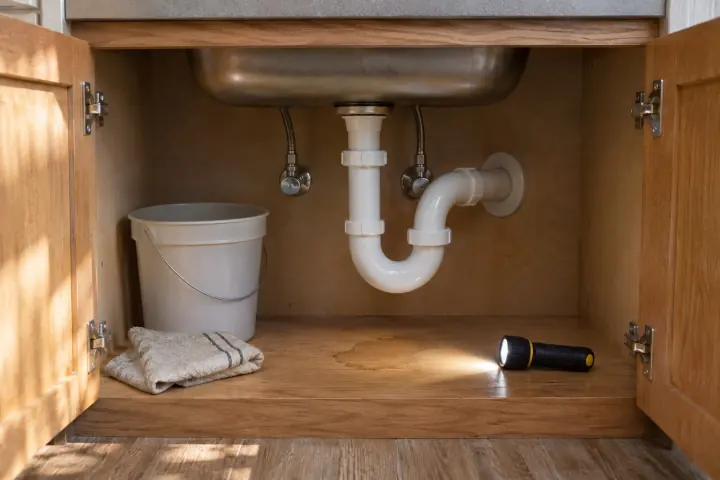
- Check under every sink with a flashlight. Look for drips on the pipes and a stain or swollen patch on the cabinet floor. The EPA names slow plumbing leaks and the areas around sinks among the common places for mold.
- Open the washing machine. Extension experts point out that the rubber door gasket on a front-loader stays wet long after a cycle, which makes it a good home for mold. Pull back the folds and look.
- Look at the bathroom: tile and grout, the shower curtain, bath mats. Ask yourself whether the fan actually clears the steam.
- Check the heating and cooling system. Look at the filter, and at the air conditioner's drip pan and drain line, which the EPA says to keep clean and flowing.
- Walk the basement or crawl space. Look for damp spots on walls and floors, stored cardboard and fabric, and condensation on cold water pipes.
- Pull furniture away from outside walls and look around windows. The EPA notes mold often shows up on cold walls behind furniture, where condensation forms.
- Check the kitchen for forgotten food in the refrigerator and crisper, and look at the drip pan underneath, as a University of Kentucky extension fact sheet on household odors suggests.
If the house smells moldy but you can't see the source, the EPA says you may have hidden mold: on the back of drywall, under carpet, inside wall cavities where pipes run. Disturbing those spots can release spores, so the agency suggests hiring an experienced professional.
How to get rid of a musty smell in the house: fix the moisture first
"The key to mold control is moisture control," the EPA writes. Clean without fixing the water and the smell comes back.
Start with the leak or spill you found. The EPA says wet materials dried within 24 to 48 hours will usually not grow mold, so speed matters. Then bring the humidity down. The agency's target is indoor relative humidity below 60 percent, ideally between 30 and 50 percent. You can check it with a humidity meter, a small instrument the EPA says costs about $10 to $50 at many hardware stores.
- Run the bathroom fan or open the window when you shower.
- Use the exhaust fan or open a window when you cook or run the dishwasher.
- Vent the clothes dryer to the outside.
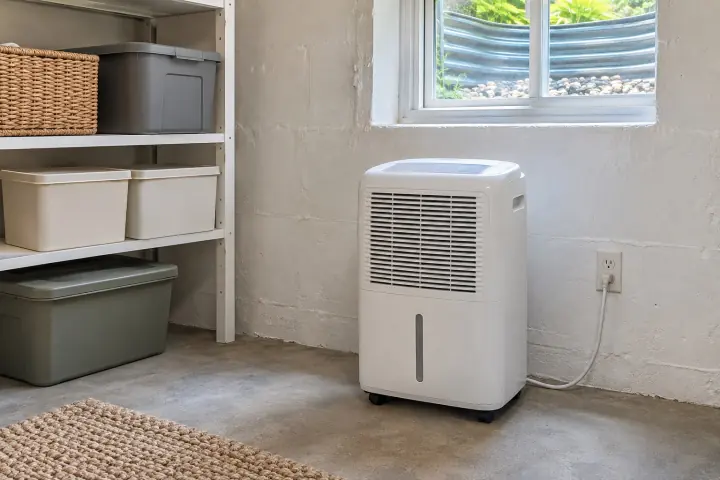
- Use an air conditioner or a dehumidifier when the air is damp.
- Open doors and windows when practical, and use fans, to keep air moving.
- Insulate cold water pipes so they stop sweating.
- Outside, keep roof gutters clean and make sure the ground slopes away from the foundation.
ENERGY STAR, the federal efficiency program, lists a space that feels damp and has a musty odor that comes and goes among the signs that a dehumidifier may help. Keep the room's doors and windows closed while the unit runs, and leave space around it so air can circulate.
How to get rid of mildew smell: clean small mold patches safely
Once the area is dry, clean what grew there. The EPA's rule of thumb: if the moldy area is less than about 10 square feet, roughly a 3-foot by 3-foot patch, in most cases you can handle the job yourself. Here's its method:
- Protect yourself. The EPA recommends an N-95 respirator, gloves that reach the middle of the forearm and goggles without ventilation holes.
- Open windows or doors for fresh air while you use any cleaning product, as the CDC advises.
- Scrub mold off hard surfaces with detergent and water, then dry the surface completely.
- Throw away absorbent or porous materials, such as ceiling tiles and carpet, if they've become moldy and can't be cleaned.
- Don't paint or caulk over a moldy surface. The EPA warns that paint applied over mold is likely to peel.
If you use bleach, the CDC's limit is no more than 1 cup of household bleach in 1 gallon of water, and its warning is absolute: never mix bleach with ammonia or any other cleaner. Use one product at a time, as its label directs.
Some people shouldn't do this job at all. The CDC lists people with allergies, weakened immune systems, underlying lung disease, asthma or COPD.
In damp spots such as showers, the EPA says cleaning more often and adding ventilation will usually prevent mold from returning or keep it to a minimum.
Mildew smell in the washer and laundry
A washer that smells musty passes the smell on to towels and clothes. An Ask Extension expert, answering a reader with exactly this problem, gave these habits:
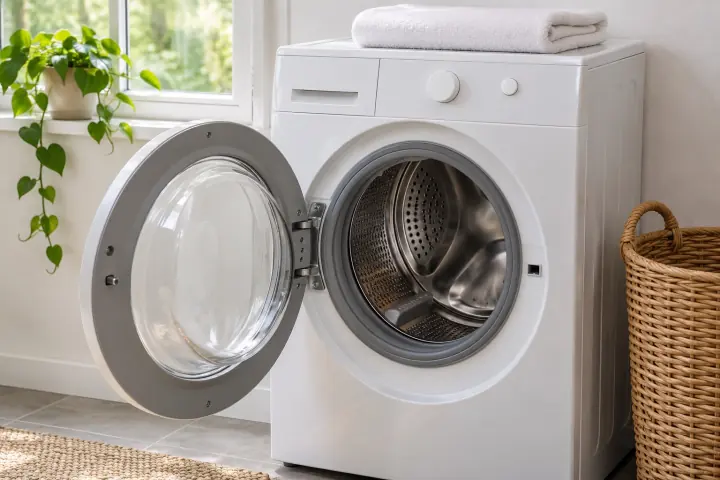
- Leave the door and the detergent drawer open between loads so the leftover water can evaporate.
- Take wet laundry out promptly.
- Run a load on the hottest setting from time to time: the machine's cleaning cycle if it has one, or a hot cycle with a cup of white vinegar.
- Use only low-suds, high-efficiency detergent, and not too much. Residue leads to more odor.
- Spray the gasket with one part vinegar to one part water and wipe it well, including the inner folds.
Odor eliminator chart: what each house smell means and what to do
Not every bad smell is mold. The best odor eliminator is whichever step removes the source, and that depends on what you're smelling. Use this chart to match the smell to its likely cause.
| Odor | Likely source | What to do | Source |
|---|---|---|---|
| Musty or mildew smell in a room, closet or basement | Moisture and mold growth: a leak, condensation or high humidity | Find and fix the water, dry within 24 to 48 hours, keep humidity below 60 percent, clean small patches | EPA |
| Musty washer, sour towels | A gasket and drum that stay wet between loads | Leave the door and detergent drawer open, run a hot cleaning cycle, wipe the gasket | Ask Extension |
| Fridge smell | Spoiled food, spills, a dirty drip pan | Empty it, wash shelves and interior, air it out, then set out baking soda, coffee or charcoal | Nebraska Extension, University of Kentucky |
| Garbage disposal smell | Food residue inside the unit | Run citrus rinds through it, or baking soda sprinkled over a few ice cubes | University of Kentucky |
| Bathroom smells like sewer | A drain trap that has dried out, or a blocked plumbing vent | Run water through floor and sink drains; call a plumber if it persists | Wisconsin Department of Health Services |
| Smoke | Residue on walls, fabrics, carpets and in the heating and cooling system | Wash hard surfaces, launder fabrics, change filters, air the house out | Texas A&M AgriLife Extension |
| Pet urine | Urine soaked into carpet, padding or flooring | Blot, rinse, then use an enzymatic cleaner; never ammonia | Ohio State University |
| Cooking smells | Steam, smoke and grease in the air while you cook | Run a fan that exhausts outdoors, open windows, wipe up splatters | EPA |
| Rotten-egg smell you can't place | Possibly natural gas, which carries a rotten-egg odorant | Leave the building and call the gas company from outside | Connecticut PURA |
Full references are listed under Sources at the end of this guide.
How to get rid of fridge smell, garbage disposal smell and cooking smells
For a refrigerator, Nebraska Extension gives a routine adapted from a USDA fact sheet. Wash the shelves, crispers and ice trays in hot, soapy water, then rinse them with a sanitizing solution of 1 tablespoon of unscented liquid chlorine bleach per gallon of water. Scrub the interior, door and gasket with hot water and baking soda, rinse with the same solution, and leave the door open for about 15 minutes.
If the smell hangs on, try one of these in the empty, running refrigerator:
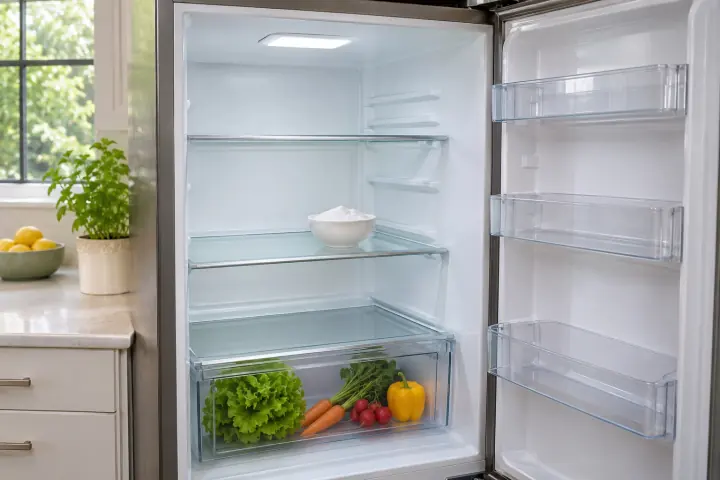
- Trays of baking soda, activated charcoal or clean cat litter on the shelves for 2 to 3 days
- Freshly ground coffee spread on cookie sheets for 2 to 3 days
- Crumpled newspaper on every shelf with a cup of water on the top shelf, for 5 to 6 days. Slow, but Nebraska Extension calls it effective.
For a garbage disposal, the University of Kentucky fact sheet has two easy fixes: toss citrus rinds down it now and then, or sprinkle baking soda over a few ice cubes and run them through. A layer of cat litter in the bottom of the garbage pail absorbs odor there.
For cooking smells, run the range fan while you cook. The EPA notes that kitchen fans that exhaust outdoors remove contaminants directly from the room, and that opening windows and doors when the weather allows brings in more outdoor air.
Bathroom smells like sewer? Check the drain traps
Every drain has a curved section of pipe, the trap, that holds a little water and blocks sewer gas. In a drain that's rarely used, that water can dry out. The Wisconsin Department of Health Services says sewer gas can enter a home through a floor drain, from a leaking or blocked plumbing roof vent, or through cracks in the foundation.
The first fix costs nothing: run water through floor and sink drains regularly so the traps don't dry out. Wisconsin's health department also suggests checking the roof vent for debris such as leaves or a bird's nest, and hiring a plumber if the leak seems to be behind a wall.
Don't live with this one. Sewer gas contains hydrogen sulfide, which smells like rotten eggs even at low concentrations and can cause headaches, dizziness and nausea.
How to get smoke smell out of a house, and how to get rid of pet odor
Smoke leaves residue on everything, so airing the house out only thins the smell. Texas A&M AgriLife Extension's advice is that to remove it for good, you have to remove the source:
- Wash walls and other hard surfaces with mild soap or a suitable cleaner and rinse well, including inside cabinets, drawers and closets.
- Launder or dry-clean fabrics, adding 1 cup of white vinegar to the wash. Smell each item before you dry it, because the dryer can set the odor.
- Have carpets, window coverings, upholstery and mattresses steam cleaned.
- Change the heating and cooling filters; after a fire, have the system and ductwork professionally cleaned.
- Set out bowls of vinegar, baking soda or activated charcoal for several days, and keep windows open in warm weather.
If the odor has soaked deep into carpets, draperies or furniture, replacing them may be the only thing that works, the extension service notes.
For pet urine on carpet, Ohio State University's veterinary college says to blot up as much as you can with paper towels, saturate the spot with carpet cleaner or a few drops of dish detergent in water for an hour or two without scrubbing, rinse by blotting with a wet sponge, then use an enzymatic cleaner as its label directs. Never use ammonia-based products; the smell can draw the pet back to the same spot. Cornell's Feline Health Center adds that cleaning works best soon after the accident.
How to make your house smell good: a simple weekly routine
A house that smells good is mostly a house with nothing in it that smells bad. The EPA says the most effective way to improve indoor air is usually to eliminate the individual sources, then ventilate. A short routine keeps the common sources from building up:
- Open the windows for a while when the weather allows.
- Empty the trash, wipe out the pail and check the fridge for anything past its best.
- Wipe down kitchen and bathroom surfaces: stovetop, counters, sink, shower glass and tile.
- Run water in any drain that didn't get used this week.
- Leave the washer door open, and wash towels before they sit damp.
- Glance at the humidity meter and under the sinks.
- Change or clean the heating and cooling filter on the schedule its package gives.
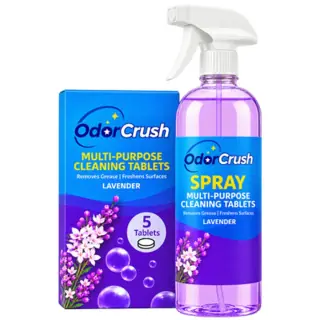
For the wipe-down step, we reviewed OdorCrush Multi-Purpose Cleaning Tablets. You drop one lavender tablet into the reusable spray bottle that comes with the order, add water and let it dissolve; according to the brand, each tablet makes 16 oz of cleaner for kitchen grease, soap scum and everyday grime on hard, washable surfaces. The brand says to spray, wait 2 to 3 minutes and wipe clean, and to spot-test delicate, porous or painted finishes first. Use it on its own, as the label directs, never together with another cleaner.
To deodorize a room between cleanings, the University of Kentucky fact sheet lists pantry items that absorb odors: baking soda, vinegar, activated charcoal and coffee grounds. Small bowls of vinegar freshen a stale room, and simmering a cinnamon stick, orange peel and whole cloves in water scents it. For more cleaning how-tos, see our guides to removing a toilet bowl ring and cleaning a wooden cutting board.
When to call a professional
Most house smells are a cleaning and drying job. These are not:
- You smell gas. Gas companies add an odorant that smells like rotten eggs. Connecticut's utility regulator says that if the smell is strong or you're unsure, leave the building, then call the gas company from a phone away from the smell. Don't touch light switches, use a phone or doorbell, or light matches or candles on the way out.
- Mold covers more than about 10 square feet, or there has been a lot of water damage. If you hire a contractor, the EPA says to make sure they have experience cleaning up mold.
- The water came from sewage or another contaminated source. The EPA says to call a professional experienced with that kind of damage.
- You suspect mold in the heating and cooling system. The EPA says not to run it.
- The house smells moldy but you can't find the source.
- A sewer smell keeps coming back after you've refilled the traps. Call a plumber. If you think sewer gas is highly concentrated in an enclosed space, Wisconsin's health department says to leave, avoid anything that could spark, and call the fire department.
- Someone at home has symptoms. See a doctor about headaches, dizziness, drowsiness or nausea when you suspect sewer gas, and talk to a health professional about health concerns related to mold.
- You rent. The EPA advises reporting leaks and moisture problems to the building owner or manager right away.
Cleaning tablets we've reviewed
FAQ
How do I get rid of a musty smell in my house?
Find the moisture behind it, fix the leak or condensation, and dry the area within 24 to 48 hours. Keep indoor humidity below 60 percent, ideally 30 to 50 percent, as the EPA recommends, then scrub small mold patches off hard surfaces with detergent and water and dry them completely.
Why does my house smell musty even though it's clean?
Because the source is usually damp, not dirt. The EPA says mold gives off gases with a strong odor and can grow out of sight: behind drywall, under carpet, in a crawl space or on a cold wall behind furniture. Check under sinks, the washer gasket, closets and the basement.
What is the best odor eliminator for a house?
Removing the source. The EPA says eliminating individual sources is usually the most effective way to improve indoor air, followed by ventilation. Baking soda, vinegar and activated charcoal help absorb what lingers, and a regular wipe-down keeps kitchens and bathrooms fresh; we reviewed OdorCrush cleaning tablets for that surface-cleaning step.
How do you get smoke smell out of a house?
Texas A&M AgriLife Extension says to remove the residue: wash walls and hard surfaces, launder fabrics with 1 cup of white vinegar added to the wash, steam clean carpets and upholstery, change the heating and cooling filters, and set out bowls of vinegar, baking soda or activated charcoal for several days.
Why does my bathroom smell like sewer?
Often a drain trap has dried out, which lets sewer gas up through the drain. Run water through floor and sink drains regularly, especially ones you rarely use. If the smell persists, the Wisconsin Department of Health Services suggests checking the roof vent for debris and hiring a plumber.
How do I get rid of fridge smell?
Throw out spoiled food, wash the shelves and drawers in hot, soapy water, and scrub the interior with hot water and baking soda. If odor remains, Nebraska Extension suggests trays of baking soda, activated charcoal or freshly ground coffee in the empty, running refrigerator for 2 to 3 days.
Sources
- A Brief Guide to Mold, Moisture and Your Home, US Environmental Protection Agency
- Mold Cleanup in Your Home, US Environmental Protection Agency
- Mold Course Chapter 1: Introduction to Molds, US Environmental Protection Agency
- Mold Course Chapter 2: Why and Where Mold Grows, US Environmental Protection Agency
- Mold Clean Up Guidelines and Recommendations, Centers for Disease Control and Prevention
- Improving Indoor Air Quality, US Environmental Protection Agency
- Care for Your Air: A Guide to Indoor Air Quality, US Environmental Protection Agency
- Dehumidifiers, ENERGY STAR (US EPA and Department of Energy)
- Solving Odor Problems in Your Refrigerator or Freezer, University of Nebraska-Lincoln Extension (adapted from USDA)
- Odors: What's That Smell? (HF-LRA.125), University of Kentucky Cooperative Extension Service (1997)
- How can I get rid of a weird smell in the washing machine?, Ask Extension (Cooperative Extension)
- How to Remove Smoke Smell from a Home, Texas A&M AgriLife Extension Service (2023)
- Air: Sewer Gas, Wisconsin Department of Health Services
- What To Do If You Smell Natural Gas, Connecticut Public Utilities Regulatory Authority
- How to Clean-Up Cat Urine, Indoor Pet Initiative, The Ohio State University College of Veterinary Medicine
- Feline Behavior Problems: House Soiling, Cornell Feline Health Center, Cornell University College of Veterinary Medicine
This guide is general information, not professional or medical advice. If you smell gas, leave and call your gas company or 911 from outside. Call a professional for large areas of mold, sewage or a sewer odor that won't go away, and see a doctor about any symptoms.