
Gadgets
Key Finder Guide: How to Keep Track of Keys, Wallets and Luggage
A key finder is a small Bluetooth tracker you attach to your keys, wallet or bag so your phone can ring it when it's nearby and show where it was last seen on a map. Below: how these trackers work, which shape suits which item, the habits that stop things going missing, and the exact steps for a lost wallet, a lost phone and a suitcase that didn't arrive.
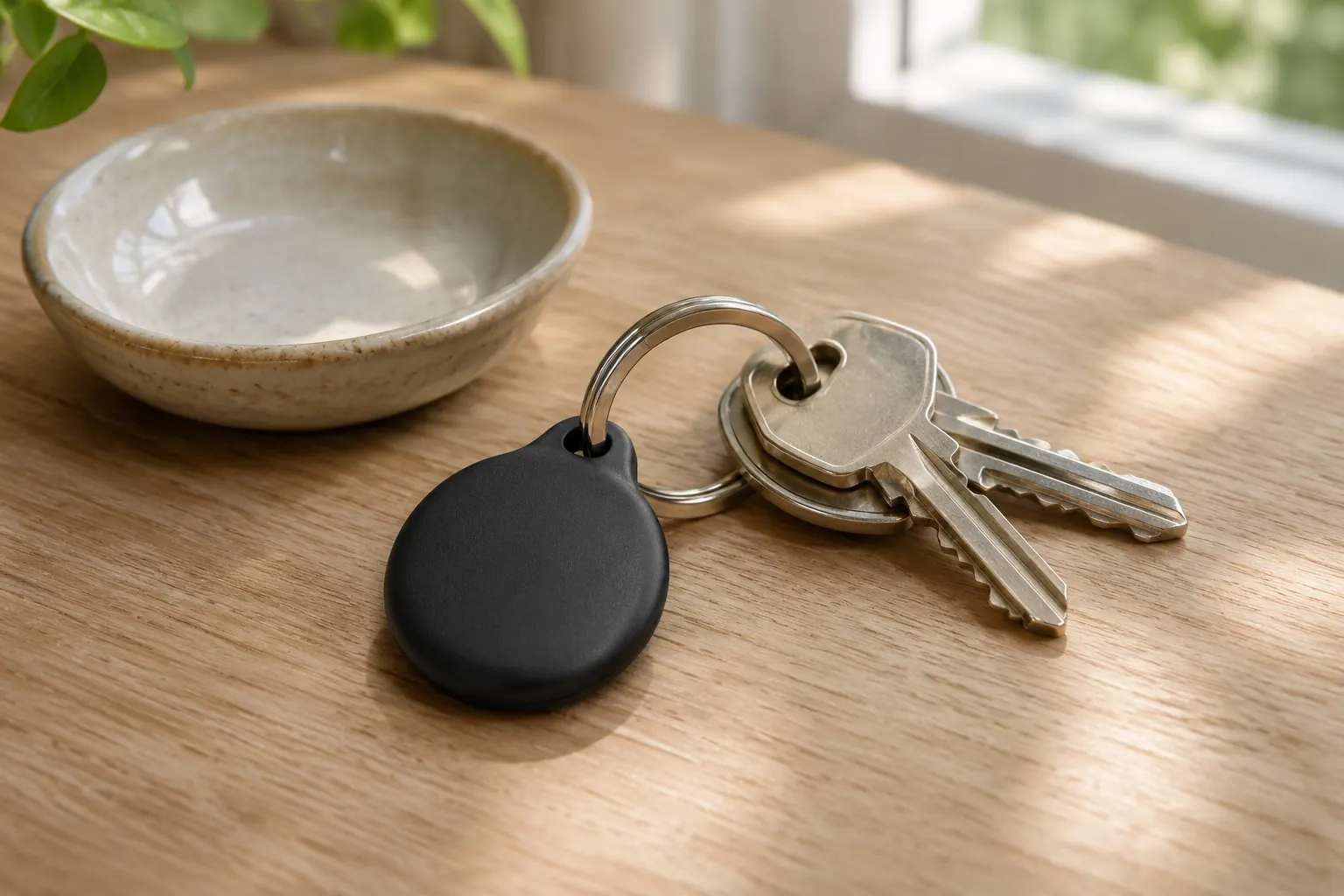
What a key finder is, and how a Bluetooth tracker works
A key finder, also sold as a Bluetooth tracker or item tracker, is a coin-sized tag or a flat card with a small battery inside. You pair it with your phone once, attach it to something you tend to misplace, and from then on the phone can help you find that thing.
The trackers we've reviewed describe three ways of finding an item, and most models on the market follow the same pattern:
- Ring it when it's close. While the tag is within Bluetooth range of your phone, you tap a button in the finding app and the tag plays a sound. Think keys under a couch cushion or a wallet in yesterday's jacket.
- Check where it was last seen. If the tag is out of range, the app shows the last place your phone was connected to it.
- Get help from phones passing by. Trackers that join a phone maker's built-in finding network can have their location refreshed when other people's phones pass near them, anonymously. That's how a tag with no SIM card and no monthly plan can still show up on a map from an airport or another city.
Many trackers add a left-behind alert, a notification that reaches your phone when you walk away from the item. Some also work in reverse: the maker of the iTagPro Bluetooth Tracker says pressing the tag makes your phone ring, which is handy when it's the phone that has slipped between the car seats.
One note: a tracker belongs on your own things.
Tag or card? Wallet tracker, tracker for keys and luggage tracker compared
Trackers come in two main shapes, and a tracker only helps if it stays on the item.
A tag has a hole or loop for a key ring. It's the natural tracker for keys, backpacks and suitcases. The iTagPro we reviewed is this kind: a small black tag with a keyring hole that, according to the brand, runs on a replaceable coin battery for up to 6 months and has no monthly fee.
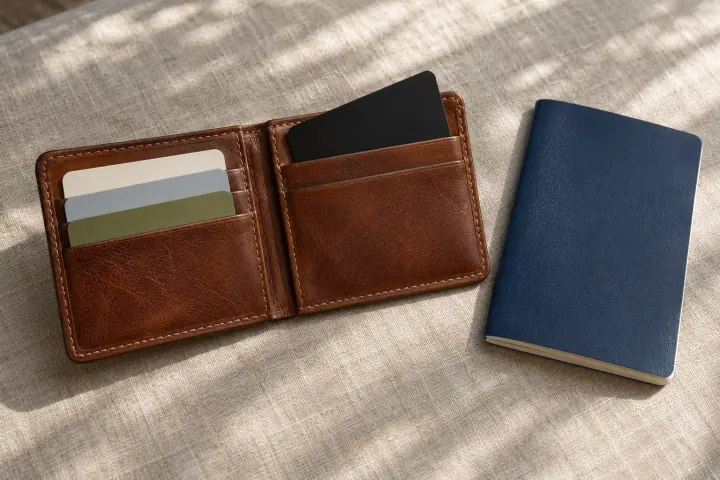
A card is flat like a bank card, so it works as a wallet tracker where a round tag would leave a bulge. The Tagsley Tracking Card is the one we've reviewed. The brand gives its thickness as 1.8 mm, about two credit cards, and says it recharges on a wireless charging pad and lasts up to 5 months per charge. It's built around one phone maker's finding network, so check our review for the phones it supports before you order.
| Item | Shape that fits | Where to put it | Tip |
|---|---|---|---|
| House and car keys | Tag | On the key ring | Name the tag after the keys in the app so you ring the right one |
| Wallet | Card | In a card slot | Turn on the left-behind alert, since wallets get left on counters and tables |
| Passport holder | Card | In the inside pocket | Charge it or check the battery before a trip |
| Backpack, purse or laptop bag | Tag or card | Clipped to an inner loop or in a zip pocket | Inside is better than outside, where a tag can snag |
| Checked suitcase | Tag or card | In an inner pocket | Check the airline battery rule further down before you fly |
| Carry-on | Tag or card | In the lid pocket | Useful when a full flight means your bag is checked at the gate |
Battery type and phone compatibility vary by model. Our reviews list both for each tracker.
Habits that stop keys and wallets from going missing
A tracker finds things. Good habits mean you need it less often. These cost nothing:

- Give everything a landing spot. Pick one tray, bowl or hook by the door, and put keys, wallet and sunglasses there every time you come home.
- Do a three-item check when you stand up. Phone, wallet, keys: say it before you leave a restaurant table, a rideshare or a waiting room.
- Slim the wallet down. The Federal Trade Commission (FTC) advises carrying only the cards you need, and keeping your PIN out of your wallet, purse or pocket. USAGov adds that your Social Security card belongs in a safe place at home, not in your wallet.
- Save the phone numbers now. The FTC suggests finding your card issuer's number on your statement or online account and saving it in your phone, so you can report a missing card in minutes.
- Write down your phone's ID number. The Federal Communications Commission (FCC) recommends noting the make, model, serial number and the IMEI or MEID, which are usually in the device settings. Police may ask for them if the phone is lost or stolen.
- Set up the tracker properly. Pair it the day it arrives, name it, switch on notifications and give the app the Bluetooth and location permissions it asks for.
How to find lost keys or a lost wallet
Before you assume the worst, work through the search in order.
- Ring the tracker if the item has one. Walk slowly from room to room with the app open, since the sound only plays while the tag is within range of your phone.
- No sound? Open the map and look at the last-seen location. It tells you whether the item is at home, in the car or back at the store.
- Retrace your last hour without a tracker: the pockets of the coat you wore, the bag you carried, the car seats and door pockets, the counter where you set the groceries down.
- Call the places you visited. Stores, restaurants and gyms keep lost-and-found items, and a clear description helps staff match the item to you.
- Lost it at an airport? The Transportation Security Administration (TSA) lists lost-and-found contacts for each airport's security checkpoint and holds items left there for a minimum of 30 days. For other parts of the airport, TSA says to contact the airport itself.
- If a wallet hasn't turned up after that search, stop looking and start protecting your accounts with the steps in the next section. A replacement card is a small hassle next to charges you were slow to report.
What to do if you lose your wallet, or your wallet is stolen
Speed matters here. The FTC's advice for lost or stolen cards is blunt: don't wait to report it. Work down this list the same day.
- Call or use the mobile app of each bank or credit union that issued a card in the wallet, and report the card lost or stolen. Start with debit and ATM cards, because your protection depends on how fast you report them.
- Follow up in writing. The FTC recommends a letter to the card issuer with your account number, when you noticed the card was missing and when you first reported it. Keep a copy, along with notes from your calls.
- Watch your statements. Check them often and report any charge you don't recognize by phone right away.
- Consider a credit freeze. The FTC says a freeze is free, doesn't affect your credit score and stays in place until you lift it. While it's on, nobody can open a new credit account in your name. You place it by contacting all three credit bureaus. The agency calls it especially helpful after a lost wallet.
- Replace your driver's license or state ID through your state motor vehicle agency, as USAGov directs.
- Replace the other cards that were inside. USAGov points to Social Security for a Social Security card, your Medicare account or 1-800-MEDICARE (1-800-633-4227) for a Medicare card, and your unit security officer for a military ID.
- If you see signs that someone is using your identity, such as bills for things you didn't buy or accounts you don't recognize, USAGov says to report it to the FTC at IdentityTheft.gov or 1-877-438-4338, which gives you a recovery plan.
| Card | When you report it | Your maximum loss |
|---|---|---|
| Credit card | Before anyone uses it | $0 |
| Credit card | After someone has used it | $50 |
| ATM or debit card | Before any unauthorized charges | $0 |
| ATM or debit card | Within 2 business days of learning it's gone | $50 |
| ATM or debit card | After 2 business days, but within 60 calendar days of your statement being sent | $500 |
| ATM or debit card | More than 60 calendar days after your statement is sent | All the money taken from the account, and possibly more |
Source: Federal Trade Commission, Lost or Stolen Credit, ATM, and Debit Cards.
Two more things from the FTC. Check whether your homeowner's or renter's insurance covers card theft. And if someone calls offering "credit card loss protection insurance" or claiming to be from your card company's security department, it's a scam: federal law already limits what you can owe.
Flying soon without your license? TSA says adult passengers must show valid identification at the checkpoint, and a passport is on its list of acceptable IDs. Since February 1, 2026, travelers who can't show an acceptable ID have the option to pay a $45 fee to use TSA ConfirmID, and TSA will then attempt to verify their identity.
How to find a lost phone
Your phone is the remote control for every tracker you own. The FCC's guidance for a missing device goes like this:
- Try to locate it. Call it, or sign in to your phone's built-in find-my service from another device to see it on a map and make it play a loud sound.
- Lock it remotely, even if you think you only misplaced it. The FCC says to lock it to be safe.
- Report the loss or theft to your service provider immediately. The FCC warns that you may be responsible for charges made to your account before you report it. Ask the provider to disable the device, and request written confirmation.
- If it was stolen, report the theft to the police with the make, model, serial number and IMEI or MEID. Some providers ask for proof of theft, and a police report provides it.
- If it isn't coming back, use the remote wipe to erase contacts, messages, photos and accounts.
All of this works only if the find, lock and erase features were switched on before the phone went missing, along with a strong passcode. Check them today.
Using a luggage tracker when you fly
A luggage tracker tells you where your bag is while you talk to the airline. Drop a tag or card in an inner pocket of each checked bag and your carry-on.
The Federal Aviation Administration (FAA) covers these devices in its PackSafe pages. Baggage location trackers powered by lithium batteries are allowed in checked baggage when the battery is small: a lithium metal battery with no more than 0.3 grams of lithium, or a lithium-ion battery rated at no more than 2.7 watt-hours. The FAA also says to check with your airline before traveling with one, and notes that rules on international flights may differ.
Spare batteries are a different matter. The FAA says spare lithium batteries must go in carry-on baggage only, so a spare coin cell for your tag travels in the cabin with you.
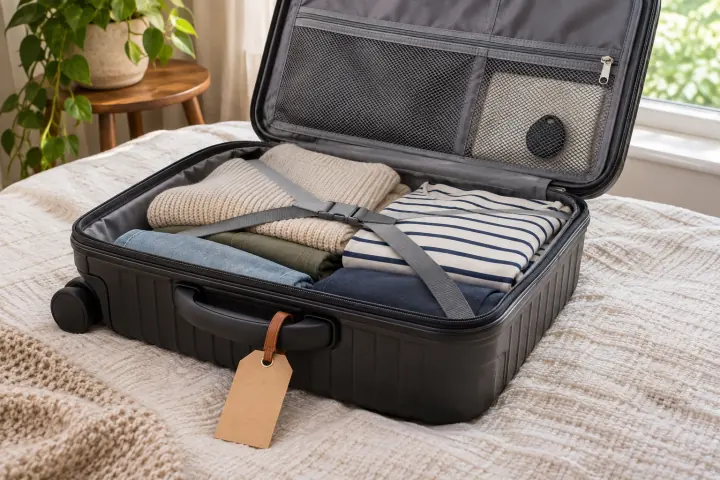
- Label the bag. The US Department of Transportation (DOT) says to make sure checked baggage carries your name, phone number and email address. Put a second label inside in case the outside one tears off.
- Photograph the bag and its contents before you close it. Airlines may ask for receipts or other proof for valuable items, and a photo makes the bag easy to describe.
- Keep valuables and essentials with you. The DOT lists cash, cards, jewelry, medicine, keys, passports and eyeglasses among the things to pack in a carry-on.
- Check in early. The DOT warns that if you check in at the last minute, your bag may miss the flight even if you make it.
- Hold on to the bag identification tag the airline gives you for each bag until you have your luggage back.
- Choose nonstop flights when you can. By the DOT's ranking, a nonstop is the safest for bags, and a connection that changes both aircraft and airline is the riskiest.
Lost luggage and delayed baggage compensation: what airlines owe you
The carousel has stopped and your suitcase isn't on it. The DOT says the airline is responsible for locating the bag, and that almost all delayed bags turn up eventually. Here's what to do meanwhile:
- Go to the airline's baggage desk and file a claim before you leave the airport. The DOT's advice is to file as soon as possible, insist that a report is created, and note the date, the time and the name of the person you dealt with.
- Tell the agent where your luggage tracker shows the bag. It's one more clue for the airline's own tracking system.
- Keep receipts for what you have to buy while you wait. The DOT says airlines must compensate passengers for reasonable, verifiable and actual incidental expenses during a delay, up to the liability limits, and can't cap it at an arbitrary daily amount.
- Ask for your bag fee back if the delay is long. You're entitled to a refund of the checked bag fee when the bag is significantly delayed: not delivered within 12 hours of arrival on a domestic flight, or within 15 hours on an international flight of 12 hours or less and 30 hours on a longer one. You need a mishandled baggage report on file to get it.
- Stay in touch with the airline. The DOT says most airlines declare a bag lost between 5 and 14 days after the flight.
- If the bag is declared lost, claim the value of what was inside. The airline owes you compensation for the contents, subject to depreciation and the limits below, plus a refund of the bag fee.
The limits: on domestic flights, the DOT's rule lets airlines cap their liability at $4,700 per passenger. On most international flights, the Montreal Convention sets the cap at 1,519 Special Drawing Rights, about $2,175, per passenger. Airlines also often exclude fragile items, electronics and cash on domestic trips, which is one more reason to keep valuables in your carry-on.
Open your bag at the carousel if it arrives unlocked or damaged, and report missing or broken items before you leave the airport. For items that go missing from a checked bag during security screening, TSA has its own claims process.
When to call the bank, the airline or the police
Some losses can wait until you've checked the car one more time. These can't:
- Call the bank right away if a wallet with a debit or credit card is missing and a quick search doesn't find it, or the moment you see a charge you didn't make.
- See the airline's baggage desk before you leave the airport if a checked bag doesn't arrive, or arrives open or damaged.
- Call your phone's service provider as soon as you know the phone is lost or stolen, so charges stop being your responsibility.
- Call the police if your phone or wallet was stolen. For a phone, the FCC notes that a police report gives you the proof of theft some service providers ask for.
- Report a lost or stolen passport to the State Department right away, online, by mail or at 1-877-487-2778, as USAGov explains. A reported passport is invalidated and can't be used even if you find it later, and you apply for the replacement in person. Abroad, contact the nearest US embassy or consulate.
- Go to IdentityTheft.gov if unfamiliar accounts or bills start to appear after a loss.
And if your tracker's map shows a stolen item at an address you don't know, give that information to the police with your report.
Trackers we've reviewed

iTagPro review
People who misplace keys, wallets and bags, and travelers who want a small tag on their luggage without paying a monthly fee. From $32.99.
Read the review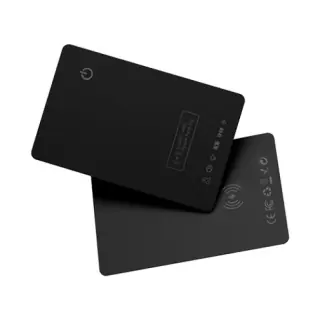
Tagsley review
iPhone owners who want a tracker that lies flat in a wallet, passport holder or luggage pocket, and families who'd like one card per wallet. From $29.99.
Read the review
FAQ
How does a key finder work?
It's a small Bluetooth tracker paired with your phone. Within range, you ring it from the finding app. Out of range, the app shows where it was last seen, and trackers that join a phone's built-in finding network can be located when other phones pass nearby.
What is the best tracker for keys, and what works as a wallet tracker?
Match the shape to the item. A tag with a keyring hole, like the iTagPro Bluetooth Tracker, suits keys and bags. A flat card, like the Tagsley Tracking Card, slides into a wallet's card slot or a passport holder.
What should you do if you lose your wallet?
Report every card to its bank or credit union the same day, follow up in writing and watch your statements. The FTC also suggests a free credit freeze. Then replace your driver's license through your state motor vehicle agency.
Can you put a luggage tracker in a checked bag?
Yes, when its battery is small. The FAA allows baggage trackers in checked bags with a lithium metal battery of up to 0.3 grams of lithium, or a lithium-ion battery of up to 2.7 watt-hours, and says to check with your airline before traveling.
How much is delayed baggage compensation?
Airlines must cover reasonable, verifiable expenses caused by the delay, the DOT says, up to their liability limit: $4,700 per passenger on domestic flights and about $2,175 on most international ones. A bag fee is refunded when the delay passes 12 hours on a domestic flight.
How do you find a lost phone?
Call it, then use your phone's built-in find-my service from another device to see it on a map, play a sound and lock it. The FCC says to report the loss to your service provider immediately, and to the police if it was stolen.
Sources
- Lost, Delayed, or Damaged Baggage, US Department of Transportation (updated October 29, 2025)
- PackSafe: Baggage Equipped with Lithium Batteries (smart bags and baggage location trackers), Federal Aviation Administration (updated April 13, 2026)
- PackSafe: Lithium Batteries, Federal Aviation Administration (updated August 11, 2026)
- Airline Passengers and Batteries, Federal Aviation Administration
- Lost or Stolen Credit, ATM, and Debit Cards, Federal Trade Commission Consumer Advice
- Get a credit freeze to stop identity thieves, Federal Trade Commission Consumer Alert (September 2025)
- Protect Your Smart Device, Federal Communications Commission (reviewed November 25, 2025)
- How to replace lost or stolen ID cards, USAGov
- Lost or stolen passports, USAGov
- Identity theft, USAGov
- Lost and Found, Transportation Security Administration
- Acceptable Identification at the TSA Checkpoint, Transportation Security Administration
This guide is general information, not legal or financial advice. Card protections, airline rules and battery limits can change, so confirm the details with your bank, your airline and the official pages listed in the sources.