
Mushrooms
Lion's Mane Benefits: What the Research Says About Memory, Mood and Safety
Lion's mane benefits are promising but unproven: a handful of small human trials suggest the mushroom may modestly help memory and mood, while most other claims come from lab and animal studies. Below is what each trial found and how big it was, the side effects reported so far, and what to know before buying a supplement, a powder or a lion's mane coffee.

What is lion's mane mushroom?
Lion's mane mushroom (Hericium erinaceus) is an edible mushroom that grows on dead hardwood trees. Its long white spines dangle downward, which is where the name comes from. Memorial Sloan Kettering Cancer Center (MSK) notes it also goes by yamabushitake, monkey head mushroom and pom pom mushroom, among other names.
It has been eaten for a very long time. LiverTox, the National Institutes of Health's database on supplements and the liver, describes lion's mane as an edible mushroom found most abundantly in East Asia that has been used widely as a food and in traditional Chinese medicine. More recently, LiverTox adds, it has been purported to improve cognition and relieve anxiety and depression. That newer reputation is what fills store shelves with capsules, powders, gummies and coffee blends.
Researchers are mostly interested in two groups of compounds: hericenones, from the fruiting body (the part you'd cook), and erinacines, from the mycelium, the root-like network the mushroom grows from. In lab studies, both prompt cells to make nerve growth factor, a protein that helps nerve cells grow and survive. That finding is the root of nearly every brain claim you'll read on a label.
What does lion's mane do? The benefits at a glance
A 2025 systematic review gathered the published research on lion's mane as a supplement. It found five randomized controlled trials and three pilot trials in people, next to 15 laboratory studies. The human trials were small, with between 13 and 77 participants each, and short, mostly a few weeks to a few months.
MSK's summary for health professionals is that limited clinical data suggest lion's mane may improve memory and mood in certain groups. Here's how the main claims line up against that evidence.
| Claimed benefit | Evidence in people | How strong it is |
|---|---|---|
| Memory in older adults with mild cognitive impairment | One trial in 30 adults aged 50 to 80: better scores than placebo at 8, 12 and 16 weeks | Small and never repeated at scale |
| Memory in mild Alzheimer's disease | One 49-week pilot trial of an erinacine-enriched mycelium product: better scores than placebo on some tests | A pilot study |
| Focus in healthy young adults | One pilot trial in 41 adults: faster on one attention task an hour after a single dose, with null results on other measures | Small and mixed |
| Mood, stress and anxiety | One 4-week trial in 30 women, and a trend toward lower stress in the 41-adult pilot | Small and preliminary |
| Nerve repair | Cell and animal studies only | Not tested in people |
| Cancer | Lab studies only | No human studies show an anti-cancer effect, MSK says |
Sources: the trials and reviews listed at the end of this guide, each with its PubMed record.
A second review, published in 2024, looked at mushrooms in general. Its authors found 10 intervention studies on mood and thinking, mainly of lion's mane, and called the results mixed, with some enhancement of mood and cognitive function in middle-aged and older adults. They asked for trials with adequate sample sizes. That review was funded by a grant from a mushroom industry council, which the authors disclose.
Lion's mane for memory and focus
The study behind most memory claims is from Japan, published in 2009. Thirty men and women aged 50 to 80 with mild cognitive impairment were split into two groups of 15. One group took tablets of dried lion's mane powder three times a day for 16 weeks, and the other took a placebo. The mushroom group scored significantly higher on a cognitive function scale at weeks 8, 12 and 16. Four weeks after they stopped, their scores dropped again. Lab tests showed no adverse effects.
Two things stand out. The benefit seemed to depend on continued use, and the trial had 15 people per group, which is too few to settle anything. It also came from a mushroom company's laboratory, a common situation in supplement research that's worth knowing about.
Later trials point the same way without closing the question. A 12-week trial in Japan reported improved scores on a standard memory screening test, though not on its two other tests, in adults taking a fruiting body supplement, and a 49-week pilot study in Taiwan reported better cognitive scores in people with mild Alzheimer's disease who took an erinacine-enriched mycelium product. When the 2025 review combined two of the studies that used the same screening test, a 30-point scale, the average gain in the lion's mane groups was about 1 point (1.17).
What about healthy younger people who want sharper focus? A 2023 pilot trial in the United Kingdom gave 41 adults aged 18 to 45 either 1.8 grams of lion's mane or a placebo daily for 28 days. An hour after the first dose, the lion's mane group was quicker on one attention task. The authors also reported null and limited negative findings on other measures, and wrote that the results should be interpreted with caution given the small sample.
Lion's mane for ADHD is a popular search, but when we searched PubMed on November 13, 2026, we found a single laboratory and computer-modeling study, and no trial in people. If you take ADHD medication, don't swap it for a mushroom supplement. Talk to your prescriber about anything you'd like to add.
Lion's mane for mood, stress and anxiety
The best-known mood study, from 2010, randomly assigned 30 women to eat cookies containing lion's mane or placebo cookies for four weeks. Scores on a depression scale and on a scale of general complaints were lower after the lion's mane cookies than before, and a few individual items, including feeling anxious and irritated, tended to be lower than in the placebo group. The authors' own wording was careful: lion's mane intake "has the possibility" to reduce depression and anxiety.
In the 2023 pilot trial in young adults, 28 days of supplementation produced a trend toward lower self-rated stress that fell just short of statistical significance.
So the fair reading is that lion's mane may help some people feel a little calmer, and that no trial has tested it as a treatment for depression or an anxiety disorder. If low mood or worry is getting in the way of your days, see a doctor or therapist first.
Claims that haven't been tested in people
A lot of lion's mane marketing leans on findings from cells and animals. They're real findings, and they're a starting point rather than proof.
- Nerve regeneration. A 2026 systematic review of mushrooms for peripheral nerve injury found 11 studies in cells and animals, five of them on lion's mane, and concluded that these approaches still need clinical research.
- Neuroprotection. A 2025 systematic review of erinacines covered only cell and rodent models. It reported benefits for movement, memory and depression-like behavior in animals.
- Cancer. Lion's mane has slowed the growth of cancer cells in the lab, but MSK states plainly that there are no studies in humans that show it has anti-cancer effects.
- Gut health. Most of this work is in the lab, though MSK notes that clinical findings suggest lion's mane may increase the diversity of the gut microbiome.
Lots of substances look impressive in a dish and do little in a person. Until human trials exist, treat these as open questions.
Lion's mane side effects: is it safe?
As a food, lion's mane has a long record. MSK says it's generally safe to use in food and tea. LiverTox describes it as generally recognized as safe and reports that it hasn't been linked to liver enzyme elevations or to episodes of clinically apparent liver injury.
Supplements are more concentrated, and their side effects are less well documented. What has been reported so far:
- Abdominal discomfort, nausea and skin rash, the side effects MSK lists. In the 49-week Alzheimer's pilot, four participants dropped out because of them.
- Stomach discomfort, headache and allergic reactions, which the 2025 systematic review names as possible side effects, adding that they're rarely reported.
- Unknowns from thin data. The human trials were small and mostly short, so rare or long-term effects could easily have been missed.
Talk to your doctor before taking a lion's mane supplement if you take any medication, have a medical condition, are scheduled for surgery, or are pregnant or breastfeeding. The National Center for Complementary and Integrative Health (NCCIH) notes that dietary supplements may interact with medications or pose risks with certain medical problems, and that many haven't been tested in pregnant women, nursing mothers or children. If you're allergic to mushrooms, skip it.
Lion's mane supplement, powder or food: what to know before you buy
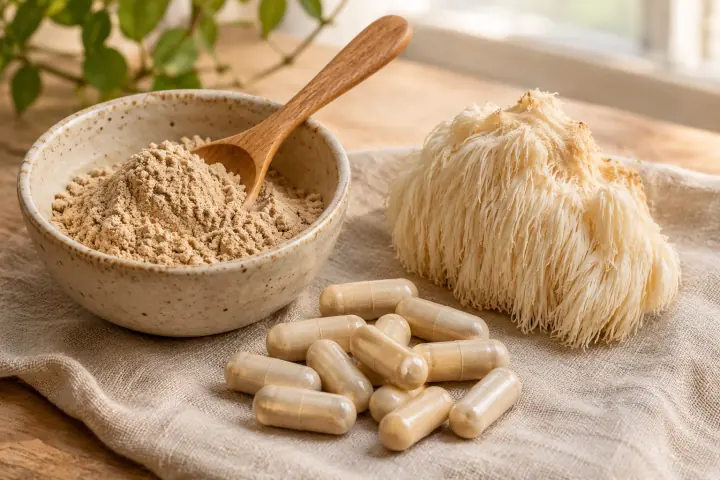
Lion's mane supplements come as capsules, powders and liquid extracts. Before you pay for one, keep four things in mind.
First, nobody checks the claims in advance. The NCCIH explains that the FDA isn't authorized to review dietary supplements for safety and effectiveness before they're marketed, and that words like "standardized," "verified" or "certified" on a label don't necessarily guarantee quality or consistency.
Second, products differ. Some use the fruiting body, some the mycelium and some both, and the trials did too. A result from one kind of product doesn't automatically carry over to another.
Third, there's no official dose. The trials used amounts ranging from about 1 to a little over 3 grams of dried powder a day, and none of them was designed to find the best amount. Follow the label on the product you choose, as the NCCIH advises for any supplement, and don't exceed it.
Fourth, give it a fair but limited trial. In the 16-week Japanese study, the difference from placebo showed up at the 8-week check, so if you notice nothing after a couple of months, it's reasonable to stop. If you get side effects, the NCCIH's advice is to stop taking the supplement and contact your health care provider.
Lion's mane coffee and tea
Lion's mane coffee is regular coffee blended with powdered mushroom or mushroom extract, and lion's mane tea is the dried mushroom or its powder steeped in hot water. No trial has tested either drink. The studies above used tablets, capsules, powders or, in one case, cookies.
Blends often don't say how much mushroom is in a serving, so you can't compare your cup with the amounts used in research. And if a lion's mane coffee makes you feel sharper, remember that the caffeine is doing well-documented work of its own. We go through lion's mane, reishi, chaga and cordyceps blends in our guide to mushroom coffee benefits.

A note on the products we've reviewed, so nobody is misled: none of our reviews covers a lion's mane product. The three coffee products we've reviewed are built for a different purpose. Akemi Coffee Boost is a flavorless sachet with green tea extract, green coffee bean extract and fibers. Slimqa is a coffee blend with L-carnitine, green coffee extract and capsicum. Bryo is an instant coffee with berberine, L-carnitine and garcinia. All three are sold by their brands with appetite or metabolism claims, and none contains lion's mane or any other mushroom. They belong here only if what you're really after is a simple daily coffee routine rather than this particular mushroom.
Eating lion's mane as food
The lowest-risk way to try lion's mane is to eat it. MSK notes that it's used in East Asian cuisine and eaten raw, dried or cooked. If you find it fresh, it looks like a white, shaggy ball.
Most cooks slice or tear it into thick pieces and brown it in a hot pan with a little butter or oil until the edges turn golden. Eaten this way it's simply a mushroom: a pleasant food, with no promise attached and no research dose to chase.

When to see a doctor
Many people look into lion's mane because they're worried about their memory. Some forgetfulness is a normal part of aging, the National Institute on Aging (NIA) says, but it lists these signs that it might be time to talk with a doctor:
- Asking the same questions over and over again
- Getting lost in places you used to know well
- Having trouble following recipes or directions
- Becoming more confused about time, people and places
- Not taking care of yourself: eating poorly, not bathing or behaving unsafely
A doctor can run tests to find the source of memory problems, and some causes are treatable. A supplement shouldn't delay that visit, and it shouldn't replace any medicine you've been prescribed.
Also see a doctor if you feel depressed for weeks at a time, or if a supplement gives you a rash, stomach pain or nausea that doesn't settle after you stop it. Call 911 for signs of a severe allergic reaction: difficulty breathing or swallowing, swelling of the face, eyes or tongue, hives all over, or dizziness. MedlinePlus says not to wait to see if a severe reaction gets worse.
FAQ
What are the benefits of lion's mane?
The best-supported possible benefits are modest improvements in memory and mood, seen in a few small trials of 13 to 77 people. Claims about nerve repair, cancer and immunity come from lab and animal studies and haven't been confirmed in people.
Does lion's mane work for memory?
It may help a little. In a 16-week trial of 30 older adults with mild cognitive impairment, those taking lion's mane scored better than the placebo group, and the gain faded after they stopped. Larger trials are needed before anyone can say it works.
What are the side effects of lion's mane?
The ones reported so far are abdominal discomfort, nausea, skin rash, headache and allergic reactions. They appear to be uncommon, but the trials were small and short, so the full picture isn't known.
Is lion's mane safe to take every day?
As a food it's generally considered safe. Trials of daily supplements lasted from a few weeks to 49 weeks and reported mostly mild side effects, and the NIH's LiverTox database reports no link to liver injury. Longer-term safety hasn't been studied, so check with your doctor if you take medication, have a health condition, or are pregnant or breastfeeding.
How long does lion's mane take to work?
Nobody knows for sure. In the best-known trial, a difference from placebo appeared at the 8-week check and grew through week 16. A pilot study in young adults saw a faster result on one attention task an hour after a single dose, but other measures didn't change.
Is lion's mane coffee good for you?
The coffee part has well-studied effects. The lion's mane part hasn't been tested in coffee, and blends rarely say how much they contain. Our mushroom coffee guide covers what's known about these blends.
Sources
- Lion's Mane, LiverTox (National Institute of Diabetes and Digestive and Kidney Diseases), PubMed record
- Lion's Mane Mushroom, About Herbs, Memorial Sloan Kettering Cancer Center (2025)
- Benefits, side effects, and uses of Hericium erinaceus as a supplement: a systematic review, Front Nutr (2025), PubMed
- A review of the effects of mushrooms on mood and neurocognitive health across the lifespan, Neurosci Biobehav Rev (2024), PubMed
- Improving effects of the mushroom Yamabushitake (Hericium erinaceus) on mild cognitive impairment: a double-blind placebo-controlled clinical trial, Phytother Res (2009), PubMed
- Improvement of cognitive functions by oral intake of Hericium erinaceus, Biomed Res (2019), PubMed
- Prevention of Early Alzheimer's Disease by Erinacine A-Enriched Hericium erinaceus Mycelia Pilot Double-Blind Placebo-Controlled Study, Front Aging Neurosci (2020), PubMed
- The Acute and Chronic Effects of Lion's Mane Mushroom Supplementation on Cognitive Function, Stress and Mood in Young Adults: A Double-Blind, Parallel Groups, Pilot Study, Nutrients (2023), PubMed
- Reduction of depression and anxiety by 4 weeks Hericium erinaceus intake, Biomed Res (2010), PubMed
- Application of Medicinal Mushrooms for the Treatment of Peripheral Nerve Injury: A Systematic Review, Med Sci (2026), PubMed
- Unveiling the role of erinacines in the neuroprotective effects of Hericium erinaceus: a systematic review in preclinical models, Front Pharmacol (2025), PubMed
- Phytoconstituents of Hericium erinaceus Exert Benefits for ADHD Conditions by Targeting SLC6A4 (laboratory and computational study), ACS Omega (2025), PubMed
- Using Dietary Supplements Wisely, National Center for Complementary and Integrative Health
- Memory Problems, Forgetfulness, and Aging, National Institute on Aging
- Allergic reactions, MedlinePlus Medical Encyclopedia, National Library of Medicine
This guide is general information, not medical advice. Lion's mane isn't a treatment for memory loss, dementia, ADHD, depression, anxiety or any other condition. Talk to your doctor before taking a supplement, especially if you take medication, have a health condition, or are pregnant or breastfeeding.