
Kitchen
How to Clean a Wooden Cutting Board, Sanitize It and Oil It
To clean a wooden cutting board, scrub it with hot, soapy water right after each use, rinse it with clear water and let it air-dry, ideally standing on its edge. Here's how to sanitize it after raw meat, how to oil it, and what the research says about wood, plastic and titanium boards.
How to clean a wooden cutting board after every use
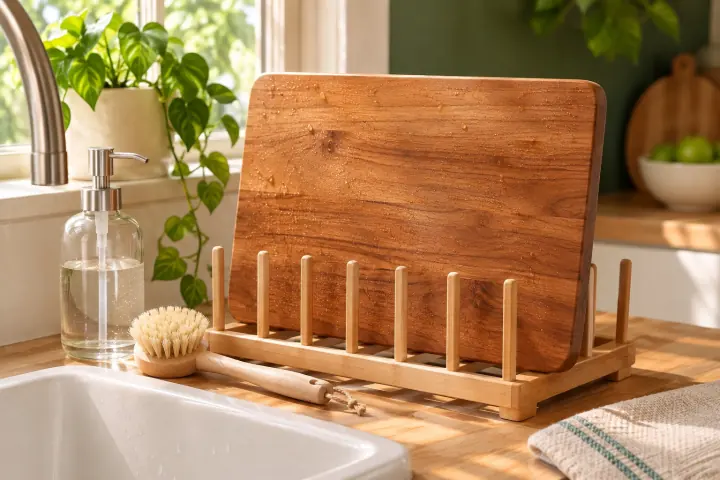
USDA's Meat and Poultry Hotline gives the same daily routine for every cutting board: wash it with hot, soapy water after each use, rinse it with clear water, then air-dry it or pat it dry with clean paper towels. With wood, a few details make that routine work better.
- Scrape food scraps into the trash or compost with the back of a knife or a bench scraper.
- Scrub both sides with hot, soapy water. NDSU Extension recommends using a brush after you've cut meat or poultry.
- Don't leave it soaking in the sink. Wood is porous and draws liquid in, as a food safety review explains, so wash it promptly and take it out of the water.
- Rinse it with clear water.
- Dry it standing on its edge, or pat it dry with a clean paper towel first, so air reaches both sides.
- Wipe down the counter where the board sat, especially after raw meat.
Can it go in the dishwasher? USDA says solid wood boards can, but laminated boards, the kind glued together from strips, may crack and split. Look at the end of your board: if you can see separate strips, it's laminated, so wash it by hand.
How to sanitize a wooden cutting board
Washing removes food residue. Sanitizing is the extra step after raw meat, poultry or seafood, or whenever the board needs a deeper clean. USDA says both wooden and plastic boards can be sanitized with a solution of 1 tablespoon of unscented liquid chlorine bleach per gallon of water.
- Wash and rinse the board first, as above.
- Mix 1 tablespoon of unscented liquid chlorine bleach into 1 gallon of water. For a spray bottle, NDSU Extension's smaller batch is 1 scant teaspoon of bleach per quart of water.
- Flood the surface with the solution and let it stand for several minutes.
- Rinse with clear water, then air-dry or pat dry with clean paper towels.
Use plain bleach and water only. Never add vinegar or another cleaner to the mix: bleach combined with acids or ammonia releases toxic gases, as we explain in our guide on how to remove a toilet bowl ring safely.
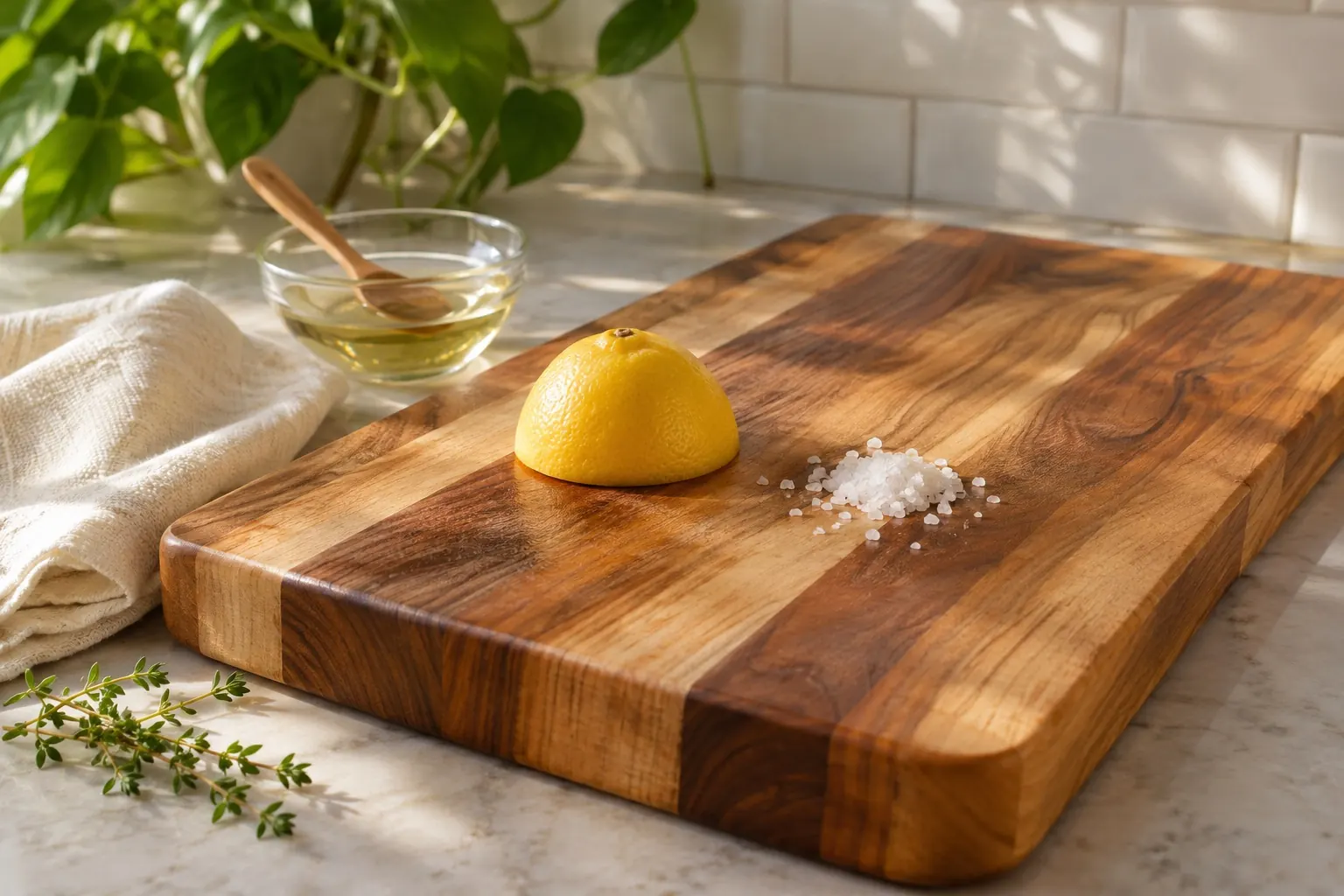
What about lemon and salt? Rubbing the board with half a lemon and coarse salt is a popular way to scrub away smells and light stains. It isn't part of USDA's sanitizing advice, so treat it as a freshening step, not a stand-in for the bleach solution after raw meat.
How to clean a cutting board of any material
The daily routine is the same for every board: hot, soapy water after each use, a rinse and a good dry. What changes is the dishwasher question and the sign that a board is wearing out.
| Board | Everyday cleaning | Dishwasher | Watch for |
|---|---|---|---|
| Solid wood | Hot, soapy water, rinse, air-dry | USDA says yes for solid wood | Wood that looks pale and dry (time to oil); deep cracks |
| Laminated wood (glued strips) | Hot, soapy water, rinse, air-dry | No: USDA says it may crack and split | Gaps opening between the strips |
| Bamboo | Hot, soapy water; sanitize if you like | Check the maker's instructions | USDA says it's harder and less porous than hardwood; rub with mineral oil |
| Plastic | Hot, soapy water | Yes, per USDA | Deep knife grooves that are hard to clean |
| Glass and other nonporous boards | Hot, soapy water | Glass: yes, per USDA; others: check the label | Easier to clean than wood, according to USDA |
| Titanium or other metal | Warm, soapy water, as the brands advise | Check the maker's instructions | No independent research yet |
USDA says the diluted bleach solution works for sanitizing both wood and plastic boards.
How to oil a cutting board
Oil doesn't make a board cleaner. In a University of Wisconsin study, treating the wood surface with mineral oil had little effect on how bacteria behaved on it. What oil does is help the wood hold its moisture, which is why USDA suggests rubbing bamboo boards with mineral oil and Nebraska Extension specifies food-grade mineral oil.
- Start with a clean board that's completely dry.
- Pour a small amount of food-grade mineral oil onto the surface.
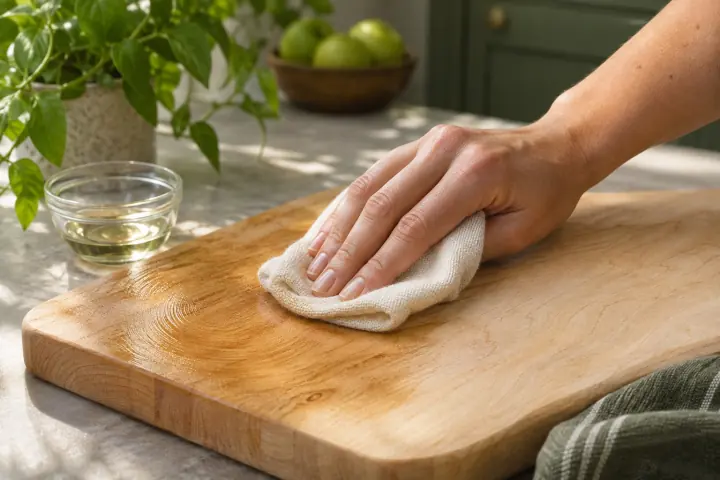
- Spread it with a clean, soft cloth, working along the grain, and treat the edges and underside too.
- Let it soak in, overnight if you can, with the board standing on its edge.
- Wipe off any oil still sitting on the surface.
- Repeat whenever the wood looks pale or dry. A new board, or one that has been through a lot of washing, may need a few coats at first.
Which oil is best? Buy oil sold as food-grade mineral oil, the type USDA and Nebraska Extension name, and check that the label says it's safe for food contact.
Wood vs plastic cutting board: which is safer?
USDA's answer is that you can use either. Its Meat and Poultry Hotline says wood or a nonporous surface such as plastic is fine for raw meat and poultry, and notes that nonporous surfaces are easier to clean than wood.
The research is more interesting than the old 'plastic is more hygienic' rule. In the University of Wisconsin study, bacteria placed on plastic were easy to recover for minutes to hours and multiplied if left overnight, while recoveries from wood were generally lower, whether the board was new or used. At the levels likely to come from raw meat, bacteria generally couldn't be recovered once they had soaked into the wood, and the authors concluded their results don't support the idea that plastic boards are more sanitary. A 2025 study from Freie Universität Berlin found E. coli on maple boards fell to the detection limit within two hours, even without cleaning, and found higher detection rates overall on polyethylene boards.
Each material has a weak spot. A review in the Journal of AOAC International notes that knife-scarred plastic can be very difficult to clean and disinfect, and that the most common commercial plastic tends to fray under knife cuts. Wood is porous, so juices are drawn in, though in that review the bacteria drawn into the wood didn't return to the surface, and no study had shown knives bringing them back out.
Knives matter too. NDSU Extension notes that chefs find plastic boards dull knives more quickly, while hardwoods such as maple are less likely to. Its bottom line: wood boards cleaned thoroughly right away are safe to use.
| Wood | Plastic | |
|---|---|---|
| Daily cleaning | Hot, soapy water by hand | Hot, soapy water or the dishwasher |
| Bacteria in lab studies | Generally fewer recovered from the surface | Readily recovered; knife grooves are hard to clean |
| Knives | Easier on edges, especially maple | Dulls knives faster, chefs report |
| Microplastics | None from the board | Released during chopping in a 2023 lab study |
| Upkeep | Oil when it looks dry | Replace when grooved |
Sources: USDA, NDSU Extension and the studies listed below.
Do plastic cutting boards shed microplastics?
Yes, in lab tests. A 2023 study from North Dakota State University chopped on polyethylene and polypropylene boards and measured what came off. Polypropylene boards released 5% to 60% more microplastic by mass than polyethylene ones. Based on its assumptions about how people chop, the team estimated a person could be exposed to 7.4 to 50.7 grams of microplastics a year from a polyethylene board and 49.5 grams from a polypropylene one, and called plastic boards a substantial source of microplastics in food. A preliminary test of the polyethylene particles on mouse cells found no effect on cell survival over 72 hours.
A 2025 study in mice went a step further. The mice ate food cut on polypropylene, polyethylene or willow wood boards for up to 12 weeks. Those fed food from polypropylene boards showed signs of gut inflammation and a weaker intestinal barrier compared with the wood group, while those on polyethylene boards showed changes in gut bacteria and metabolism instead.
These are lab and animal studies, so what the exposure means for people isn't known yet. If you'd like to cut down anyway, the simplest steps are doing most of your chopping on wood or another non-plastic board and replacing plastic boards once they're scratched and grooved.
Is a titanium cutting board safe?
Titanium boards are the newest option, sold mainly on two promises: no plastic to shed, and a non-porous surface that rinses clean. The first follows from the material, since a solid metal board contains no plastic. The second fits USDA's general point that nonporous surfaces are easier to clean than wood.
Beyond that, there's no research to lean on yet. We searched PubMed and found no published study of titanium cutting boards, so claims about bacteria, knife wear and durability come from the brands. Clean one like any other board: hot, soapy water after each use, and the USDA bleach solution after raw meat if the maker's instructions allow it.
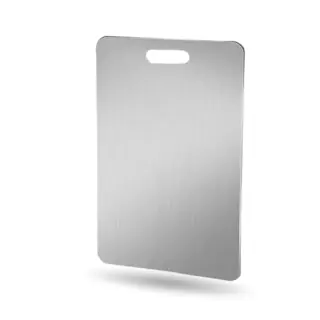
If getting plastic off your counter is the goal, we reviewed the Katori titanium cutting board. The brand says it's pure titanium with two usable sides, one for raw food and one for cooked, and lists it as dishwasher-safe and gentle on knives. It doesn't publish lab tests for its antibacterial claim.
When to replace a cutting board
USDA says all plastic and wooden boards wear out over time and should be thrown away once they're excessively worn or develop hard-to-clean grooves. NDSU Extension suggests a quick check each time you reach for one: does it have grooves that are difficult to clean? Signs it's time:
- Deep knife grooves or scratches you can't scrub clean
- Cracks or splits in the wood, or gaps opening between glued strips
- Mold that comes back after scrubbing and sanitizing, or that sits down in cracks
- A plastic board that has gone fuzzy or frayed from knife marks
Use separate boards for raw meat and produce
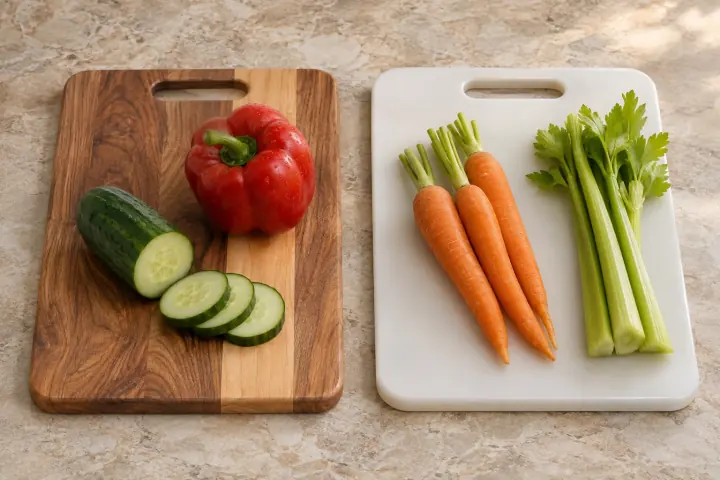
USDA suggests one board for fresh produce and bread and a separate one for raw meat, poultry and seafood, so bacteria from raw meat can't reach food that won't be cooked. NDSU Extension adds a simple system: color-code them, such as red for meat and green for produce, and make sure everyone in the house knows which is which.
Rinse fruit and vegetables before they reach the board, too. Our guide on how to clean strawberries and other produce walks through it.
When to see a doctor
Cross-contamination in the kitchen is one way food poisoning starts. CDC says to see a doctor for:
- Bloody diarrhea
- Diarrhea lasting more than 3 days
- A fever higher than 102°F
- Vomiting so often that liquids won't stay down
- Signs of dehydration: peeing very little, a dry mouth and throat, or dizziness when standing up
Pregnant women with a fever and flu-like symptoms should call their doctor, CDC advises. Young children, older adults and people with chronic illnesses should get medical advice early rather than waiting.
Cutting board we've reviewed
FAQ
Can you put a wooden cutting board in the dishwasher?
USDA says solid wood boards can go in the dishwasher, but laminated boards, glued together from strips, may crack and split. If you can see strips at the end of your board, wash it by hand.
How do you sanitize a wooden cutting board?
Wash and rinse it, then flood the surface with 1 tablespoon of unscented liquid chlorine bleach per gallon of water and let it stand for several minutes, as USDA advises. Rinse with clear water and let it dry.
What oil is best for a cutting board?
Food-grade mineral oil, the type USDA and Nebraska Extension name. Oiling keeps the wood from drying out, but it isn't a sanitizer: a University of Wisconsin study found mineral oil had little effect on bacteria on wood.
How often should you oil a cutting board?
There's no official schedule. Oil it when the wood looks pale or dry, and expect a new board or one that gets washed a lot to need oil more often.
Is wood or plastic better for raw meat?
USDA says either is fine. What matters more is using a separate board for raw meat, washing it right after use and sanitizing it with the diluted bleach solution.
Are titanium cutting boards safe?
We found no published study of titanium cutting boards. A solid metal board has no plastic to shed, and nonporous surfaces are easier to clean, according to USDA, but claims about bacteria and knife wear come from the brands.
Sources
- Cutting Boards, USDA Food Safety and Inspection Service
- Prairie Fare: Say Goodbye to Old Cutting Boards, NDSU Extension
- Charcuterie Boards and Food Safety, Nebraska Extension
- Cutting Boards of Plastic and Wood Contaminated Experimentally with Bacteria, J Food Prot (1994), PubMed
- Cutting boards in Salmonella cross-contamination, J AOAC Int (2006), PubMed
- Hygienic Evaluation of Wooden Cutting Boards: Microbiological Parameters, J Food Prot (2025), PubMed
- Cutting Boards: An Overlooked Source of Microplastics in Human Food?, Environ Sci Technol (2023), PubMed
- Simulated Microplastic Release from Cutting Boards and Evaluation of Intestinal Inflammation and Gut Microbiota in Mice, Environ Health Perspect (2025), PubMed
- Symptoms of Food Poisoning, Centers for Disease Control and Prevention
This guide is general information. Follow the label of any cleaning product, never mix cleaners, and keep them away from children and pets.