
Tools & yard
How to Sharpen a Chainsaw by Hand, Step by Step
Here's how to sharpen a chainsaw: switch it off, clamp the bar, set the chain brake and file every cutter at the same angle with the same number of strokes, then check the depth gauges. Below are the signs of a dull chain, each step in order, the tools that make it easier and the safety gear the job calls for.
Signs your chainsaw chain is dull
A sharp chain pulls itself into the wood and throws out chips. A dull one makes you do the work. A University of Hawaii extension publication on chain saw operation and maintenance lists the classic signs:
- Fine sawdust instead of chips. This is the easiest one to spot.
- Chain chatter, where the saw rattles and bounces instead of biting.
- An overheated bar.
- Curved cuts, where the saw wanders instead of cutting straight.
- You have to push. If you're leaning on the saw to make it cut, the chain needs attention.
Don't keep forcing it. The same publication warns that forcing a dull chain can damage the chain, bar, sprocket and clutch. Penn State Extension adds that a dull chain needs more force to cut and is more likely to cause kickback, and Clemson Extension notes that a dull or unevenly filed chain tires you out and can make the saw skip.
Chainsaw sharpeners: the two main ways to sharpen at home
Most homeowners sharpen with one of two kinds of tool. Both work on the chain while it stays on the bar, and both aim for the same result: every cutter ground to the same angle and length.
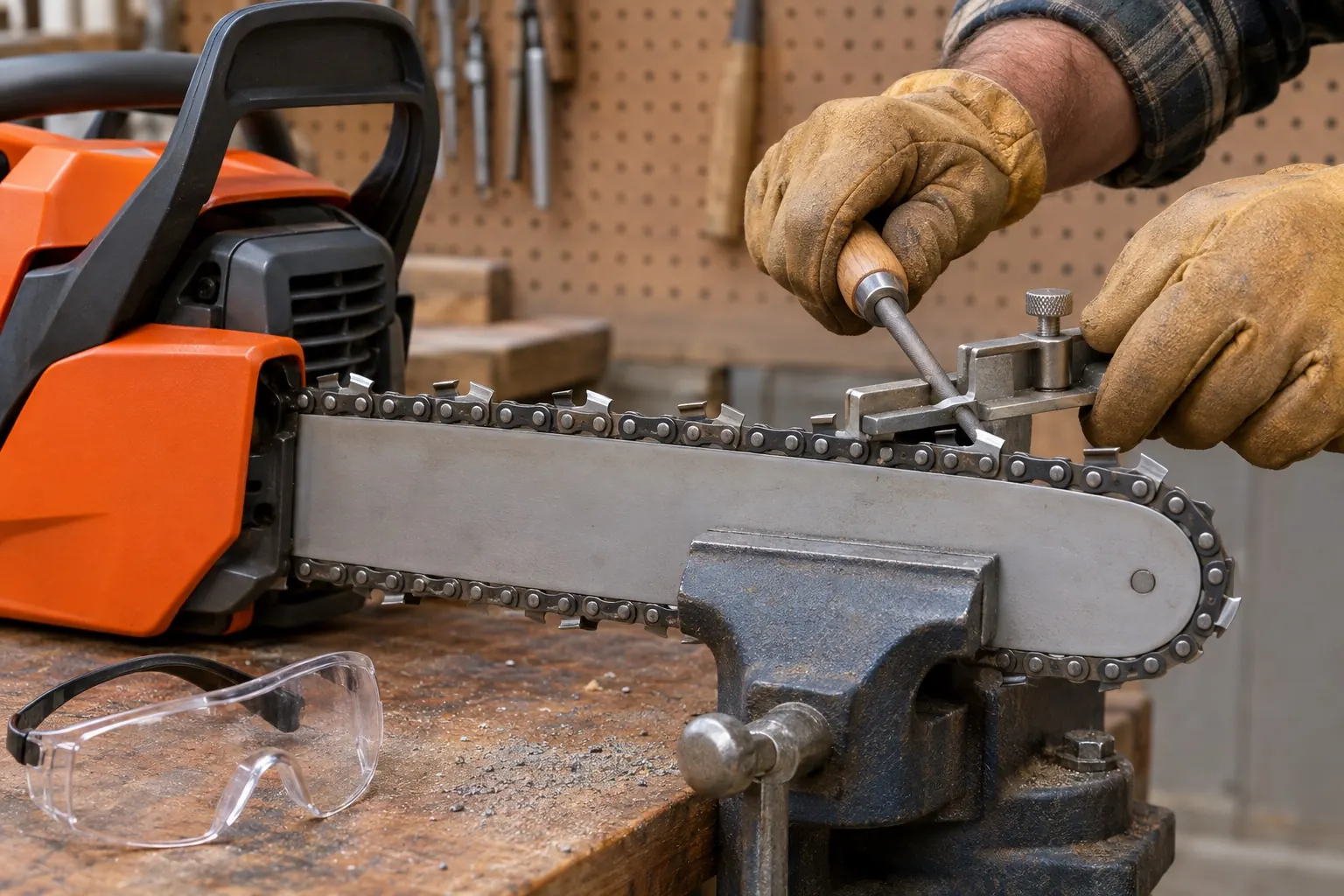
- A round file in a file guide. This is the traditional chainsaw sharpener: a round chainsaw file sized to your chain, held in a guide that rides on the chain and keeps the file at a steady height and angle. It's inexpensive and works anywhere, but getting even results takes some practice, as Clemson Extension's chainsaw safety publication points out.
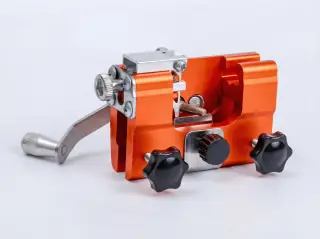
- A bar-mounted or handheld sharpener. These jigs clamp onto the guide bar and hold the cutting tool at a fixed angle for you. The SawShark Chainsaw Sharpener is the one we've reviewed: according to the brand, you attach it to the bar, tighten the knobs and turn a crank, and a built-in guide holds its grinding head at the same angle on every tooth, with no electricity needed.
| Tool | How it works | Good for | Keep in mind |
|---|---|---|---|
| Round file and file guide | You file each cutter by hand while the guide holds the angle | Any chain, at home or in the woods | Takes practice, and the file has to match your chain |
| Flat file and depth gauge tool | Lowers the depth gauges (rakers) to the right height | Every few sharpenings, as the cutters wear back | Filing the rakers too low raises the kickback risk |
| Bar-mounted sharpener | Clamps on the bar and holds a stone or file at a set angle | Homeowners who want help keeping the angle even | Check that it fits your chain as soon as it arrives |
| Electric chain grinder | A powered stone grinds each cutter | People who sharpen several chains | Needs a bench, power and practice of its own |
| Sharpening shop | A dealer or repair shop sharpens the chain for you | Damaged chains, or anyone unsure about doing it | You're without the saw or chain until it's done |
Your saw's owner's manual gives the file size and filing angles for the chain it uses.
There are also electric chainsaw sharpeners, which grind each cutter with a powered stone, and sharpening shops that do the job for a fee. If you aren't confident doing it yourself, Clemson Extension's advice is simple: have the chain professionally sharpened.
Before you start: tools and safety
You sharpen with the saw off, but you're still handling a loop of sharp steel teeth. Clemson Extension notes that many hand injuries happen during saw chain maintenance, so wear gloves, and use a file with a handle that covers the sharp tang. A Cooperative Extension safety page from Penn State specialists adds a second tip: cover the chain with a heavy rag while you sharpen.
Here's what to have on the bench:
- Work gloves and safety glasses
- A round file and file guide that match your chain, as listed in your owner's manual
- A flat file and a depth gauge tool
- A bench vise, or a stump vise for sharpening in the woods
- A marker or paint pen for your starting tooth
- A rag and bar-and-chain oil
How to sharpen a chainsaw chain by hand, step by step
This is how to sharpen a chainsaw by hand with a round file and guide, leaving the chain on the bar. Check your saw's manual for the file size and angles before you begin.
- Turn the saw off and let it cool. On a battery saw, take the battery out; on a corded saw, unplug it.
- Clamp the guide bar in a bench vise, gripping the bar rather than the chain. In the field, forestry professor Brett McLeod suggests a stump vise, or resting the bar on a log with the chain brake engaged.
- Check the chain tension. The University of Hawaii publication says to tension the chain properly on the bar before you sharpen. A well-tensioned chain doesn't sag, yet you can still pull it along the bar with a gloved hand.
- Set the chain brake so the chain stays put while you file. Release it only to pull the chain forward to the next teeth, then set it again.
- Mark your first cutter with the marker so you know when you've gone all the way around.
- Seat the round file in the guide against the cutter, lined up with the angle marks on the guide and the angle your manual gives.
- File from the inside of the cutter toward the outside, with smooth forward strokes. McLeod explains in Northern Woodlands that the outer edge is chrome-plated and harder than the file, so working outward from the inside spares your file.
- Give every cutter the same number of strokes so the teeth stay the same length. File every other cutter along one side, then move to the other side of the saw for the cutters that face the other way.
- Check the depth gauges, as explained in the next section, and lower any that stand too high.
- Wipe off the filings, recheck the tension, make sure the bar oil tank is full and make a test cut. You should get chips again instead of fine dust.
If the file starts to skate over the tooth when you add pressure, McLeod notes, the file is probably worn out. A fresh file cuts faster and more evenly.
Chainsaw depth gauges (rakers): the step most people skip
Just ahead of each cutter sits a small hump called the depth gauge, or raker. The University of Hawaii publication describes a saw chain as a loop of cutters with depth gauges, connecting links and drive links. The depth gauge sets how deep a bite the cutter takes.
Each time you file a cutter, it gets a little shorter and lower, so the raker slowly ends up too high. If you never lower the rakers, Northern Woodlands notes, the chips get smaller after every sharpening. File them too low and the saw bogs down and the kickback risk goes up.
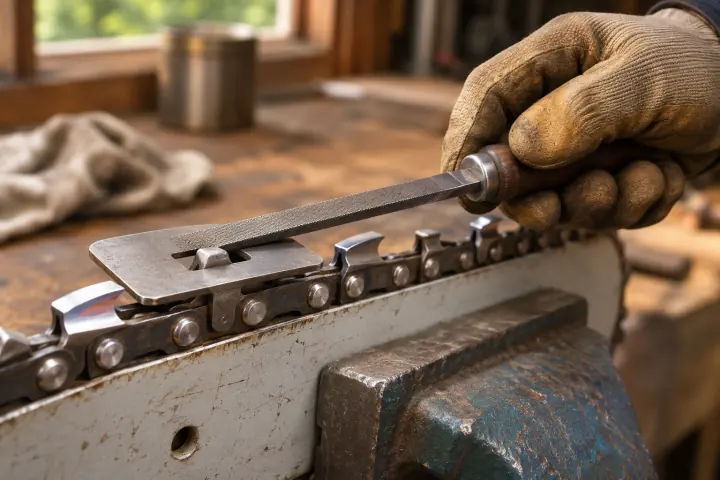
- Lay the depth gauge tool across the chain so a raker pokes up through its slot.
- If the raker stands above the tool, file it flat with the flat file until it's level with the tool.
- Check every raker, not just one, and use the depth setting your manual gives for your chain.
You don't need to do this on every sharpening. The gauge tool shows you when the rakers need lowering as the cutters wear back.
How often should you sharpen a chainsaw?
More often than most people do. The University of Hawaii publication's rule is to file a little each time and file often. Penn State Extension recommends checking the chain's sharpness before each use, and OSHA's chainsaw safety card says to make sure the chain is always sharp.
Touch it up whenever the saw starts leaving dust instead of chips, and right away if the chain hits dirt, a rock or a nail. The Hawaii publication advises keeping the chain away from rocks, dirt and other abrasive material to make it last.
When to replace the chain or find chainsaw sharpening near you
Filing can't fix everything. Buy a new chain, or take the saw to a dealer or repair shop, when:
- The cutters are filed back to the limit your chain's maker sets. Your manual shows it, and a chain worn that far is due for replacement.
- Teeth are chipped, cracked or broken after hitting a rock or metal.
- The saw still cuts curved after a careful sharpening. Ask a shop to check the cutters and the bar.
- The chain brake doesn't stop the chain when you test it. Clemson Extension says a saw that fails the brake test shouldn't be used until a dealer inspects it.
- The bar isn't getting oil. The Hawaii publication says to take the saw to a dealer if the oil flow is still poor after adjusting it.
- You're not sure you can do it well. Clemson Extension recommends professional sharpening for anyone in doubt.
For a chainsaw chain replacement, buy the chain your owner's manual specifies, since chains differ in size from saw to saw.
Chainsaw safety: kickback, chaps and the rest of your gear
Penn State Extension reports that from 2018 to 2022, nearly 128,000 people were treated in US emergency departments for chainsaw-related injuries. Clemson Extension cites older federal data putting 42% of injuries on the arm and hand area and 38% on the legs, and an analysis of 2009 to 2013 emergency room data in which 81% of the injuries were cuts.
Kickback is the danger to respect most. It happens when the tip of the bar touches something or is suddenly stopped, and the saw is thrown back toward you. Clemson calls the upper part of the bar tip the kickback corner. OSHA's advice is not to saw with the tip, and to keep the tip guard in place. A dull chain or badly filed rakers make kickback more likely, which is one more reason to keep up with sharpening.
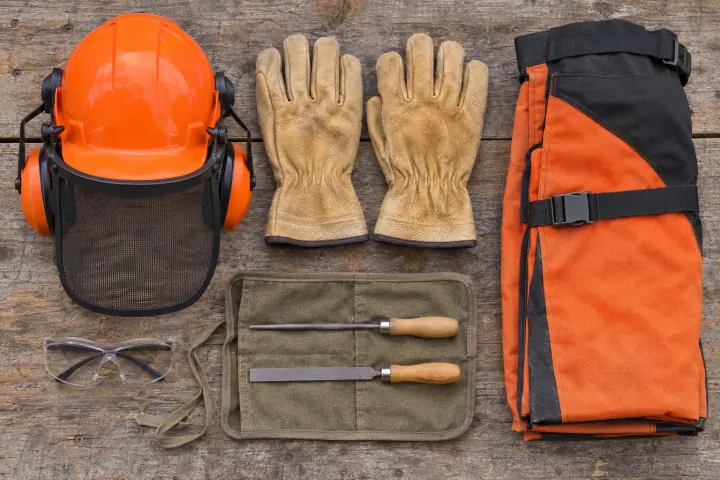
- Chainsaw chaps or cut-resistant pants. Clemson says chaps or pants with six cut-resistant layers are enough for non-professional users.
- Chainsaw gloves. Penn State Extension notes they protect your hands from cuts and improve your grip.
- Eye protection. Clemson recommends impact-rated safety glasses that meet the ANSI Z87 standard.
- Hearing and head protection. A helmet with attached earmuffs and a mesh face screen covers both.
- Sturdy boots with ankle support, and steel or composite toes when you're cutting up logs, according to Clemson.
OSHA's quick card lists hand, foot, leg, eye, face, hearing and head protection for anyone operating a saw. It also says to start the saw on the ground or another firm support with the chain brake engaged, keep your hands on the handles, and shut the saw off or engage the chain brake when you carry it over rough or uneven ground. Clemson calls the chain brake probably the most crucial safety feature a chainsaw has.
Tools we've reviewed for chainsaw owners
FAQ
How often should you sharpen a chainsaw chain?
Whenever it starts leaving fine dust instead of chips, and a quick check before each job is a good habit. Extension specialists recommend filing a little and often rather than waiting until the chain is very dull.
What size file do I need for my chainsaw?
It depends on your chain. Your owner's manual lists the round file size and the filing angles for the chain your saw uses, and your file guide should match that file.
Can you sharpen a chainsaw blade without taking it off?
Yes. The chain stays on the bar: tension it properly, clamp the bar in a vise, set the chain brake and file each cutter in place. Round files and bar-mounted sharpeners are both used this way.
What angle do you sharpen a chainsaw chain at?
It depends on the chain, so use the angle in your manual. File guides carry angle marks, which help you hold the file the same way on every cutter.
Do handheld chainsaw sharpeners work?
They do the same job as a file guide: hold the cutting tool at a fixed angle so the teeth come out alike. The brand behind the SawShark Chainsaw Sharpener says its crank-turned jig sharpens a whole chain in a few minutes without power. We found no independent test of it, so try it on your saw as soon as it arrives.
Is it safe to sharpen a chainsaw yourself?
Yes, with the saw switched off, the bar clamped and gloves on. Clemson Extension notes that many hand injuries happen during chain maintenance, and recommends professional sharpening for anyone unsure about doing it.
Sources
- Chainsaw Safety (Quick Card OSHA 3269), Occupational Safety and Health Administration
- Working Safely with Chainsaws (Fact Sheet FS-3920, 2018), Occupational Safety and Health Administration
- Chain Saw Operation and Maintenance, Research Extension Series 092, University of Hawaii College of Tropical Agriculture and Human Resources (1988)
- How to Stay Safe Around Chainsaws, Land-Grant Press LGP 1141, Clemson Cooperative Extension (2022)
- The Dangers of Using Chainsaws, Penn State Extension (updated 2024)
- Chainsaw Safety, Safety, Health and Wellness in Agriculture, Cooperative Extension
- Tricks of the Trade: Myths and Mistakes of Chainsaw Sharpening, Brett R. McLeod, Northern Woodlands (2018)
This guide is general information. Follow your chainsaw's manual for file sizes, angles and maintenance, sharpen only with the saw switched off, and wear protective gear every time you run it.