
Kitchen
Titanium Cutting Board: Pros, Cons, Safety and How It Compares
A titanium cutting board is a metal board that can't shed plastic into your food and has a nonporous surface that rinses clean, but no published study has tested one yet for bacteria or knife wear. Here's what the material is, what the research on wood and plastic boards says, how hard titanium is on knives, and how to look after one.
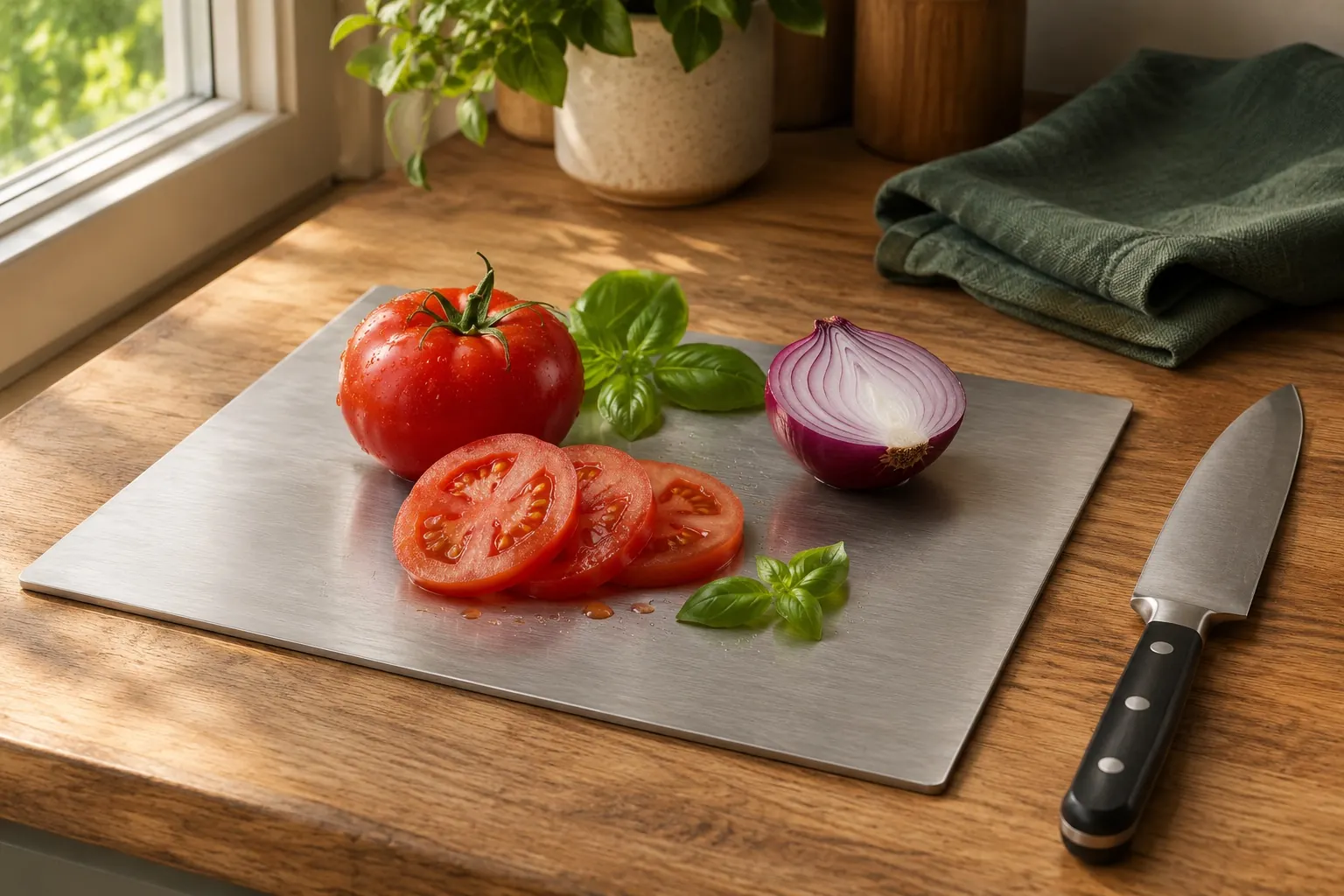
What is a titanium cutting board?
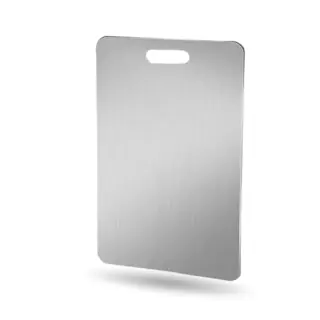
It's a thin sheet of titanium used as a chopping surface, usually rectangular, sometimes with a handle cut-out, and sometimes designed to be used on both sides. The appeal is the metal itself. The U.S. Geological Survey describes titanium metal as well known for its corrosion resistance and its high strength-to-weight ratio, which is why a board can be thin and still feel solid.
Read the material line before you buy. Some listings say pure or solid titanium; others describe a titanium coating or a titanium blend over another metal. Those are different products, and a coating could wear through where the knife lands most often.
Don't confuse the metal with titanium dioxide. USGS says about 95% of the titanium the world uses goes into titanium dioxide, a white pigment for paints, paper and plastics. The FDA describes titanium dioxide as a synthetically produced white pigment that it regulates as a color additive in foods such as candy and baked goods, and it's currently reviewing a 2023 petition about that use. A titanium cutting board is the metal, not this powder, so the food-additive debate isn't about your board.
Titanium cutting board pros and cons
Most of what you'll read about titanium boards comes from the companies selling them. Here's how the claims stack up against what independent sources actually say.
| Point | The upside | The catch |
|---|---|---|
| Plastic | A metal board has no plastic to wear off into food | The microplastics research is on plastic boards; nobody has compared health outcomes with titanium |
| Cleaning | Nonporous surface; USDA says nonporous boards are easier to clean than wood | It still needs washing after every use, and a separate side or board for raw meat |
| Knives | The brand we reviewed calls its board gentle on edges | It's a hard metal surface, and no independent test of knife wear exists |
| Durability | Titanium is known for resisting corrosion, per USGS, and a metal surface won't soak up juices | Water spots can show, so the brand we reviewed says to dry it right away |
| Evidence | Nothing suggests it's less hygienic than other nonporous boards | We found no published study of titanium cutting boards on PubMed |
Sources: USDA, USGS and our PubMed search on November 9, 2026, listed below.
Is a titanium cutting board safe?
For everyday cooking, nothing we found points to a safety problem, and the material has real advantages. The honest caveat is that 'safe' here rests on general principles rather than tests of titanium boards themselves.
Here's what's solid. USDA says you can use wood or a nonporous surface such as plastic, marble or glass for raw meat and poultry, and that nonporous surfaces are easier to clean than wood. A metal board falls in the nonporous group. It also contains no plastic, so it can't add microplastics to your food the way chopping on plastic does in lab tests.
Here's what's missing. When we searched PubMed on November 9, 2026, we found no study of titanium cutting boards at all: nothing on how bacteria behave on them, whether they release metal particles when you chop, or how they hold up over years of use. Claims that a board is antibacterial, non-toxic or 'the safest cutting board' come from the brands.
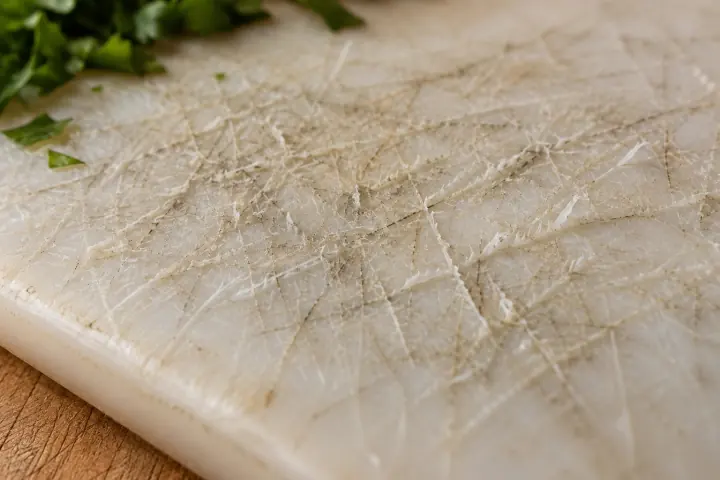
What keeps any board safe is the routine around it. USDA advises washing every board with hot, soapy water after each use, keeping one board for produce and bread and another for raw meat, poultry and seafood, and throwing out boards that develop hard-to-clean grooves. A titanium board makes the last part easier, since it doesn't groove the way plastic does, but it doesn't replace the first two.
Are titanium cutting boards bad for knives?
Probably harder on them than wood, though no one has measured it. Every chop ends with the edge striking the board, and titanium is a metal, far harder than wood or plastic. A knife can sink slightly into a wooden board; on metal, the edge stops dead.
The only independent guidance we found compares wood and plastic. NDSU Extension notes that chefs find plastic boards dull knives more quickly, while hardwoods such as maple are less likely to dull them. The titanium brand we reviewed says its board is gentle on knife edges, but it doesn't publish a test to back that up.
If you already own a titanium board, a few habits protect your edges:
- Slice and rock the knife rather than chopping hard straight down.
- Use the spine of the knife, not the edge, to scrape food off the board.
- Hone your knife more often, and keep a wooden board for heavy chopping jobs like squash or herbs by the bunch.
- Save the metal board for jobs where an easy rinse matters most, such as raw meat, fish or strong-smelling garlic and onions.
Wood vs plastic vs titanium cutting board
Each material wins on something different. Wood is kindest to knives and has surprisingly good lab results on bacteria. Plastic is dishwasher-friendly but wears into grooves and sheds microplastics. Titanium avoids both of plastic's problems but has no research of its own yet.
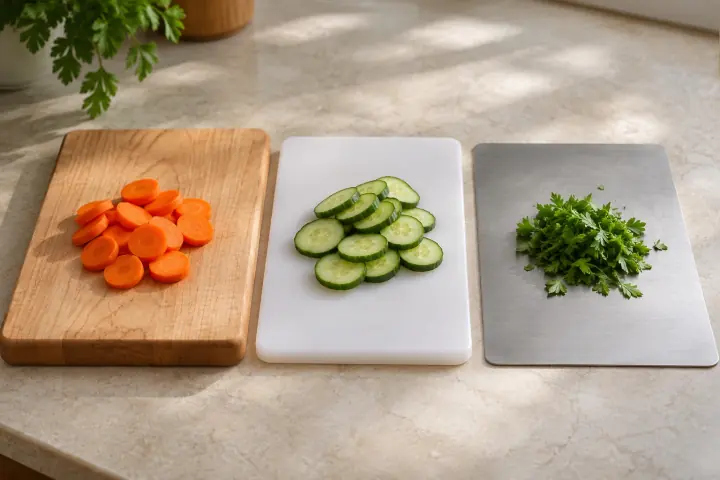
| Wood | Plastic | Titanium | |
|---|---|---|---|
| Surface | Porous | Nonporous, but knife grooves are hard to clean | Nonporous |
| Bacteria in lab studies | A 2025 study found E. coli on maple fell to the detection limit within two hours | Higher detection rates than maple in the same study | Not studied |
| Microplastics | None from the board | Released while chopping in a 2023 lab study | None from the board |
| Knives | Maple is less likely to dull knives, per NDSU Extension | Dulls knives faster, chefs report | Not tested; a hard metal surface |
| Dishwasher | Solid wood yes, laminated no, per USDA | Yes, per USDA | Check the maker's instructions |
| Replace when | Cracked or deeply grooved | Grooved and hard to clean | Bent, or a coating wears through |
Sources: USDA, NDSU Extension and the studies listed below.
If wood is your pick, our guide on how to clean a wooden cutting board covers daily washing, USDA's sanitizing ratio and how to oil it.
Do plastic cutting boards shed microplastics?
This research is the main reason people look at titanium in the first place. In a 2023 study from North Dakota State University, researchers chopped on polyethylene and polypropylene boards, with and without carrots, and collected what came off. Polypropylene released 5% to 60% more microplastic by mass than polyethylene. Using their own assumptions about how often people chop, the authors estimated yearly exposure at 7.4 to 50.7 grams from a polyethylene board and 49.5 grams from a polypropylene one, and called plastic boards a substantial source of microplastics in food.
A 2025 study took it into animals. Mice ate diets prepared on polypropylene, polyethylene or willow wood boards for 4 or 12 weeks. After 12 weeks, the polypropylene group had more inflammation markers and signs of a weaker gut barrier than the wood group. The polyethylene group didn't show clear inflammation but had shifts in gut bacteria and in gut and liver metabolism.
What does it mean for people? A 2024 rapid systematic review from the University of California, San Francisco looked at microplastics in general, not cutting boards. It found only 3 human studies alongside 28 animal studies and concluded that microplastics are 'suspected' to harm digestive, reproductive and respiratory health. That's a cautious label: the evidence leans one way but isn't settled.
So a metal board removes one known source of microplastics from your kitchen, but there's no study showing that switching boards changes anyone's health. If cost is a concern, a wooden board does the same job on the plastic front.
Titanium vs stainless steel cutting board
Stainless steel boards are the other common metal option, and they share most of titanium's traits: nonporous, no plastic, easy to rinse and hard on knife edges. Neither has been studied as a home cutting board, so the choice comes down to practical things.
Titanium's selling point in industry is strength for its weight, per USGS. In a cutting board, that matters mostly if you want something thin and easy to lift. Beyond that, compare the size against your sink, whether the board is truly solid metal or coated, what the maker allows for cleaning, and the return policy. A stainless board that fits your kitchen beats a titanium one that doesn't.
How to clean a titanium cutting board
Treat it like any other board, with a couple of extra steps to keep the surface looking good.
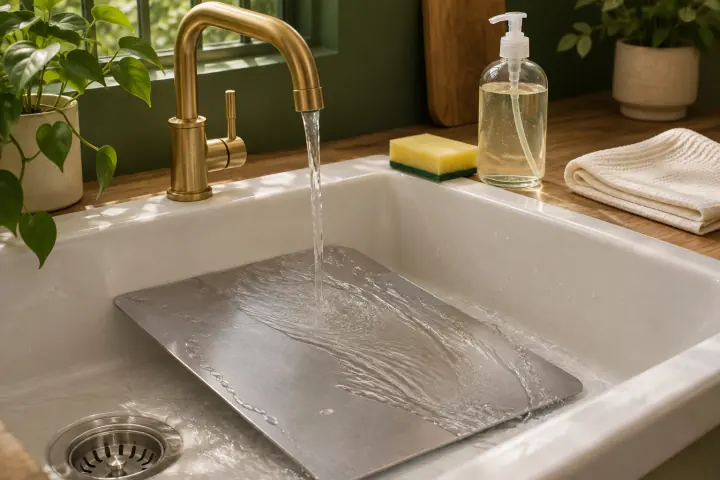
- Scrape scraps off with the back of the knife or a bench scraper.
- Wash both sides with hot, soapy water after each use, as USDA advises for every cutting board. The titanium board we reviewed comes with instructions for warm water and mild soap, and no scouring pads or abrasive cleaners.
- Rinse with clear water.
- Dry it right away with a soft cloth, which that brand says prevents water spots.
- After raw meat, poultry or seafood, wash it straight away and keep that side or board for raw foods. USDA's sanitizing solution of 1 tablespoon of unscented liquid chlorine bleach per gallon of water is written for wood and plastic boards, so check your board's instructions before using bleach on metal.
Can it go in the dishwasher? The board we reviewed is listed as dishwasher-safe on its sales page, while its care instructions describe washing by hand. Follow the instructions that came with yours, especially if the board is coated rather than solid metal.
How to choose the best titanium cutting board
There's no independent testing to rank titanium boards, so focus on what you can check yourself before you buy:
- The exact material. 'Pure titanium' or 'solid titanium' is different from a titanium coating. If the listing doesn't say, ask the seller.
- A size that fits both your biggest prep jobs and your sink.
- Two usable sides, if you want one for raw meat and one for ready-to-eat food.
- Clear care instructions: dishwasher or hand-wash only, and whether bleach is allowed.
- Proof behind antibacterial claims. Ask for the lab report; a claim without one is marketing.
- A return policy you can live with, since you can't judge weight and feel from a photo.
If you want to try one, we reviewed the Katori titanium cutting board. The brand says it's 100% pure titanium, measures 11.4 by 7.9 inches and has two usable sides, one for raw food and one for cooked, and it lists the board as dishwasher-safe and gentle on knives. It doesn't publish a lab test for its antibacterial claim, so treat that part as the brand's word.
When to see a doctor
No board prevents food poisoning on its own. One common route is raw meat juices reaching food that won't be cooked, which is exactly what USDA's separate-board advice is meant to stop, so the washing and separate-board habits matter more than the material. CDC lists diarrhea, stomach cramps, nausea, vomiting and fever as the usual symptoms. Get medical care for:
- Diarrhea with blood in it
- Diarrhea that goes on for more than 3 days
- A temperature over 102°F
- Vomiting that keeps you from holding down liquids
- Signs of dehydration, such as peeing very little, a dry mouth and throat, or feeling dizzy when you stand up
CDC says to see your doctor if you're pregnant and have a fever with flu-like symptoms. For babies, young children, older adults and anyone with a chronic illness, call the doctor early rather than waiting it out.
Titanium cutting board we've reviewed
FAQ
Are titanium cutting boards safe?
Nothing we found points to a safety problem. A metal board is nonporous, which USDA says is easier to clean than wood, and it has no plastic to shed. But we found no published study of titanium cutting boards, so claims about bacteria and toxicity come from the brands.
Do titanium cutting boards dull knives?
Likely more than wood, though no independent test exists. Titanium is a hard metal, and NDSU Extension notes that even plastic dulls knives faster than maple. Slicing instead of hard chopping and honing more often help.
Is titanium better than wood for a cutting board?
It depends on what you want. Titanium rinses clean and won't absorb juices. Wood is easier on knives, and a 2025 study found E. coli on maple boards dropped to the detection limit within two hours. Neither sheds plastic.
Can a titanium cutting board go in the dishwasher?
Check your board's instructions. The one we reviewed is listed as dishwasher-safe, and its brand also describes washing by hand with mild soap and drying right away to avoid water spots. Be more careful with a coated board than a solid one.
What is the safest cutting board material?
There isn't one winner. USDA says wood or a nonporous board such as plastic is fine, as long as you wash it after each use, keep raw meat on its own board and replace boards with hard-to-clean grooves. If you want to avoid microplastics, choose wood or metal over plastic.
Is titanium the same as titanium dioxide?
No. Titanium dioxide is a white pigment, which the FDA regulates as a color additive in some foods. A titanium cutting board is made of the metal itself.
Sources
- Titanium Statistics and Information, U.S. Geological Survey
- Titanium Dioxide as a Color Additive in Foods, U.S. Food and Drug Administration
- Cutting Boards, USDA Food Safety and Inspection Service
- Prairie Fare: Say Goodbye to Old Cutting Boards, NDSU Extension
- PubMed search for titanium cutting board studies (no studies of titanium boards found, November 9, 2026)
- Cutting Boards: An Overlooked Source of Microplastics in Human Food?, Environ Sci Technol (2023), PubMed
- Simulated Microplastic Release from Cutting Boards and Evaluation of Intestinal Inflammation and Gut Microbiota in Mice, Environ Health Perspect (2025), PubMed
- Effects of Microplastic Exposure on Human Digestive, Reproductive, and Respiratory Health: A Rapid Systematic Review, Environ Sci Technol (2024), PubMed
- Hygienic Evaluation of Wooden Cutting Boards: Microbiological Parameters, J Food Prot (2025), PubMed
- Symptoms of Food Poisoning, Centers for Disease Control and Prevention
This guide is general information. Follow the label of any cleaning product, never mix cleaners, and keep them away from children and pets.