
Recipe
Homemade Electrolyte Drink: Easy Recipe, Variations and When You Need One
This homemade electrolyte drink takes two minutes: stir 1/4 teaspoon of salt and 1 1/2 tablespoons of honey into 3 1/4 cups of water, then add 1/2 cup of orange juice and 2 tablespoons of lemon juice. Each cup has about 146 mg of sodium, 74 mg of potassium and 40 calories, worked out from USDA data. Below: when you actually need electrolytes, sugar-free and coconut water versions, and why it isn't a substitute for oral rehydration solution when you're sick.

Homemade Citrus Electrolyte Drink
Ingredients
- 3 1/4 cups cold water, divided
- 1/2 cup 100% orange juice
- 2 tbsp fresh lemon juice (from about 1 lemon)
- 1 1/2 tbsp honey (or maple syrup)
- 1/4 tsp table salt
- Ice and lemon slices, to serve (optional)
Steps
- Pour 1 cup of the water into a pitcher or a 1-quart jar. Add the salt and honey and stir until both dissolve completely.
- Add the remaining 2 1/4 cups of water, the orange juice and the lemon juice, and stir again.
- Taste it. It should taste only faintly salty. If it tastes clearly salty, the salt was over-measured, so make a fresh batch rather than adding more of anything.
- Serve over ice or chill it first. Keep leftovers covered in the refrigerator and stir before pouring.
Per serving, estimated from USDA FoodData Central: 40 calories, 0 g protein, 0 g fiber, 9 g sugar. About 6.5 g of the sugar is added sugar from the honey. Each serving also has about 146 mg of sodium and 74 mg of potassium.
What's in a homemade electrolyte drink, and why
Electrolytes are minerals in your blood and body fluids that carry an electric charge. MedlinePlus lists sodium, potassium, chloride, calcium, magnesium and phosphorus, and explains that they affect your body's water balance, its acidity, and how your nerves and muscles work. You lose electrolytes when you sweat, and water alone doesn't contain a significant amount of them.
A homemade version needs just three things. Salt supplies sodium and chloride. Juice adds potassium and flavor. And a little sugar isn't only there for taste: the World Health Organization explains that glucose helps the small intestine absorb sodium, and water along with it. That's why medical rehydration solutions contain both salt and sugar.
Electrolyte drink recipe: how much salt per cup?
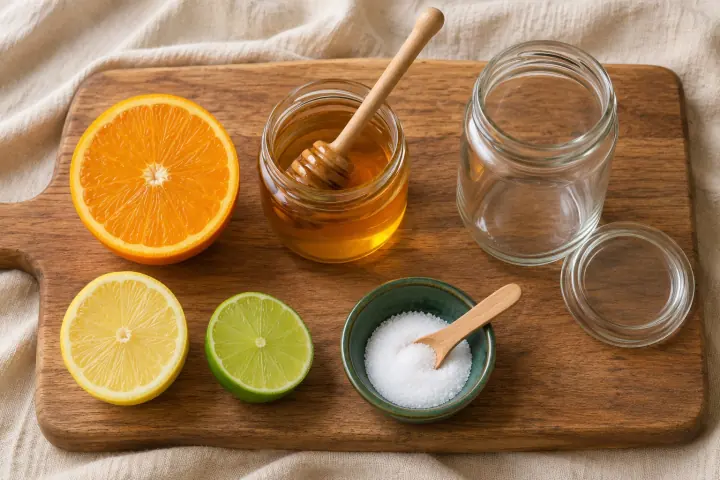
The recipe uses 1/4 teaspoon of table salt for about 4 cups. USDA FoodData Central lists table salt at 38,800 mg of sodium per 100 grams, and a teaspoon weighs about 6 grams, so 1/4 teaspoon carries roughly 580 mg of sodium. Spread over 4 cups, that's about 146 mg per cup.
For scale, the whole batch has about a quarter of the FDA's 2,300 mg Daily Value for sodium, and Americans already average about 3,400 mg a day, according to the FDA. That's why the salt stays low here: on an ordinary day, most people don't need extra sodium.
Here's how the recipe and its variations compare, per 1-cup serving:
| Version | Sodium | Potassium | Sugar | Calories |
|---|---|---|---|---|
| Citrus with honey (recipe above) | 146 mg | 74 mg | 9 g | 40 |
| Sugar-free: skip the honey | 146 mg | 70 mg | 3 g | 16 |
| Maple syrup instead of honey | 147 mg | 86 mg | 7 g | 35 |
| Coconut water and lime | 199 mg | 309 mg | 3 g | 25 |
| Watermelon and lime | 146 mg | 90 mg | 5 g | 24 |
Calculated by us from USDA FoodData Central values for table salt, orange juice, lemon juice, lime juice, honey, maple syrup, coconut water and watermelon, and rounded. Tap and bottled water add small, variable amounts of minerals that aren't counted.
Measure the salt with a measuring spoon, not a shaker or a pinch, and never double it to make the drink stronger.
Sugar-free, coconut water and watermelon versions
Each version makes about 4 cups (4 servings). Only the changes from the base recipe are listed.
- Sugar-free electrolyte drink: leave out the honey. The sodium stays the same, and the orange juice still adds about 3 g of natural sugar per cup. For almost no sugar at all, replace the orange juice with more water, though potassium then drops to nearly nothing.
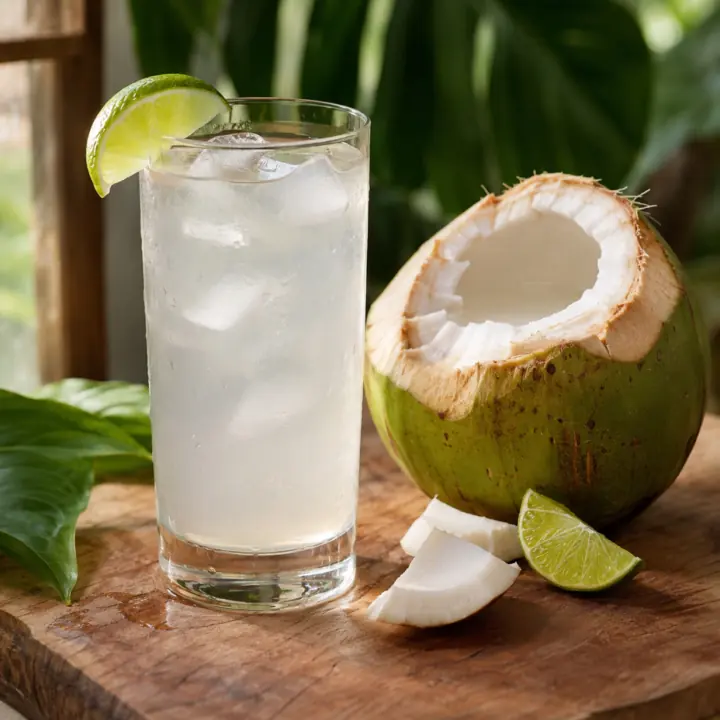
- Coconut water electrolyte drink: use 2 cups of unsweetened coconut water plus 1 3/4 cups of water, 2 tbsp lime juice and only 1/8 tsp salt, with no honey. Coconut water brings its own electrolytes: USDA lists 1 cup at about 600 mg of potassium and 252 mg of sodium.
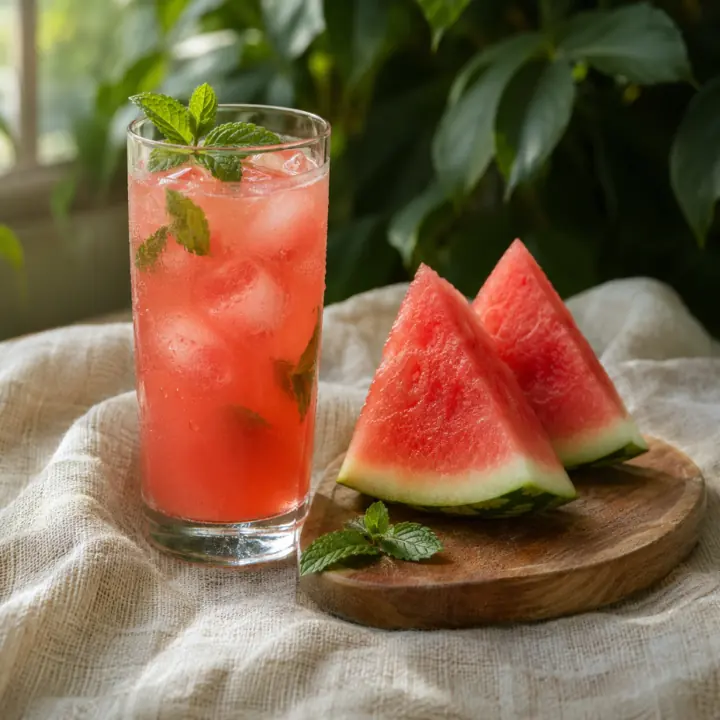
- Watermelon electrolyte drink: blend 2 cups of diced watermelon with 2 cups of water, strain it if you like a smoother drink, then stir in 1 tbsp lime juice and 1/4 tsp salt. A few mint leaves are a nice finish.
- Maple version: swap the honey for 1 1/2 tbsp maple syrup, which adds a little potassium and calcium.
When do you actually need electrolytes?
Less often than the ads suggest. For most exercise, water is enough. The CDC's travel-health guidance says that during mild to moderate exertion, electrolyte replacement offers no advantage over plain water, and that for recreational athletes, food is the most efficient way to replace salt, with salty snacks such as crackers, pretzels or trail mix.
Electrolytes start to matter when sweating goes on for hours. The CDC's workplace heat guidance (from its NIOSH institute) recommends water, about 1 cup every 15 to 20 minutes, for moderate activity in the heat lasting less than 2 hours, and sports drinks with balanced electrolytes if sweating lasts for several hours. For exercise longer than about 6 hours or long heat exposure, the CDC advises supplemental sodium, and it notes that most sports drinks don't contain enough sodium to prevent low blood sodium.
In practice, a homemade electrolyte drink makes sense for:
- Long, sweaty days: yard work, a long hike or an outdoor shift in the heat that runs several hours.
- Endurance training that lasts a couple of hours or more, especially in hot weather.
- Recovering from a long, sweaty session when your next meal is hours away. Otherwise, a normal meal and water do the same job.
- Not needed: a 30-minute walk, a typical gym session or a day at a desk. Plain water covers those.
Signs that you're low on fluids overlap with dehydration: thirst, darker urine, headache and muscle cramps, as MedlinePlus lists them. Our guide to how much water you should drink a day covers daily needs and the warning signs in detail.
Foods high in electrolytes
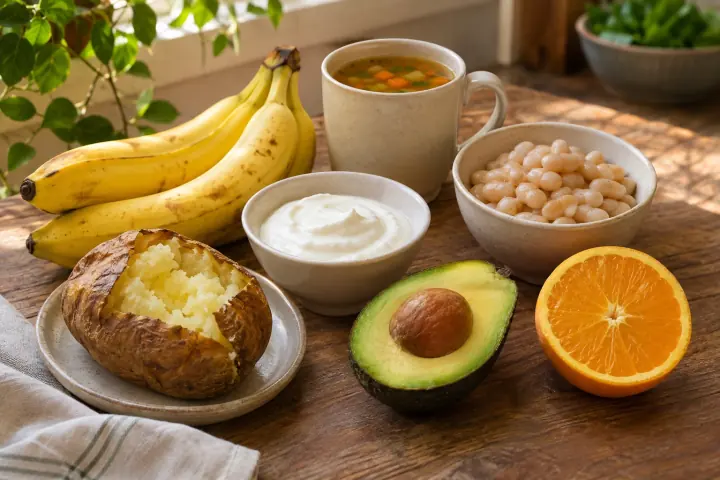
Since food is the most efficient way for recreational athletes to replace salt, per the CDC, your meals can do much of the work. For potassium, MedlinePlus says vegetables and fruit are the richest sources, and adults need 3,400 mg a day (men) or 2,600 mg (women). Here's what common foods carry, from USDA FoodData Central:
| Food | Serving | Potassium | Sodium |
|---|---|---|---|
| White beans, canned | 1 cup | 1,189 mg | 891 mg |
| Baked potato, with skin | 1 medium | 926 mg | 17 mg |
| Spinach, cooked | 1 cup | 839 mg | 126 mg |
| Avocado | 1 cup cubes | 728 mg | 11 mg |
| Coconut water | 1 cup | 600 mg | 252 mg |
| Plain low-fat yogurt | 1 cup | 573 mg | 172 mg |
| Orange juice | 1 cup | 496 mg | 2 mg |
| Banana | 1 medium | 422 mg | 1 mg |
| Watermelon | 1 cup diced | 170 mg | 2 mg |
| Chicken broth, ready-to-serve | 1 cup | 45 mg | 924 mg |
From USDA FoodData Central (SR Legacy); per-serving amounts are our math, rounded. Canned beans and broth vary a lot by brand, and low-sodium versions have much less sodium.
More potassium isn't safe for everyone. MedlinePlus warns that poor kidney function and some blood pressure medicines (ACE inhibitors, ARBs and potassium-sparing diuretics) can raise potassium levels, which can cause dangerous heart rhythms. If that applies to you, talk to your doctor before adding potassium-rich drinks such as coconut water.
Homemade electrolyte drink vs. oral rehydration solution
When you're sick with vomiting or diarrhea, a homemade drink isn't the right tool. Oral rehydration solution (ORS) is a medical formula with exact amounts. The WHO's current formula contains, per liter, 2.6 g of sodium chloride, 13.5 g of glucose, 1.5 g of potassium chloride and 2.9 g of trisodium citrate, which works out to 75 mmol of sodium per liter. Here's how our everyday recipe compares:
| Per liter | WHO oral rehydration solution | Our citrus recipe |
|---|---|---|
| Sodium | About 1,725 mg | About 620 mg |
| Potassium | About 780 mg | About 310 mg |
| Sugar | 13.5 g glucose | About 43 g carbohydrate, mostly sugar |
| Made for | Dehydration from diarrhea | Long, sweaty days |
WHO composition from its ORS production guidance (75 mmol/L sodium, 20 mmol/L potassium); milligram conversions and recipe values are our math from USDA FoodData Central.
The difference matters. The CDC explains that drinks commonly used to treat diarrhea don't contain physiologically sound amounts of carbohydrate and electrolytes, and that sugary liquids can make diarrhea worse. It adds that although a homemade solution with the right glucose and sodium is possible, serious errors can occur, so it recommends standard commercial oral rehydration products where they're available. ORS powder is sold in many pharmacies and stores.
For children, check with a pediatrician before using any homemade drink, and get medical help quickly for signs of dehydration.
Tips for the best homemade electrolyte drink
- Dissolve first. Salt and honey dissolve faster in a cup of room-temperature water than in a pitcher of ice water.
- Use fresh citrus. Bottled lemon juice works, but fresh tastes brighter.
- Make it when you need it. Mix a batch for the long, hot day rather than sipping it daily out of habit.
- Pack it cold. Pour it into an insulated bottle with ice before a hike or a morning of yard work.
- Skip the honey for babies. The CDC says not to feed honey to a child younger than 1 year old; use maple syrup or no sweetener, and ask the pediatrician before giving babies or young kids any electrolyte drink.
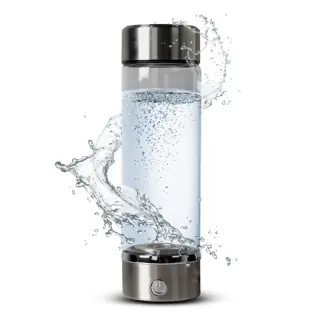
Most days, plain water is the right drink. If a refillable bottle within reach keeps you sipping, we reviewed the LifeWater Hydrogen Bottle, a 14.2-ounce rechargeable glass bottle that the brand designed for plain water; it says a 3-minute cycle adds hydrogen gas. Research on hydrogen water is still early, so see it as a way to keep water handy rather than an electrolyte source.
When to see a doctor
See a doctor, or call 911 in an emergency, rather than relying on any drink if you notice:
- Signs of severe dehydration: little or no urine, very dark urine, dizziness, confusion, a rapid heartbeat or breathing, or sunken eyes (MedlinePlus).
- Diarrhea or vomiting in a baby, a young child or an older adult, or in anyone who can't keep fluids down.
- Blood in the stool, diarrhea that won't stop, or signs of dehydration during diarrhea; the WHO advises seeing a health professional in those cases.
- Nausea, headache, confusion or muscle cramps after long exercise. These can be signs of low blood sodium (MedlinePlus), which the CDC notes can progress to seizures and coma.
- Kidney disease, heart failure, high blood pressure, or a medicine that affects sodium or potassium. Ask before using electrolyte drinks, since you may need limits on salt, potassium or fluids.
- Pregnancy or any condition you're being treated for. Your doctor can tell you how much fluid and salt fit your plan.
For the plain-water days
FAQ
How do you make a homemade electrolyte drink?
Stir 1/4 teaspoon of salt and 1 1/2 tablespoons of honey into 1 cup of water until dissolved, then add 2 1/4 more cups of water, 1/2 cup of orange juice and 2 tablespoons of lemon juice. It makes about 4 cups.
How much salt goes in a homemade electrolyte drink?
About 1/4 teaspoon of table salt per 4 cups of liquid. That's roughly 580 mg of sodium in the batch, or about 146 mg per cup, based on USDA data. Measure it rather than adding a pinch.
Is coconut water good for hydration?
It's mostly water and carries electrolytes: USDA lists 1 cup at about 600 mg of potassium and 252 mg of sodium. For everyday hydration plain water works fine; coconut water is an option for long, sweaty days.
Do I need electrolytes every day?
Usually not. The CDC says that during mild to moderate exertion, electrolyte replacement offers no advantage over plain water, and that food is the most efficient way for recreational athletes to replace salt.
Can I use a homemade electrolyte drink for diarrhea?
It's not the best choice. The CDC recommends standard commercial oral rehydration products when available, because homemade solutions are easy to get wrong and sugary drinks can worsen diarrhea. Ask a doctor, especially for children.
Is a sugar-free electrolyte drink better?
It has fewer calories, which suits everyday sipping. A little sugar helps your gut absorb sodium and water, according to the WHO, which is why rehydration solutions include glucose.
Sources
- Salt, table (FDC ID 173468), USDA FoodData Central
- Orange juice, raw (FDC ID 169098), USDA FoodData Central
- Lemon juice, raw (FDC ID 167747), USDA FoodData Central
- Lime juice, raw (FDC ID 168156), USDA FoodData Central
- Honey (FDC ID 169640), USDA FoodData Central
- Syrups, maple (FDC ID 169661), USDA FoodData Central
- Nuts, coconut water (FDC ID 170174), USDA FoodData Central
- Watermelon, raw (FDC ID 167765), USDA FoodData Central
- Beans, white, mature seeds, canned (FDC ID 175204), USDA FoodData Central
- Potatoes, baked, flesh and skin, without salt (FDC ID 170093), USDA FoodData Central
- Spinach, cooked, boiled, drained, without salt (FDC ID 168463), USDA FoodData Central
- Avocados, raw, all commercial varieties (FDC ID 171705), USDA FoodData Central
- Yogurt, plain, low fat (FDC ID 170886), USDA FoodData Central
- Bananas, raw (FDC ID 173944), USDA FoodData Central
- Soup, chicken broth, ready-to-serve (FDC ID 174536), USDA FoodData Central
- Electrolytes, MedlinePlus Medical Encyclopedia (National Library of Medicine)
- Potassium in diet, MedlinePlus Medical Encyclopedia (National Library of Medicine)
- Dehydration, MedlinePlus Medical Encyclopedia (National Library of Medicine)
- Low blood sodium, MedlinePlus Medical Encyclopedia (National Library of Medicine)
- Sodium in Your Diet, FDA
- Heat and Cold Illness in Travelers, CDC Yellow Book
- Heat Stress: Workplace Recommendations, CDC NIOSH
- Treatment of Cholera (oral rehydration solution), CDC
- Managing Acute Gastroenteritis Among Children: Oral Rehydration, Maintenance, and Nutritional Therapy, CDC MMWR (2003)
- Oral Rehydration Salts: Production of the new ORS (2006), World Health Organization
- Diarrhoeal disease fact sheet, World Health Organization
- Botulism Prevention, CDC
This guide is general information, not medical advice. Talk to your doctor before making changes to your diet, sleep or exercise routine.