
Lighting
Headlamp Guide: How to Choose One for Work, Walks and Power Outages
A headlamp is a light worn on a head strap that leaves both hands free, and the right one for you comes down to brightness in lumens, beam shape, run time, water resistance and a comfortable fit. Below you'll find what those numbers on the package mean, which features suit work, running, camping and dog walks, and how a headlamp fits into a power outage kit.
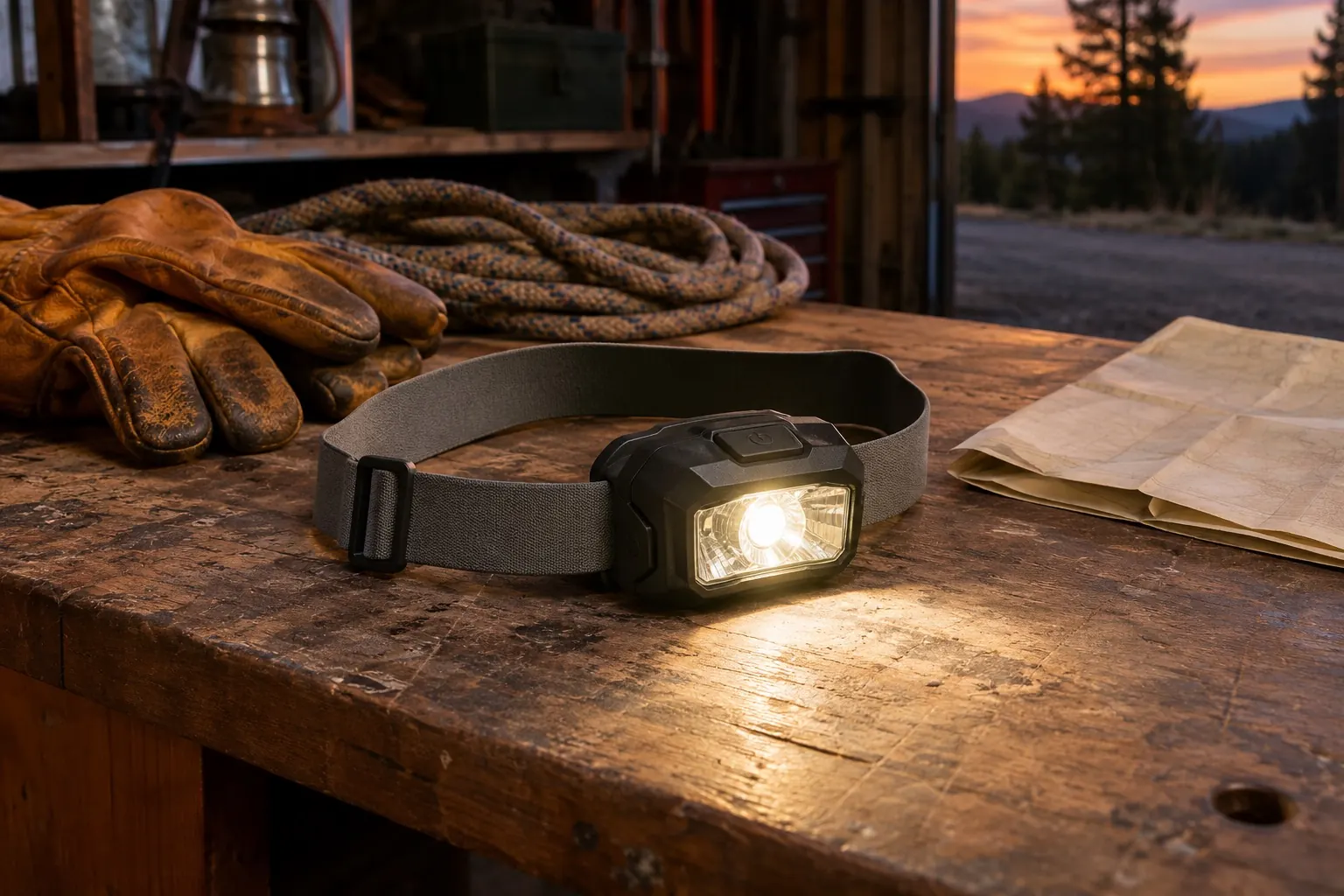
Why a headlamp instead of a flashlight?
Because it gives you your hands back. A flashlight ties up one hand while you turn a wrench or clip a leash. A headlamp points wherever you look and stays there.
The National Park Service makes the same point in its Ten Essentials list for the outdoors. Illumination is one of the ten, the items it names are flashlights and headlamps, and it says headlamps are the recommended light source because they are hands-free. It also tells hikers to pack extra batteries. A separate NPS hiking safety page adds a blunt reminder that your cell phone is not a light source.
What is a lumen? Headlamp lumens in plain terms
Lumens measure brightness. The Federal Trade Commission puts it in one line: more lumens means brighter, fewer lumens means dimmer. Watts are a different thing. They tell you how much energy a light uses, and they say nothing about how bright it is.
That's why every headlamp and flashlight is sold by its lumens. If the number means little to you, compare it with the light bulbs you grew up with. ENERGY STAR publishes the lumens that replace each old incandescent bulb:
| Incandescent bulb | Light output it's replaced by |
|---|---|
| 40 watts | 450 lumens |
| 60 watts | 800 lumens |
| 75 watts | 1,100 lumens |
| 100 watts | 1,600 lumens |
Source: ENERGY STAR, minimum lumens for bulbs that replace each incandescent wattage.
Keep one difference in mind when you read flashlight lumens or headlamp lumens against that table. A room bulb spreads its light in every direction, while a headlamp aims its light at whatever is in front of your face. A few hundred lumens pointed at your hands or at the path ahead is a lot of light.
How many lumens do I need? Lumens, beam distance and run time
We looked for an official chart of lumens per task and didn't find one, so we won't invent numbers. What does exist is a standard for how the numbers on the package are measured, and knowing it will help you more than any single lumen figure.
That standard is ANSI/PLATO FL 1, published by the Portable Lights American Trade Organization. PLATO describes it as a consistent way to understand and compare portable lighting performance, and its latest revision formally lists headlamps among the products it covers. A package that follows it reports:
- Light output, in lumens: how much light the lamp gives overall.
- Beam distance: how far the beam reaches.
- Peak beam intensity: how strong the brightest part of the beam is.
- Run time: how long the light lasts on a charge or a set of batteries.
- Durability: impact resistance, plus protection against water and dust.
The detail worth remembering is how run time is counted. According to PLATO, output is measured shortly after the light is switched on, and run time ends when the output has fallen to 10 percent of that starting value. So a headlamp doesn't stay at its headline brightness for the whole run time on the box. Short turbo or boost modes are measured over the first seconds only, and their run time is shown in seconds.
In practice, choose the brightness by the job. Close work, like reading a label, needs little light. Seeing down a trail or across a yard is where higher output and a focused beam earn their place. As a point of reference for a headlamp for work, OSHA's construction rule sets the minimum lighting for work areas in foot-candles: 5 for general construction areas, 10 for shops such as carpenter shops and equipment rooms, and 30 for first aid stations and offices.
So when you ask how many lumens is a good flashlight or headlamp, the honest answer is a range of modes: a low setting for close tasks, a high one for distance, and a run time that covers your longest night out.
Flood vs spot beam: which headlamp for work, camping or walks?
Two headlamps with the same lumens can feel completely different, because of how the beam is shaped.
A flood beam is wide and even. It lights your hands, your feet and the edges of the path at once, which is what you want for cooking at camp, repairs, reading a map or walking the dog. A spot beam is narrow and reaches farther, so it suits looking down a trail, checking a fence line or finding a house number. Many headlamps offer both, and that is the most flexible choice.

| Use | Beam that suits it | Features to look for |
|---|---|---|
| Repairs and DIY | Wide flood for close work | Even light, a tilt or wide angle, easy switching with dirty hands |
| Walking the dog | Flood, with some reach | Light weight, simple controls, enough run time for a week of walks |
| Running | Flood aimed a few steps ahead | A snug strap that doesn't bounce, low weight, sweat and rain protection |
| Camping and hiking | Flood plus a spot | A red mode, long run time, spare power for multi-day trips |
| Power outage | Flood for rooms and stairs | Long run time on low, one light per person, easy to find in the dark |
This table is practical guidance on features, not a brightness standard.
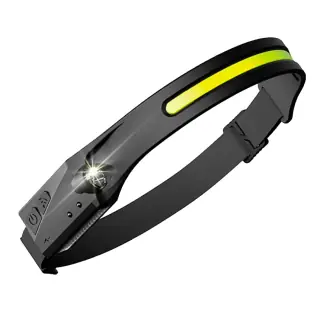
The headlamp we've reviewed takes the two-beam idea further. The LumenLight LED headlamp is a slim band with a curved LED strip across the forehead, which the brand says spreads light over a 230-degree angle, plus a separate spotlight the brand rates at 350 lumens. That gives you the strip for chores and walking and the spotlight for distance.
Red light mode and your night vision
A red mode is more than a camping extra. The National Park Service explains that night vision depends on a chemical in the eye called rhodopsin, and that it takes 20 to 40 minutes in the dark before you start to benefit from it. A few seconds of bright light is enough to shut that down. Deep red light doesn't trigger the same breakdown, so it preserves your night vision.
NPS adds one caution: a dim red light works best, because even bright red light can reduce rhodopsin. For stargazing, it recommends a red flashlight or headlamp so you can find your way without spoiling your view of the sky.
Rechargeable headlamp or disposable batteries?
Both work. The better pick depends on where you'll use the light.
A rechargeable headlamp is the easy choice for regular use, such as a headlamp for running or nightly dog walks: you top it up from a wall adapter, a car or a power bank. A model that takes disposable batteries makes sense for a kit that sits untouched for months, or for long trips with no way to recharge, because fresh spares bring it straight back to full.
Whichever you choose, carry backup power. Ready.gov lists extra batteries in its basic emergency kit, along with phone chargers and a backup battery, and the Park Service tells hikers to pack extra batteries with their light.
- Cold weather: Yosemite National Park's winter safety page warns that batteries can be unreliable in cold conditions, and lists a flashlight or headlamp with extra batteries as emergency gear.
- Heat: the US Fire Administration says to minimize the exposure of lithium-ion batteries to extreme temperatures, especially when charging.
- Disposal: the EPA says alkaline batteries can go in household trash in most communities, though recycling is preferred. Lithium-ion batteries should never go in household garbage or recycling bins. Tape the terminals or bag them separately and take them to a battery recycler.
Water resistance: how to read an IP rating
Rain, sweat and a dropped lamp in wet grass are all part of a headlamp's life, so check the water rating. The usual label is an IP code, defined in the international standard IEC 60529, which classifies how well an enclosure protects against solid objects and against water.
The code has two characters after the letters IP. The first rates protection against solid objects, with the two highest levels covering dust. The second rates protection against water. On headlamps you'll often see the first position written as an X, as in IPX4, with only the water level given. The standard's water tests rise in steps:
- Levels 3 and 4: spraying and splashing water.
- Levels 5 and 6: water jets from a hose nozzle.
- Level 7: temporary immersion, at a depth between 0.15 and 1 meter.
- Level 8: continuous immersion, under conditions agreed with the maker.
For walks and runs in the rain, splash protection covers the job. If the light may end up in a puddle, a stream or a boat bilge, look for an immersion level. Not every maker publishes a code. The brand behind LumenLight describes it as waterproof and says it keeps working in a storm or after a drop in water; the store doesn't list an IP rating, so ask its support before taking it swimming or diving.
Headlamp for running and dog walks: fit, weight and being seen
For anything that involves moving, fit matters as much as brightness. Look for an adjustable strap, a light front unit and a shape that sits flat on the forehead, then try it at home: shake your head, jog in place, and aim the beam at the ground a few steps ahead rather than straight out.
The second job of a headlamp near roads is making you visible. The CDC reports that more than 8,000 pedestrians were killed in crashes with motor vehicles in the United States in 2022. The Pedestrian and Bicycle Information Center, which is funded by the Federal Highway Administration, gives walkers these tips for being seen:
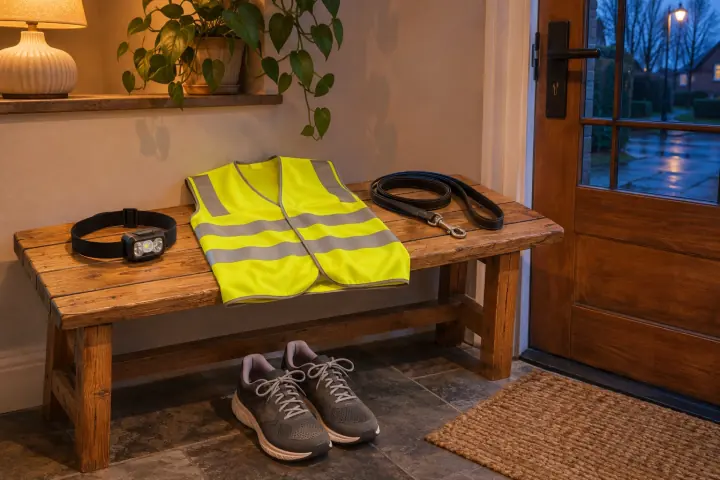
- Wear bright or light-colored clothing and reflective materials.
- Carry a flashlight when walking at night. A headlamp does this job with your hands free for the leash.
- Cross the street in a well-lit area at night.
- Always walk on the sidewalk. If there is no sidewalk, walk facing traffic.
Tilt the beam down when a car, a cyclist or another walker comes toward you, so you light the ground and not their eyes. If headlight glare bothers you when you're the one driving, see our guide to night driving glasses.
Emergency lighting: a headlamp in your power outage kit
When the power goes out, the first problem is seeing. Ready.gov's basic disaster supplies kit lists a flashlight and extra batteries, and its power outage page is specific about how many: have flashlights for every household member.
Skip the candles. The US Fire Administration's advice is direct: use flashlights, not candles, if you have a power outage. It notes that on average 20 home candle fires are reported each day. The CDC likewise recommends battery-powered flashlights and lanterns rather than candles or torches to reduce the risk of fire.
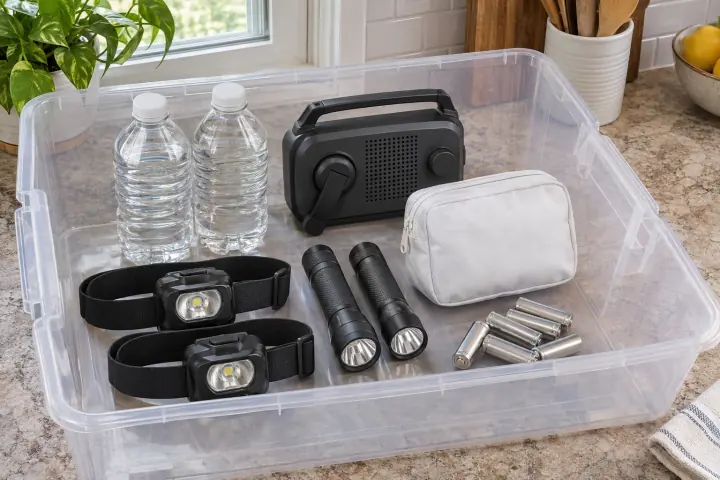
- One light for each person in the home, children included. A headlamp lets you cook, carry things and climb stairs with both hands.
- Spare batteries for every light that takes them, and a charged power bank for the rechargeable ones.
- A battery-powered or hand-crank radio, which Ready.gov also lists in the basic kit.
- A set place for the kit. Ready.gov says to keep it where you can grab it quickly and to make sure all family members know where it is.
- A yearly check. Ready.gov suggests reassessing your kit every year, which is a good day to recharge the lights and replace old batteries.
If you're equipping a whole family, multi-packs keep the cost per light down. Our LumenLight review covers the pack options on the official store, and the brand says the adjustable band fits all head sizes, including children.
Headlamp care and charging, step by step
A headlamp only helps if it works on the night you need it. This routine takes a few minutes and follows the US Fire Administration's guidance for lithium-ion devices.
- Read the maker's charging instructions and follow them. Use the charger or cable that came with the headlamp, or one from a reputable supplier.
- Charge it fully before the first outing, and top it up after any long night of use.
- Charge and store it in a cool, dry place. Don't leave it charging for too long, and if it gets noticeably hot while charging, unplug it.
- Look it over now and then. If the battery area shows cracking, bulging or leaking, stop using it and ask the maker how to dispose of it safely.
- Keep it in the same spot every time, such as the kit, the glove box or a hook by the door, so you can find it in the dark.
- Once a year, when you check your emergency kit, switch every light on, recharge it and replace the spare batteries that have run down.
When to call a professional
A headlamp helps you see a problem. It doesn't make every problem yours to fix. Put the tools down and call for help in these situations:
- Downed power lines. The CDC's rule is never touch a fallen power line. Stay well away, don't drive through standing water if downed lines are in it, and report the line to your utility or 911.
- Electric shock. If you believe someone has had an electric shock, the CDC says to call 911 or emergency medical help.
- Electrical faults at home. A breaker that keeps tripping, a burning smell, scorched outlets or wiring you aren't sure about are jobs for a licensed electrician, however good your light is.
- Medical equipment that needs power. Ready.gov advises talking to your medical provider about a power outage plan for electric medical devices and refrigerated medicines before an outage happens.
- Generator trouble or carbon monoxide symptoms. Generators belong outdoors, at least 20 feet from windows, doors and attached garages. Headache, dizziness, weakness, nausea or confusion during an outage can be signs of carbon monoxide poisoning; the CDC says to call 911 or Poison Control at 1-800-222-1222.
- A battery fire. The US Fire Administration says that if a lithium-ion battery fire occurs, don't try to put it out. Evacuate and call 911.
Headlamp we've reviewed
FAQ
What is the best headlamp?
The best headlamp is the one that matches how you'll use it. For repairs and dog walks, look for a wide flood beam and a comfortable strap. For running, low weight and a snug fit. For trails, a spot beam and a red mode. For outages, long run time and one light per person.
How many lumens do I need in a headlamp?
There's no official chart of lumens per task. Close work needs little light, while seeing far down a trail or across a yard calls for more output and a focused beam. Choose a headlamp with several brightness modes, and check the run time on the package as well as the lumens.
What is a lumen?
A lumen is a unit of brightness. The Federal Trade Commission's rule of thumb is that more lumens means a brighter light, while watts only tell you how much energy the light uses. For scale, ENERGY STAR equates an old 60-watt incandescent bulb with 800 lumens.
Is a rechargeable headlamp better than one with batteries?
For regular use, a rechargeable headlamp is more convenient: you recharge it from a wall adapter, car or power bank. Disposable batteries suit a kit that sits for months or a long trip without power. Either way, keep backup power, as Ready.gov and the National Park Service both advise.
What should I look for in a headlamp for running?
A light front unit, an adjustable strap that doesn't bounce, a flood beam aimed a few steps ahead and protection against sweat and rain. Near traffic, add bright or reflective clothing and face oncoming traffic where there's no sidewalk, as federal pedestrian safety guidance recommends.
Which LED headlamp have you reviewed?
The LumenLight LED headlamp. According to the brand, it pairs a 230-degree LED strip with a 350-lumen spotlight, switches on and off with a wave of the hand near the right temple, recharges with the included cable and runs for up to 8 hours of continuous use.
Sources
- Ten Essentials, National Park Service
- Hiking Safety, National Park Service
- Shopping for Light Bulbs, Federal Trade Commission Consumer Advice
- Learn About Brightness, ENERGY STAR
- Revised ANSI/PLATO FL 1-2025 Standard publication, Portable Lights American Trade Organization
- ANSI/PLATO FL 1-2025: Getting the Testing Right, Portable Lights American Trade Organization
- ANSI/PLATO FL 1-2025: How to Mark and Message Your Products Correctly, Portable Lights American Trade Organization
- 29 CFR 1926.56, Illumination (Table D-3), Occupational Safety and Health Administration
- Dark Adaptation of the Human Eye and the Value of Red Flashlights, National Park Service
- Stargazing, Night Skies, National Park Service
- Winter Wilderness Safety, Yosemite National Park, National Park Service
- Lithium-Ion Batteries: Educating Your Community, US Fire Administration
- Used Household Batteries, US Environmental Protection Agency
- IEC 60529, Degrees of protection provided by enclosures (IP Code), edition 2.1, publisher's preview, International Electrotechnical Commission
- Pedestrian Safety, Centers for Disease Control and Prevention
- Safety Tips for Pedestrians, Pedestrian and Bicycle Information Center (funded by the Federal Highway Administration)
- Build A Kit, Ready.gov
- Power Outages, Ready.gov
- Candle Fire Safety, US Fire Administration
- What to Do to Protect Yourself During a Power Outage, Centers for Disease Control and Prevention
This guide is general information. Follow your headlamp maker's instructions for charging and use, never touch a downed power line, and leave electrical repairs to a licensed electrician.