
Eyes
Reading Glasses Strength Chart: How to Choose the Right Power
A reading glasses strength chart by age starts near +1.00 diopters in your early 40s and rises about +0.25 every two years, reaching roughly +2.00 at 50, by the American Academy of Ophthalmology's rule of thumb. Age only gets you close, though. Below you'll find the full chart, a five-minute check you can do in the store or at home, and the signs that an eye exam will serve you better than another pair from the rack.
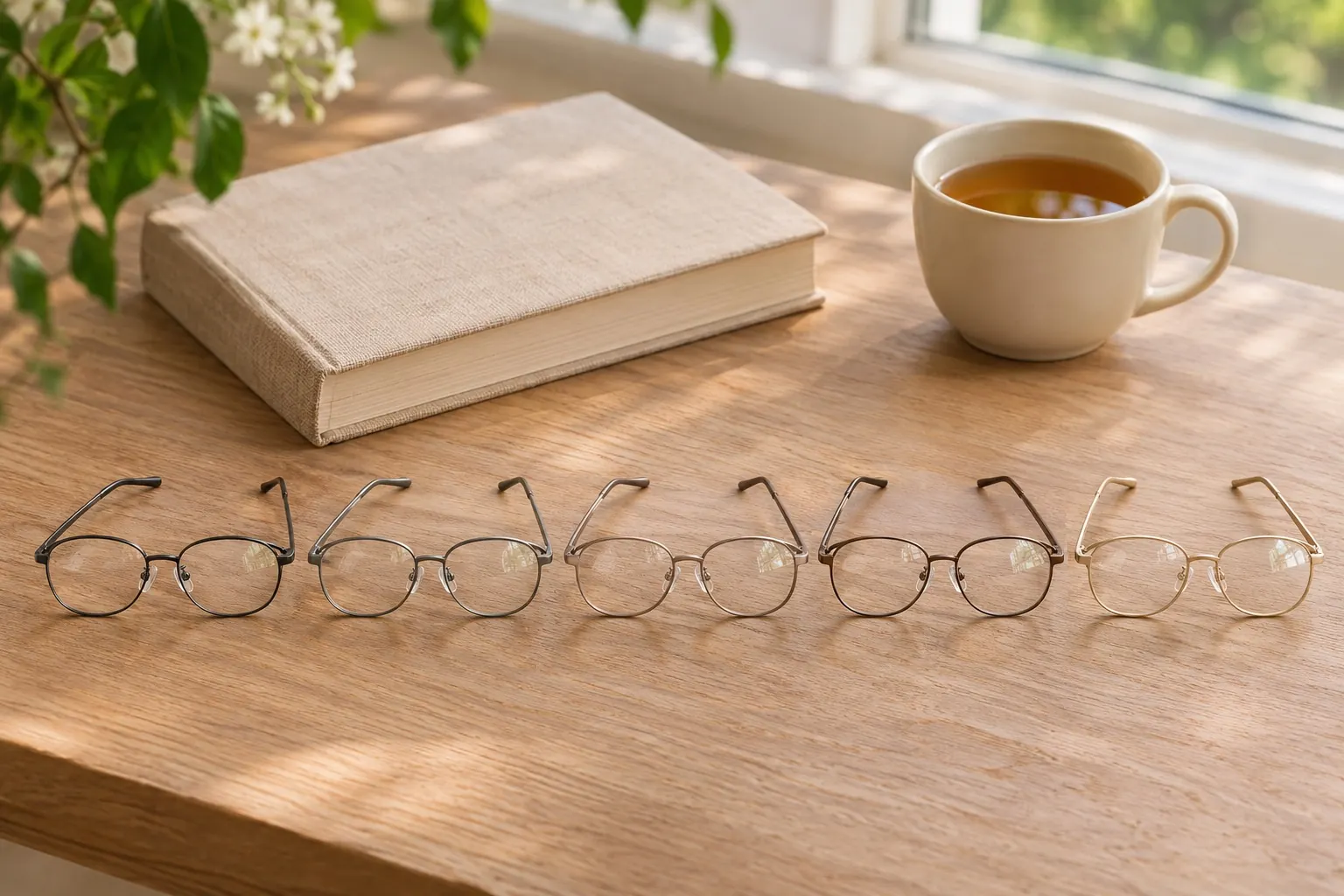
Reading glasses strength chart by age
The American Academy of Ophthalmology (AAO) teaches new eye doctors a simple estimate: expect a reading power of about +1.25 diopters at age 44, then add +0.25 for every two years of age. Its own worked example is a 50-year-old, who would need about +2.00. The chart below applies that rule year by year.
For the years before 44, there's no formula. Cleveland Clinic's advice for anyone without a prescription is to try the lowest power, +1.00, first and move up only until reading feels comfortable.
| Age | Estimated strength | Where the number comes from |
|---|---|---|
| Early 40s, first blur up close | +1.00 | The lowest power on most racks and Cleveland Clinic's suggested starting point |
| 44 | +1.25 | The AAO's starting estimate |
| 46 | +1.50 | AAO rule: +0.25 for every two years |
| 48 | +1.75 | AAO rule |
| 50 | +2.00 | The AAO's own example |
| 52 | +2.25 | AAO rule |
| 54 | +2.50 | AAO rule |
| 56 | +2.75 | AAO rule |
Ages 44 to 56 are calculated from the AAO's rule of thumb for clinicians (+1.25 D at 44, plus +0.25 D for every two years). It assumes presbyopia is your only vision problem. Your reading distance, your distance vision and differences between your two eyes can all move the number.
We stopped the chart at 56 on purpose. Near vision doesn't keep sliding forever: Harvard Health notes that by age 60 most changes in near vision begin to slow, and MedlinePlus says that by 65 most of the lens's elasticity is gone, so a reading prescription usually doesn't need to get stronger after that. Past your mid-50s, let the at-home check below or an eye exam set the number rather than your birthday.
What do the numbers on reading glasses mean?
The number on the sticker or inside the temple arm is the lens power in diopters, often shortened to D. The AAO describes the scale as a number line with zero in the middle: the farther a lens sits from zero, the stronger it is. A plus sign means the lens helps with near vision, which is why every pair of readers carries one.
Over-the-counter readers have the same power in both lenses. According to Cleveland Clinic they range from +1.00 to +4.00 in most cases, and Harvard Health describes most drugstore racks as running from +1.25 to +3.50 in steps of +0.25. That quarter-diopter step is the difference between neighboring pairs on the rack, and it's small enough that many people can read with two or three different strengths. The goal is the weakest one that's still comfortable.
What strength reading glasses do I need? A simple at-home check
You don't need special equipment to narrow it down. Cleveland Clinic's advice comes down to this: bring what you actually read, start low and choose the lowest power you can still see comfortably at your preferred reading distance. Here's that advice as a routine you can run at a store rack, or at home with a few pairs you can return.

- Find your starting number in the chart above. No prescription and not sure? Start at +1.00.
- Grab what you really read: a paperback, your phone, a pill bottle or a newspaper.
- Hold it where you naturally read, not at arm's length and not up against your nose. Use ordinary room light.
- Try your starting strength. If small print is still blurry or you catch yourself pushing the page away, go up one step (+0.25). If the print is sharp only when you pull it very close, go down a step.
- Read for a full minute or two before you decide. A pair that feels fine for five seconds can still bring on eye strain or a headache.
- Pick the lowest strength that keeps the print clear and comfortable.
- Cover one eye, then the other. Readers have identical lenses, so if one eye sees clearly and the other doesn't, an eye exam will do more for you than a different pair.
One more fit tip from Cleveland Clinic: the frame shouldn't be wider than your cheekbones. Oversized frames raise the risk of double vision, especially in powers above +2.00.
Reading glasses test: charts, kiosks and printables
A reading glasses test is usually a card with lines of text that get smaller, each line labeled with a strength. Store kiosks often supply one, as Cleveland Clinic points out, and many sellers post a printable version online.
These cards are a reasonable shortcut with two catches. They only work at the distance printed on the card, and a printable only works if it comes out of your printer at exactly its intended size. If the card says one thing and your own book says another, trust the book. That's what you bought the glasses for.
None of these is a vision test in the medical sense. A card can tell you which magnification feels comfortable. It can't check the health of your eyes, measure each eye separately or find astigmatism.
Do you need a different strength for the computer?
Often, yes. A book sits closer than a monitor. The AAO puts computer screens at an intermediate distance of about 20 to 26 inches from your face, and suggests sitting about 25 inches, roughly arm's length, from the screen. A pair picked for a paperback may blur at that range.
If you spend hours at a screen, the AAO notes that prescription computer glasses, focused for that intermediate distance, may reduce eye strain. The American Optometric Association (AOA) makes a similar point: even people who already have a prescription may find it isn't suited to the viewing distance of their computer. Run the same at-home check sitting at your desk before you settle on a pair for work.
Whether those glasses need a blue-light filter is a separate question, and we cover it in do blue light glasses work?
Why your reading glasses strength changes with age
The reason you need readers at all is presbyopia, and it comes for everyone. The lens inside your eye changes shape to focus up close. When you're young it's soft and flexible. After about 40 it becomes more rigid, the AAO explains, and reading, threading a needle and other close work get harder. The National Eye Institute (NEI) calls presbyopia a normal part of aging that usually shows up after age 45.
The classic first sign is holding the menu or your phone farther away to bring it into focus. The NEI also lists eye strain and headaches, and suggests that in the early stages brighter reading lights and larger print can help.
Because the lens keeps stiffening, the strength you need creeps up for years. MedlinePlus says reading glasses need to be strengthened as you get older, until most of the lens's elasticity is lost at around 65. So the pair that was perfect at 46 feeling weak at 50 isn't a sign that the glasses harmed your eyes. It's the same process continuing.
When drugstore readers aren't the right tool
For many people they work well. A Cleveland Clinic optometrist says over-the-counter readers can work without much of a problem for the vast majority of people, as long as they match the power of their prescription. But ready-made pairs are built for an average pair of eyes, and they fall short if:
- Your two eyes need different powers. Readers have identical lenses.
- You have astigmatism, which ready-made readers don't correct.
- Your pupils sit unusually close together or far apart. Readers don't account for that distance, which can cause eye strain or double vision.
- You're also nearsighted or farsighted. The AAO says reading glasses may be all you need only if presbyopia is your only vision problem.
- You want one pair for near and far. Off-the-shelf readers typically don't come in multifocal or progressive options, the AAO notes.
The AAO adds one more caution that applies to everybody: readers can be bought without a prescription, but the specific power you need should be determined by an eye exam. Think of the chart and the at-home check as a way to get by sensibly between exams, not a replacement for them.
One pair for reading, screens and sunshine
If the pair you want is less about a precise number and more about convenience, BlueLume Glasses are the reading glasses we've reviewed. The brand describes them as one lightweight pair with near-to-far lenses for reading up close and seeing farther away, a photochromic tint that darkens in sunlight and clears indoors, and a built-in blue-light filter. It says they weigh under an ounce and can be ordered without a prescription.
Here's how that fits with this guide: the store offers no strength options and the brand doesn't publish the lens power, so you can't match BlueLume to a number from the chart. That makes them a better fit for casual readers who don't need a specific strength than for someone who already knows they're a +2.50. If you order a pair, test them with your own book and phone as soon as they arrive, and keep the box, because the 30-day guarantee covers unused glasses in their original packaging.
One note on the sun tint, which applies to any photochromic lens: the AAO says photochromic lenses aren't recommended for use in cars.
Are reading glasses bad for your eyes?
No. A Harvard-affiliated ophthalmologist quoted by Harvard Health puts it plainly: there's nothing wrong with drugstore readers, and they won't damage your eyes, since they work like magnifiers. Wearing a pair that's too strong or too weak can leave you with eye strain or a headache, which is your cue to change the strength, but it isn't injuring your eyes.
The real risk is a different one. Cleveland Clinic warns that readers are so easy to buy that they can become a shortcut to diagnosing yourself, and that skipping an eye exam could delay finding other eye conditions.
When to see an eye doctor
An eye exam is the only way to get your true reading power and to check the health of your eyes at the same time. The AAO recommends a baseline eye disease screening by age 40, when early signs of disease and changes in vision often begin, and an exam every year or two from 65. People with diabetes, high blood pressure or a family history of eye disease shouldn't wait.
Book a regular appointment if:
- No strength on the rack makes print clear, or you need a stronger pair every few months.
- You get headaches, eye strain or double vision while wearing readers. Cleveland Clinic's advice is to schedule a visit with your eye care provider.
- One eye sees noticeably worse than the other.
- You have trouble seeing at night, colors look faded, or your vision is gradually losing sharpness at any distance. MedlinePlus lists these as reasons for a complete eye exam.
- You have diabetes or a family history of diabetes or eye disease.
Get emergency care, from a provider experienced with eye emergencies, if you lose vision in one or both eyes even briefly, see double, feel as if a shade or curtain is being pulled across your vision, suddenly notice blind spots, halos or distorted areas, or have sudden blurred vision with eye pain, especially in a red eye. MedlinePlus lists all of these as emergencies, and reading glasses won't fix any of them.
Glasses we reviewed
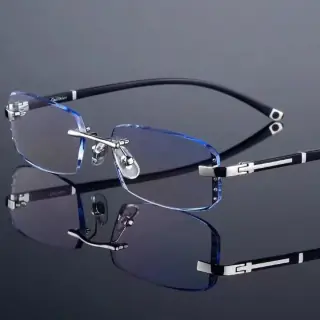
BlueLume Glasses review
Casual readers who want one light pair for the page, the screen and a sunny walk, and don't need a specific prescription. From $35.56.
Read the review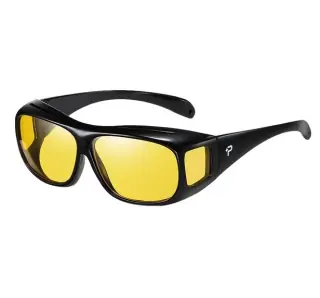
PolorVision Driving Glasses review
Drivers who wear prescription glasses and want one fit-over pair with polarized, UV-blocking lenses for sun glare, low sun and wet roads. From $49.99.
Read the review
FAQ
What strength reading glasses do I need?
Start from your age: about +1.00 in your early 40s, +1.25 at 44 and roughly +0.25 more for every two years after that, by the American Academy of Ophthalmology's rule of thumb. Then test with your own reading material and keep the lowest strength that's clear and comfortable. An eye exam gives you the exact number.
What strength reading glasses do most 50-year-olds need?
About +2.00. That's the example the American Academy of Ophthalmology uses for its rule of thumb. Your own number may be a step or two away, so check it with a book in your hands.
Is it better to go stronger or weaker with reading glasses?
Weaker, as long as the print is still clear. Cleveland Clinic advises choosing the lowest power that you can still see comfortably at your preferred reading distance.
What is the strongest reading glasses strength you can buy?
Over-the-counter readers range from +1.00 to +4.00 in most cases, according to Cleveland Clinic. If the strongest pair on the rack still isn't enough, see an eye doctor rather than hunting for a higher number.
How does a reading glasses test work?
It's a card with lines of shrinking text, each labeled with a strength, read at the distance printed on the card. It can point you to a comfortable magnification, but it isn't an eye exam: it can't measure each eye separately or check your eye health.
Can I use reading glasses for the computer?
You can, but the strength that suits a book may be too strong for a screen, which sits about 20 to 26 inches away. Test a pair at your desk. If you work at a computer for hours, the American Academy of Ophthalmology notes that prescription computer glasses set for that distance may reduce eye strain.
Sources
- Optics 101 (estimated reading power by age), American Academy of Ophthalmology
- What Is Presbyopia? American Academy of Ophthalmology (2026)
- Tips for Choosing the Right Reading Glasses, American Academy of Ophthalmology
- How to Read an Eyeglasses Prescription, American Academy of Ophthalmology (2023)
- Presbyopia, National Eye Institute
- Presbyopia, MedlinePlus Medical Encyclopedia, National Library of Medicine
- Are 'Cheater' Glasses Right for You? Cleveland Clinic (2026)
- Focus on easier reading, Harvard Health Publishing (2020)
- Computers, Digital Devices and Eye Strain, American Academy of Ophthalmology (2024)
- Computer vision syndrome, American Optometric Association
- Get an Eye Disease Screening by Age 40, American Academy of Ophthalmology (2026)
- Eye Exam and Vision Testing Basics, American Academy of Ophthalmology (2024)
- Vision problems, MedlinePlus Medical Encyclopedia, National Library of Medicine
This guide is general information, not medical advice. A strength chart or an at-home check can't replace an eye exam, and reading glasses don't treat any eye condition. See an eye doctor about any sudden or unexplained change in your vision.